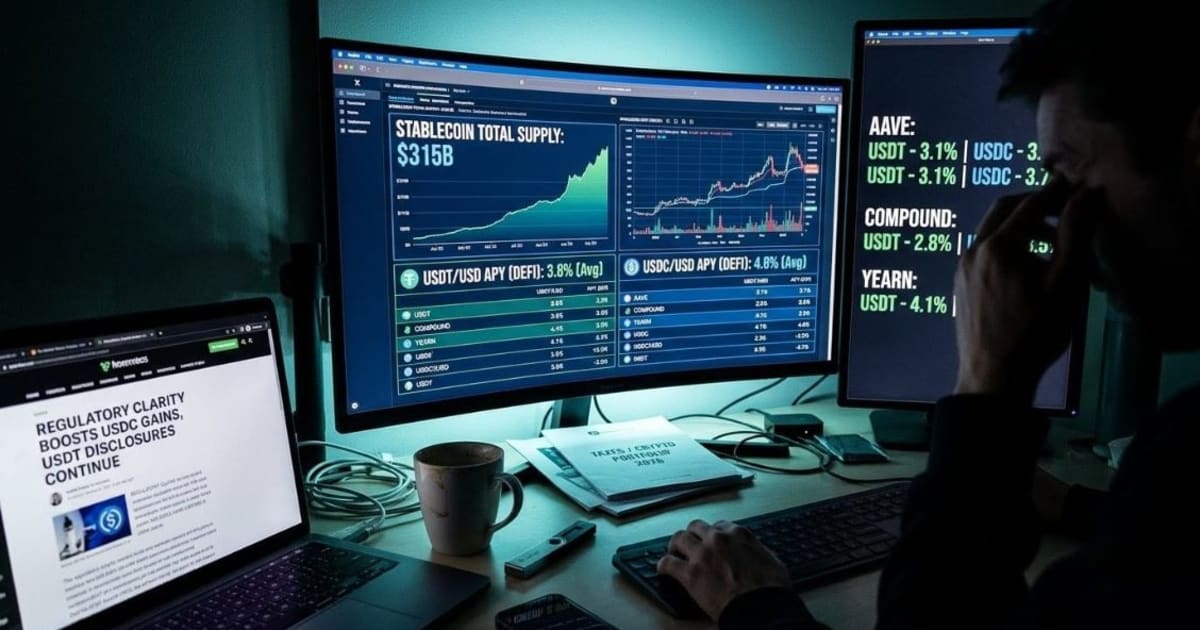
Most people holding stablecoins think they've made the safe, boring choice. Park it, wait, done. But there's a real dollar difference between holding USDT and USDC — one that compounds quietly every month. With the total stablecoin market now at $315 billion, that's a lot of money sitting in the wrong coin.
Trend Breakdown
Stablecoins had a breakout Q1. Total supply crossed $315 billion — roughly the GDP of Hong Kong — driven by investors seeking shelter from crypto volatility and a surge in algorithmic trading bots that prefer stablecoin pairs. USDC's market share has been climbing steadily, while USDT's grip has loosened just enough to be notable.
Why the rotation? Regulatory clarity is a big part of it. Circle, USDC's issuer, publishes monthly attestations of its reserves and holds assets in short-duration US Treasuries and cash. Tether — USDT's issuer — has improved its disclosures since 2021, but it still carries commercial paper and secured loans in its reserve mix. That difference is no longer abstract. It's showing up in how DeFi protocols price each coin and how much yield platforms are willing to offer.
For American holders specifically, the USDC shift tracks with Coinbase's growing dominance in the post-FTX US market. Coinbase defaults users to USDC, and its rewards program has made holding USDC on-platform the path of least resistance. In the UK and EU, similar dynamics apply: regulated exchanges are nudging users toward coins with cleaner audit trails. In India, where P2P crypto flows remain heavy, USDT still dominates — but the yield gap is starting to matter even there as DeFi access grows.
This isn't just a market-share story. It's a cost story. And most retail holders haven't run the numbers.
What the Data Reveals
Here's what the aggregate $315B headline doesn't tell you: the two dominant stablecoins don't pay the same, don't cost the same to redeem, and don't get treated the same inside DeFi protocols. On $10,000, those differences add up to real money over a year.
A breakdown of where the gaps appear:
- Platform yield (US): Coinbase currently offers around 4.7% APY on USDC for US users. USDT earns nothing natively on Coinbase — you'd need to move to a third-party platform to earn anything comparable. That's a $470/year gap (roughly £370, or ₹39,000) on a $10,000 position, before fees.
- DeFi lending rates: On Aave, USDC supply rates have consistently run 0.3–0.8% above USDT rates. Markets are pricing in USDT's slightly higher counterparty risk. On a $10,000 deposit, that's $30–$80/year quietly lost.
- Redemption fees: Tether charges 0.1% to redeem USDT directly, with a $1,000 minimum. Circle offers free USDC redemption with no minimum. If you ever need to exit, that 0.1% fee on $10,000 costs $10 — not devastating, but it's a fee USDC holders don't pay at all.
- Depeg risk premium: USDT has depegged briefly three times since 2018 — each time recovering, but briefly trading at $0.97–$0.985. DeFi liquidation engines now build this into collateral ratios, meaning you can borrow slightly less against USDT than USDC at the same platforms.
Adding it up conservatively — yield gap, lending spread, redemption cost — a US holder sitting on $10,000 in USDT vs USDC is likely leaving $300–$550 on the table annually. That's not a rounding error. It's a month of groceries.
Comparison Breakdown
There's a framing that treats USDT and USDC as interchangeable, like two brands of bottled water. They aren't. They're more like two savings accounts at different banks — one federally insured and interest-bearing, one paying nothing with a small withdrawal fee.
Here's the side-by-side at $10,000 for a US holder in 2026:
| Factor | USDC | USDT |
|---|---|---|
| Platform yield (Coinbase) | ~4.7% APY / $470/yr | 0% native |
| DeFi lending rate (Aave) | Higher by ~0.5% | Lower |
| Direct redemption fee | $0 | 0.1% ($10) |
| Reserve transparency | Monthly attestation | Quarterly report |
| Depeg history | None since 2023 | 3x brief depegs |
| Estimated annual cost gap | — | $300–$550 vs USDC |
For UK holders, that £370–£435 annual gap matters especially now, with sterling crypto markets still recalibrating after last year's FCA guidance updates. In India, where many retail holders use USDT as a dollar proxy for remittances or P2P trades, the yield gap doesn't apply the same way — but the redemption fee and DeFi rate spread still do.
One analytical observation worth making: the market is telling you something. When DeFi protocols consistently price USDC at a premium — offering higher yields for USDC deposits than USDT deposits — that's not an accident. It's a collective risk signal from thousands of smart contracts pricing in reserve quality. You don't have to agree with it. But ignoring it costs you money.
Data-Based Outlook
USDC's share gains aren't slowing. With the US stablecoin bill advancing in Congress and Circle reportedly preparing for a public listing, regulatory tailwinds are firmly behind USDC. If the bill passes, it would require stablecoin issuers to hold only Treasuries and cash — a standard USDC already meets and USDT would need to adjust to.
That shift could widen the DeFi rate gap further. Protocols that currently price in a small USDT risk premium might increase it if regulatory uncertainty around Tether's reserves grows. For holders sitting on large USDT positions, that's a quiet compounding cost that doesn't show up in any daily price feed.
The $315 billion headline will grow. But the question isn't whether stablecoins are a good idea — it's whether you're in the right one.
Where This Leaves You
Stablecoins aren't all created equal, and at $315 billion in total supply, the stakes of choosing wrong are higher than ever. If you're holding USDT and not actively using it for a specific purpose — like P2P transfers where it's dominant — you're probably leaving $300–$550 a year unclaimed on a $10,000 position. That's a cost that doesn't show up on any exchange dashboard, which is exactly why most people don't see it.
The views expressed here are for informational purposes and do not constitute personalized financial guidance. Readers should consult a licensed advisor before making investment decisions.