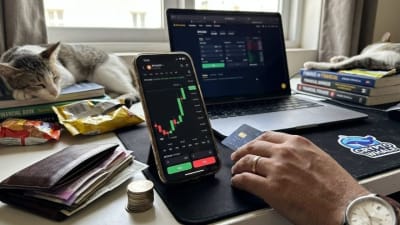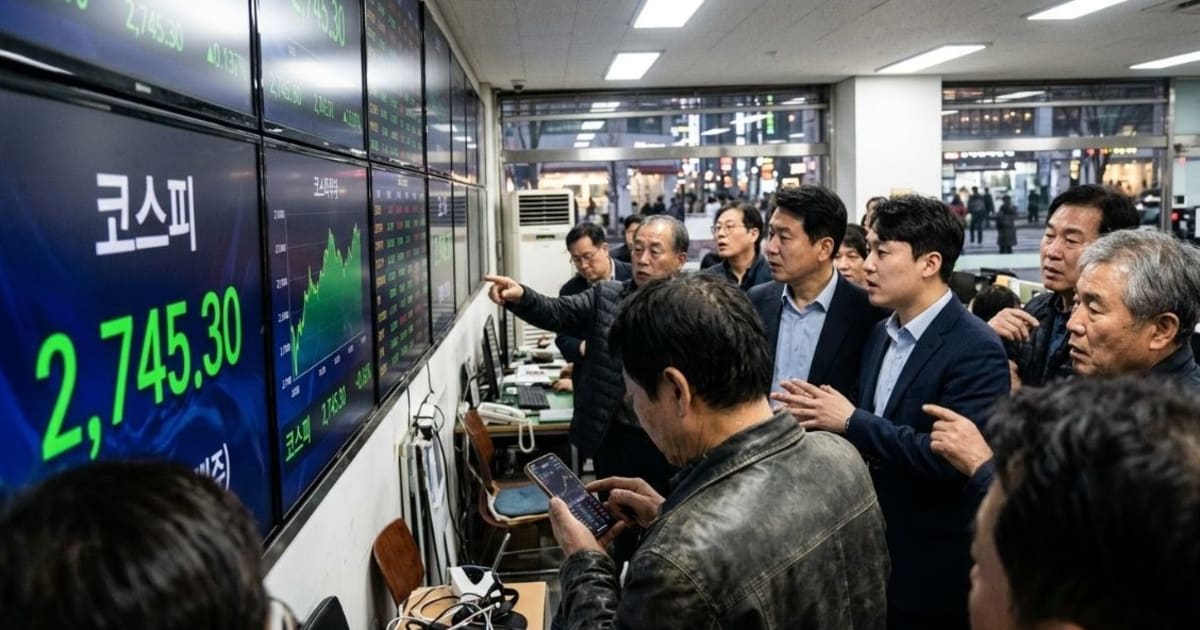
While Wall Street hit sell and London hedge funds cut exposure, South Korea's army of retail investors — nicknamed 'ants' — did the exact opposite.
They bought. Hard. And it moved markets.
If you think this is a local story, you're already behind — because when retail crowds defy a crash at this scale, global money pays attention fast.
Korea's Retail Army Just Did Something Unusual
South Korean retail investors have dramatically increased their equity exposure during the current global market selloff. Rather than retreating, they doubled down — channeling savings into KOSPI-listed stocks at a pace now accounting for more than 60% of daily trading turnover. That's not noise. That's a structural shift.
Two forces are driving it. Job insecurity is widespread across Korea's corporate sector. And housing costs have become so extreme that a standard Seoul apartment now prices above $800,000 — roughly £635,000 or ₹6.7 crore — effectively locking an entire generation out of property ownership.
With property locked out and savings accounts offering near-zero real returns, equities have become the default wealth-building tool for Korean households under 40. That behavioral shift doesn't reverse on a bad news day.
The result: the KOSPI held key support levels during a broader selloff that hit the S&P 500, FTSE 100, and Nifty 50 in the same week. Korea's retail army absorbed the institutional selling and kept the index afloat.
By the Numbers
The scale of Korea's retail equity shift:
- Retail's share of KOSPI daily turnover: 60%+ — up from under 30% before the pandemic
- Korean household equity exposure growth since 2020: nearly 3x
- Standard Seoul apartment average price: $800,000+ (~£635,000 / ₹6.7 crore)
- Estimated EM index exposure supported by Korean retail floor: $300–500B
- Daily KOSPI volumes influenced by retail: billions in daily flows
For context: US retail participation in equities took over 20 years to reach comparable levels. Korea compressed that shift into five years — driven almost entirely by the property lockout forcing capital toward the only accessible wealth-building asset class.
Korea vs global sentiment this week:
| Market | Direction (same week) | Retail behavior |
|---|---|---|
| S&P 500 | Down | Institutional selling, retail mixed |
| FTSE 100 | Down | Institutional de-risking |
| Nifty 50 | Down | Mixed |
| KOSPI | Held support | Retail buying absorbed institutional sell |
Why This Matters Beyond Seoul
Here's why this isn't just a Korea story.
When retail investors drive 60%+ of daily trading, two things shift. Volatility patterns change — the usual institutional 'sell the news' moves get absorbed faster. But if sentiment flips, the unwind can be brutal and sudden. Retail crowds don't have risk committees slowing them down.
For a US investor with global ETF exposure, retail confidence abroad matters more than most people realise. When Korean ants stay in, it signals household investors globally haven't given up — and that's a sentiment floor worth an estimated $300–500 billion across emerging market indices, including the Nifty 50 funds millions of Indian SIP investors hold monthly.
For Indian SIP investors, the parallel hits closest. Indian retail participation in equities has tripled since 2020, mirroring Korea's trajectory almost exactly. How the ant story ends in Seoul is a preview of what comes next in Mumbai. Whether retail conviction holds or breaks in Korea tends to arrive in Indian flows within one to two weeks — not months.
The Bank of Korea's Next Move vs. US Jobs Data
Two triggers decide whether the Korean retail floor holds or cracks.
Trigger 1: The Bank of Korea's next rate decision. Any surprise hold or cut would supercharge the retail rally and ripple into EM fund flows globally. A hawkish surprise — or a hint of concern about inflation — could trigger a fast reversal. Retail crowds historically unwind faster than any institutional desk.
Trigger 2: US non-farm payrolls due early April. A weak print rattles global sentiment hard and tests whether Korea's ants are ahead of the curve or simply early. The KOSPI's ability to hold above its current support level during the US jobs release will tell you more about retail conviction than any individual session.
What Korean Retail Signals for Global EM Investors
South Korea's retail investors are running a live experiment in real time: can household money hold up a market when institutional confidence is gone? The answer so far is yes. But the signal it sends isn't just about Korea.
When the world's most financially squeezed retail class — locked out of property, stuck in stagnant wages, with equities as their only real wealth option — chooses to buy a crash rather than flee it, that's one of the earliest indicators that the bottom in global EM sentiment may be closer than the fear index suggests. Watch KOSPI retail volume over the next 10 trading sessions. If it holds above 55% of daily turnover, the floor is real. If it slides toward 40%, the ants are quietly exiting — and that tends to be the first signal before a sharper global EM leg down follows.
Nothing in this article should be considered investment advice. The information presented is for educational purposes. Consult a licensed financial advisor before making any financial decisions.