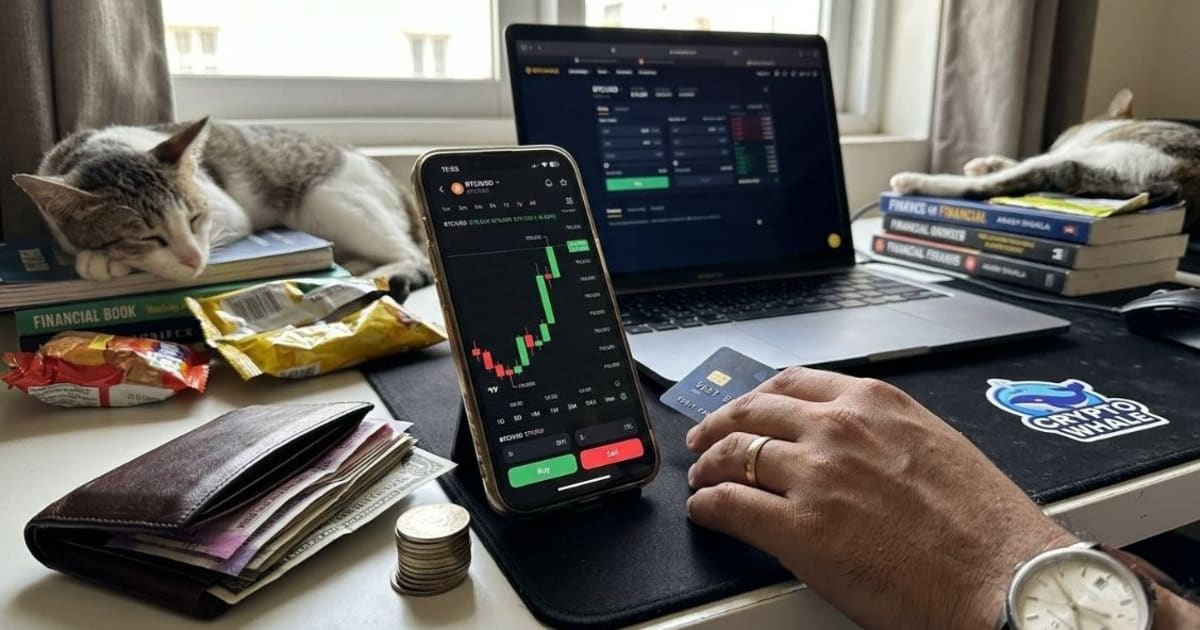
Bitcoin has barely moved in days. The price sits in a narrow band between $69,000 and $70,500 — a range so tight it almost looks like the market fell asleep. It didn't. Beneath that flat surface, something is building. On March 19 alone, whale wallets holding more than 1,000 BTC accumulated a record 66,940 BTC — the largest single-day accumulation event tracked this cycle. At current prices, that's roughly $4.6 billion worth of Bitcoin quietly moving off exchanges and into cold storage, even as retail investors panic-sold into the dip. Whether you hold Bitcoin in a Coinbase account, a SIP-linked crypto fund in Mumbai, or a self-directed IRA in New York, this divergence between price and positioning is the most important thing happening in crypto right now — and most coverage is missing it entirely.
The Core Problem
The surface story is simple: Bitcoin is consolidating. The more interesting story is who is doing what during that consolidation — and why the two groups are moving in opposite directions.
On March 19, 2026, exchange inflows spiked 23% in 24 hours to 18,500 BTC. That spike typically signals retail holders moving coins onto exchanges to sell. At the same time, whale wallets were doing the exact opposite — they added a single-day record of 66,940 BTC, pulling it off exchanges and into long-term custody. One group was running for the exit. The other group was widening the door open and walking in.
This is the central tension in Bitcoin right now. The price at $69,370 on March 19 (briefly touching $69,200 before recovering) tells you what the marginal seller is willing to accept. It does not tell you what the patient, well-capitalized buyer is expecting to receive in six months. Those are two entirely different conversations happening in the same order book.
The derivatives market tells a similar bifurcated story. Funding rates flipped negative — to -0.008% — for the first time in three weeks, meaning short sellers were paying to hold their positions, a sign of defensive positioning rather than conviction in a crash. Open interest dropped $2.1 billion as over-leveraged longs got washed out. The put/call ratio on Deribit jumped to 1.34, the highest since January 2026, as traders loaded up on downside protection. These aren't crash signals — they're cleanup signals. Leverage is being rinsed from the system, which historically clears the path for the next sustained directional move.
For an Indian investor holding Bitcoin through a CoinDCX or WazirX account, this matters because INR-denominated crypto prices follow USD Bitcoin almost tick for tick. At ₹57.5 to the dollar, a Bitcoin at $69,000 translates to roughly ₹39.7 lakh per coin. A move to $80,000 — the next widely watched target — would put Bitcoin at approximately ₹46 lakh in INR terms. That's a ₹6.3 lakh swing per coin sitting quietly on a price that looks like it's doing nothing.
For US holders with crypto in a self-directed IRA or a 401(k) that now permits Bitcoin allocations, the same math applies differently. A 5% crypto sleeve in a $200,000 retirement account is roughly $10,000. If Bitcoin moves from $69,000 to $80,000 — a 16% gain — that's $1,600 added to the account without any active decision. The inaction of the price right now does not mean the opportunity has gone quiet. It means the setup is forming.
Historical Parallel
This pattern — flat price, aggressive accumulation, nervous retail, positioned whales — has a precedent. It happened in the summer of 2020.
In May 2020, Bitcoin was trading between $8,500 and $10,500, consolidating after the violent COVID crash that saw it fall to $3,800 in March. The recovery looked tepid. Fear was elevated. The narrative was that the COVID economic shock would overwhelm any crypto thesis. On-chain data from that period showed an almost identical pattern to today: exchange outflows accelerating, long-term holder supply rising week after week, and derivatives positioning turning cautious. Retail sentiment was deeply uncertain.
What followed was one of the defining bull runs in Bitcoin history. By December 2020, Bitcoin had crossed $28,000. By April 2021, it reached $64,000. The investors who recognized the accumulation signal in the summer of 2020 and held — or added — captured returns of 500% or more in under twelve months. In Indian rupee terms, Bitcoin moved from approximately ₹6 lakh per coin in May 2020 to nearly ₹47 lakh by April 2021. For a US investor who put $5,000 into Bitcoin in June 2020, that position was worth roughly $30,000 by the following spring.
The parallel is not perfect. No two cycles are identical. In 2020, the Federal Reserve had just cut rates to near zero, flooding the system with liquidity. In 2026, the Fed has cut rates but remains cautious — the federal funds rate sits at 3.50%–3.75%, still well above the 2020 floor. The macro backdrop is softer, not absent.
What is strikingly similar, however, is the on-chain behavior. Bitcoin's realized price — the average price at which every coin last moved — currently sits at $54,000. Even at $69,000, the average Bitcoin holder is sitting on a 29% unrealized gain. That is not a market preparing to capitulate. That is a market in which holders are comfortable enough to wait. In 2020, the same dynamic persisted for months before the price caught up to the conviction. The question being priced right now isn't whether Bitcoin recovers — it's when.
The Data Under the Hood
Several numbers in the current Bitcoin data deserve more attention than they're getting in mainstream coverage.
Start with Strategy's holdings. The company formerly known as MicroStrategy now holds 720,737 BTC — representing 3.43% of Bitcoin's total supply ever to be mined. To put that in dollar terms: at $69,000 per coin, Strategy's Bitcoin treasury is worth approximately $49.7 billion. That's a single corporate balance sheet holding nearly one in every 30 Bitcoin that will ever exist. This is not a speculative position. At the firm's average acquisition cost of roughly $75.93 per share of BTC-equivalent exposure, this is a long-term structural hold that doesn't move on a bad news cycle.
The ETF picture is equally telling. BlackRock's IBIT fund recorded $600.1 million in net inflows over five consecutive trading days from March 9–13, 2026 — accounting for 78% of all Bitcoin ETF inflows that week. The prior week saw $568 million in net inflows. That's $1.3 billion entering Bitcoin ETFs in the first half of March alone, even as price hovered in the $69K–$74K range. Total net inflows into IBIT have crossed $62 billion since launch. For context: that figure exceeds the annual GDP of several small nations, concentrated into a single Bitcoin ETF product that didn't exist two years ago.
Now the on-chain numbers that matter most. Bitcoin's exchange whale ratio hit 0.85 — the highest reading since October 2015. More Bitcoin is flowing off exchanges than onto them, a pattern that has historically preceded price appreciation by four to eight weeks. Miner selling — which had been a significant headwind — eased dramatically. Peak miner net selling hit approximately 4,718 BTC per day around early February. By March, that figure dropped to around 837 BTC daily. Selling pressure is not gone, but it has lost roughly 82% of its peak intensity.
One more number: the weekly RSI on Bitcoin's price chart sat at approximately 25.6 earlier this month — one of the lowest readings in Bitcoin's entire history. The only comparable instances were January 2015 and December 2018. Both preceded significant recovery cycles. The January 2015 bottom at roughly $150 led to Bitcoin's first run above $1,000. The December 2018 bottom at $3,100 preceded the 2019 rally to $13,000 and the eventual 2021 all-time highs. For a UK investor with a Bitcoin allocation in a SIPP or ISA, this kind of extreme oversold reading on a long time frame has historically represented a favorable entry window — though the timing of the subsequent move has never been predictable.
Taken together, these numbers describe a market that has been deeply cleaned out at the leverage and sentiment level, while large holders have quietly doubled down. That combination does not guarantee an imminent rally. It does create the conditions one.
Two Sides of the Coin
The bull case for Bitcoin at $70,000 rests on a structural argument, not a narrative one.
The supply side is tightening in a way that is measurable and verifiable. The 2024 halving cut Bitcoin's daily new supply from 900 BTC to 450 BTC per day. At current prices, 450 BTC represents approximately $31 million in daily new supply entering the market. BlackRock's IBIT alone bought more than that in a single session multiple times in March 2026. When a single ETF's daily inflow exceeds the entire daily new supply of Bitcoin — sometimes by two or three times — the math on price pressure becomes directionally clear. This isn't momentum trading. This is a structural supply-demand imbalance.
The regulatory backdrop has also quietly improved. The EU's MiCA framework is now fully in effect, giving European institutional investors a clear legal pathway into Bitcoin. In the US, the SEC-CFTC crypto coordination pact signed in March 2026 reduces the regulatory ambiguity that kept many traditional asset managers sidelined. For Indian investors, SEBI's evolving stance on crypto ETF structures — while still cautious — is being watched as a potential catalyst for INR-denominated institutional entry.
The bear case is not easily dismissed, and honest analysis demands it be stated clearly.
Bitcoin dropped 5.55% on March 19 in a single session — the kind of one-day move that erases weeks of quiet accumulation gains in percentage terms. The death cross — where the 50-day moving average crossed below the 200-day moving average — formed in early 2026 and remains intact. Historically, death cross periods have extended corrections by months. The 200-day moving average sits around $96,800, meaning a full technical recovery to trend requires nearly a 40% move from current levels.
Geopolitical risk is real. The US-Iran tensions that emerged in early 2026 pushed oil prices up roughly 15% to $83 per barrel. Elevated energy prices feed into inflation; inflation complicates the Fed's rate-cutting path; a slower rate-cutting path is a liquidity headwind for risk assets including Bitcoin. The correlation between Bitcoin and equities has moderated in 2026, but it has not broken completely. If the S&P 500 were to drop sharply — triggered by an inflation surprise in the April CPI print, for example — Bitcoin would almost certainly follow, at least initially.
The honest read is this: the structural case is building, but the macro environment retains the power to delay the reckoning. Patience is not optional in this market.
Scenarios & What-Ifs
Three scenarios currently frame Bitcoin's next meaningful move — and each has a distinct set of triggers worth watching.
Scenario one: the breakout. Bitcoin holds above $68,000 through end of March, the April 10 CPI print comes in at or below expectations, and the Fed's April meeting signals at least one more rate cut in the first half of 2026. In this scenario, the supply tightness that's been building beneath the surface translates into a price move. Historical precedent from post-accumulation phases like 2020 suggests a potential move toward $80,000–$82,000 within six to eight weeks. For a US investor with $10,000 in Bitcoin, that would represent approximately $1,600 to $1,900 in gains. For an Indian investor holding 0.5 BTC, it translates to a ₹3.2 lakh increase in portfolio value at current exchange rates.
Scenario two: the reset. Inflation data surprises to the upside, the Fed pauses rate cuts, and risk appetite deteriorates across equities globally. Bitcoin tests the $64,000–$65,000 level, where on-chain data shows significant limit order concentration from institutional buyers. A $64,000 print would be painful but not structurally breaking — Bitcoin's realized price of $54,000 still leaves the average holder in profit. This scenario likely extends the consolidation by another six to eight weeks before a second attempt at $70,000+.
Scenario three — the one people aren't discussing — is a rapid decoupling. Bitcoin catches a safe-haven bid as geopolitical tensions escalate and traditional equity markets sell off. In the March 2026 Iran conflict sessions, Bitcoin has already shown early signs of this behavior: posting gains on days equities fell. If that decoupling hardens, the $74,000–$76,000 resistance zone could be tested without a macro tailwind. This was the same pattern that opened in 2019 during the US-China trade war flare-ups. It remains the least-priced scenario by derivatives markets — which is precisely why it's worth watching.
Bitcoin's price looked asleep this week. The accumulation data says it isn't.
💰 What this means for your money: For a ₹4L Bitcoin holder, a move to $80K adds ₹63K; for a $10K US position, roughly $1,600 gained.
"Whales added a record 66,940 BTC in one day while retail sold into panic — that divergence doesn't stay quiet for long."
The Bottom Line
Bitcoin's price is flat. Its accumulation data is anything but. The record single-day whale buying, three consecutive weeks of ETF inflows totaling over $1.3 billion, and a derivatives market that's finished washing out speculative leverage — these are the ingredients of a coiled spring, not a dying trend. The flat price right now is not confirmation that nothing is happening. It's the calm that serious participants use to build a position before the crowd returns.
Frequently Asked Questions
Why is Bitcoin stuck at $70,000 and not moving higher?
Bitcoin is caught between two opposing forces: retail sellers moving coins onto exchanges (exchange inflows up 23% on March 19) and large holders pulling coins off. The $70,000 level is a psychological and technical resistance zone that requires a macro catalyst — like a Fed rate cut signal or a soft CPI print — to break cleanly. Until that catalyst appears, price action will likely remain choppy between $68,000 and $73,000.
How does Bitcoin consolidating at $70K affect my crypto investment?
If you already hold Bitcoin, the on-chain data is actually encouraging — whales added a record 66,940 BTC in a single day while price was flat, and BlackRock's ETF pulled in $600 million in five days. For an Indian investor holding 0.1 BTC (worth approximately ₹3.97 lakh today), a move to $80,000 would increase the value to roughly ₹4.6 lakh. For a US investor with a $5,000 crypto position, the same move represents a gain of approximately $800.
What should I watch to know if Bitcoin will break above $70,000?
Three triggers matter most. First, the March CPI data (due April 10) — a soft reading supports a Fed rate cut and gives Bitcoin room to rally. Second, weekly ETF flow data — sustained inflows above $500 million signal institutional conviction. Third, on-chain exchange outflows — if more Bitcoin keeps leaving exchanges than entering, supply tightens and the path to $80,000 opens. A decisive weekly close above $74,500 on high volume would be the clearest technical confirmation.