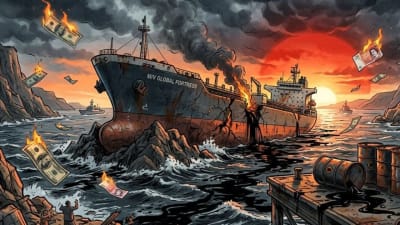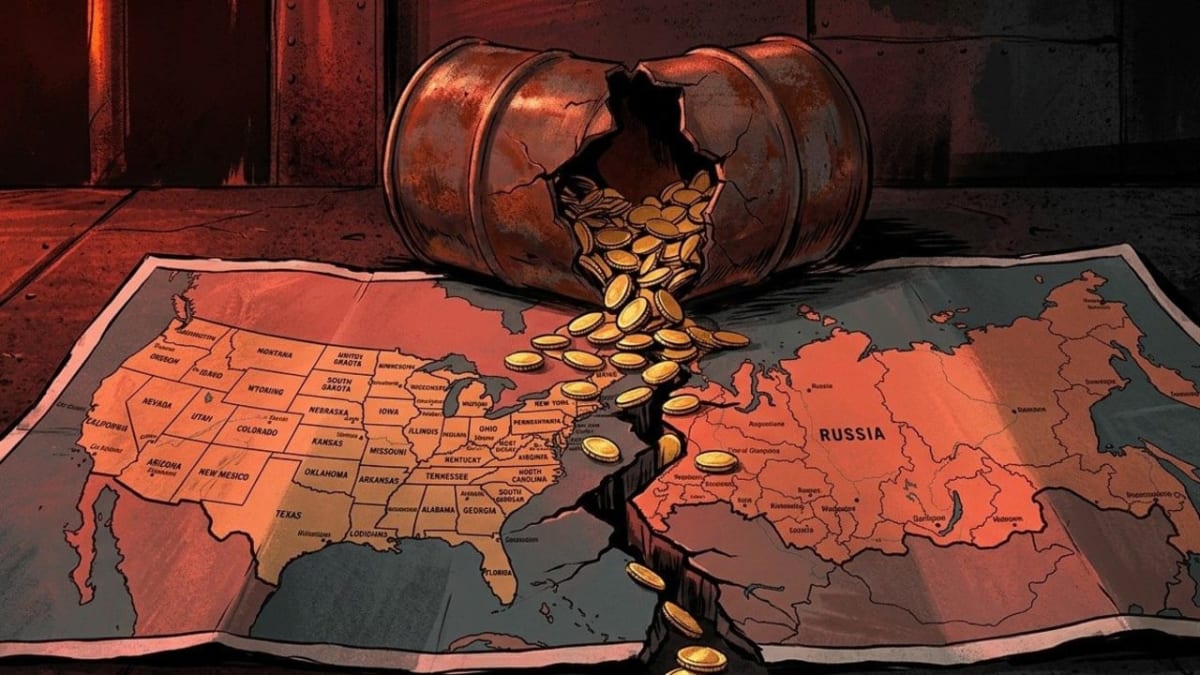
Brent crude hit $119 a barrel on March 9 — its highest reading since June 2022 — and Washington is now at war with itself over who profits from the chaos. The U.S. Treasury quietly issued a 30-day sanctions carve-out allowing Indian refiners to purchase Russian oil already loaded on vessels. Democrats immediately called it a gift to an enemy. Energy traders called it a lifeline. And American drivers, staring down a surging pump price less than eight months before midterm elections, are calling it something far less printable. The financial stakes could not be higher.
The Core Problem
The central tension is not merely political — it is a direct collision between short-term price management and long-term sanctions integrity, and the financial fallout from getting this wrong runs into the hundreds of billions of dollars.
On March 5, the U.S. Treasury issued a general license permitting Indian firms to purchase Russian crude petroleum and petroleum products already loaded onto vessels before that date, with delivery required in India before April 4. The stated rationale: relieve the acute supply shock triggered by the Iran war, which has effectively halted traffic at the Strait of Hormuz — a chokepoint that carries roughly one-fifth of the world's traded oil and gas.
The financial consequences of the Hormuz blockage are concrete and severe. Brent crude reached an intraday high of $119 a barrel on March 9, cooling to approximately $103 by day's end following G7 talks on a coordinated release of strategic reserves — still representing a single-day gain exceeding 15%, the sharpest in four years. For India, the arithmetic is punishing. DSP Mutual Fund estimates that sustained prices at $120 a barrel would push India's oil trade deficit to $220 billion annually, shunting the current account deficit beyond 3% of GDP and deepening rupee pressure. ICRA's chief economist calculates that every $10 per barrel increase in average crude prices lifts WPI inflation by 80 to 100 basis points.
For the United States, the political problem is the geopolitical one. Reports emerged that Russia has been sharing intelligence with Iran, actively assisting in targeting U.S. ships, aircraft, and military bases in the region. Rep. Sam Liccardo (D-CA) and Sen. Ruben Gallego (D-AZ), members of the House Financial Services Committee and Senate Banking Committee respectively, wrote to Treasury Secretary Scott Bessent calling the waiver 'dangerous, self-defeating, and indefensible.' What does it cost to sanction an adversary and then hand it a revenue waiver? The market is beginning to price that question.
Historical Parallel
The current episode rhymes most closely with the energy shock of February–June 2022, when Russia's invasion of Ukraine sent Brent crude from roughly $80 a barrel to an intraday peak of $127 in March of that year — a 59% surge in under six weeks. Then, as now, the West faced a binary choice: impose crippling sanctions that spiked energy costs domestically, or carve out exemptions that kept fuel affordable but blunted the financial weapon.
India's response in 2022 is directly relevant. Before the Ukraine war, Russian crude accounted for just 2.5% of India's total oil imports, per Carnegie Endowment data. By FY2023-24, that share had climbed to 35.9%, as Moscow offered discounts averaging $12.20 per barrel below the Brent benchmark — a pricing gap Indian refiners exploited to improve margins while Western buyers walked away. Russia's oil revenues, far from collapsing under sanctions, found a new routing through New Delhi and Beijing.
The 2008 oil crisis offers a different but equally instructive data point. Brent touched an all-time peak of $147 a barrel in July 2008, driven by speculative demand and supply anxiety — not war. That spike preceded the worst global financial crisis since the Great Depression. The present scenario is structurally more dangerous: supply is physically constrained by a military conflict, not just priced by sentiment. Qatar's largest LNG plant has been struck by Iranian drones, removing a critical gas supply node and pushing European natural gas futures sharply higher.
The lesson from 2022 is that sanctions architecture erodes slowly — then all at once. Each carve-out, however temporary, sets a precedent and signals to markets that the price ceiling on Russian barrels is negotiable under pressure.
The Data Under the Hood
The granular numbers tell a story that the political debate obscures.
India currently imports approximately 4.8 to 5.0 million barrels per day (mbpd) of crude oil and sources roughly 89% of its total energy needs from abroad, according to Carnegie Endowment research. In December 2025, Russian crude accounted for 25% of India's total imports — down from a peak of 35.8% in FY2024-25 — as U.S. tariff pressure and sanctions had begun to bite. By February 2026, Kpler data put Russian crude arrivals at roughly 1.0 mbpd, down from an average of 1.71 mbpd throughout 2025. That decline was not a strategic pivot; it was sanctions compliance under economic duress.
Now, the Iran war has reshuffled the deck. India received approximately 2.8 mbpd of crude from the Strait of Hormuz region in February 2026, representing 53% of total imports, according to Vortexa. With the Strait effectively blockaded, that supply line is severed. Indian state companies — Indian Oil Corporation, Bharat Petroleum, Hindustan Petroleum, and Mangalore Refinery — have already contracted approximately 20 million barrels of Russian crude for March-to-April delivery, per Reuters sources.
Nomura estimates Russian crude currently accounts for one-fifth of India's 5 mbpd import flow. Around 15 million barrels are in India's maritime vicinity, a further 7 million are near Singapore, with additional cargoes transiting the Mediterranean.
On Russia's side, the fiscal math is clear and concerning. Oil and gas tax revenues account for 20% to 30% of Russia's federal budget, according to AP-cited figures. Russia's Finance Ministry had built its 2026 budget on a Urals crude benchmark of $59 per barrel. Russian crude is now trading well above that level — meaning every dollar above $59 per barrel, after accounting for production costs of roughly $15 per barrel, flows directly toward Kremlin revenues. At current pricing, that represents a significant unbudgeted windfall for Moscow. The 30-day waiver unlocks approximately 32 million barrels of stranded Russian crude, a volume that meaningfully tightens Russia's short-term cash position regardless of Treasury's contention that tax is levied at extraction, not delivery.
Two Sides of the Coin
The bull case for the waiver rests on cold supply-demand arithmetic. The Strait of Hormuz carries approximately one-fifth of the world's oil and gas. India, with only 30 days of crude reserves, faced a genuine supply emergency — not a manufactured diplomatic talking point. Nomura's note called the Russian crude waiver 'a drop in the ocean' relative to the total disruption scale, but acknowledged it reduces immediate demand pressure on already-strained alternative supply chains. Energy Secretary Chris Wright framed it as 'pragmatic': Russian oil already at sea would otherwise flow to China, providing Beijing a supply advantage while Indian refiners scrambled for alternatives at spot premiums. The short-term deflationary effect on Brent — even a $5 to $10 per barrel reduction — translates to $7 to $16 billion in annual import bill savings for India, which has strategic significance for the $500 billion U.S.-India trade framework agreed in February 2026.
The bear case is harder to dismiss. Russian oil and gas revenues fund 20% to 30% of the federal budget that is simultaneously financing a war effort that, per Congressional Democrats, now extends to assisting Iran in targeting American forces. Treasury Secretary Bessent's argument — that tax is levied at extraction, not sale — is technically accurate but economically incomplete. Each barrel sold clears inventory, reduces storage costs, improves cash flow, and signals to Moscow that sanctions pressure has a ceiling. The broader risk is architectural: the Western sanctions framework built after February 2022 relies on consistent enforcement. One waiver under crisis conditions invites the inference that the next crisis produces the next waiver. Markets that price geopolitical risk are already drawing that conclusion — gold surged alongside oil, a combination that historically signals flight-to-safety capital rotation at scale.
Scenarios & What-Ifs
Three plausible paths forward carry materially different financial outcomes.
Scenario One — Waiver Expires, No Extension (probability: moderate): Treasury allows the April 4 expiry to stand as proof of sanctions credibility. Indian refiners accelerate U.S. and Gulf alternative sourcing. Brent stabilizes between $90 and $105 a barrel as G7 strategic reserve releases partially offset Hormuz disruption. Russia's short-term windfall is capped. Upside: sanctions architecture holds. Downside: India faces elevated energy costs that strain the $500 billion bilateral trade commitment.
Scenario Two — Waiver Extended or Expanded (probability: moderate-to-high): A second 30-day extension is granted as the Iran conflict drags beyond April. Brent dips near $95 a barrel briefly, then re-accelerates as the market reads the extension as a signal that the $60 per barrel Urals floor is politically protected. Russian energy revenues trend above budget assumptions through Q2 2026. Defense stocks and energy majors outperform. Consumer discretionary and airline equities remain under pressure.
Scenario Three — Diplomatic Breakthrough, Hormuz Reopens (probability: low near-term): A negotiated ceasefire restores partial Hormuz traffic within 60 days. Brent retreats sharply toward $75 to $80 a barrel. The waiver debate becomes moot. Indian equities recover. The rupee stabilizes. But Russian crude, now re-embedded in India's refinery mix, does not disappear overnight — the trade flow reset of 2022 took years. The geopolitical residue outlasts the price spike.
The Bottom Line
The Treasury gave India a 30-day lifeline using Russian oil, and now Washington is fighting over whether that lifeline also funds the people shooting at U.S. troops — that's the core problem. Brent at $103-plus is already repricing inflation expectations, squeezing consumer spending power, and injecting genuine uncertainty into Q2 earnings forecasts for energy-dependent sectors. Watch the April 4 waiver expiry date like a market event — because whether it's extended or killed, that decision will move crude, the rupee, defense equities, and the broader risk-on/risk-off dial simultaneously.