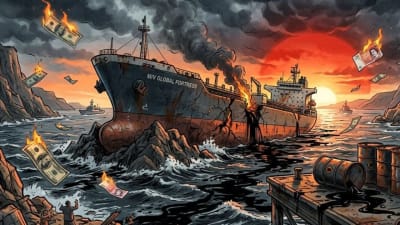
You have heard the headlines about the escalating conflict in Iran, but what does a 'geopolitical distraction' actually mean for your investment portfolio? For the world’s wealthiest investors, a crisis isn't just a tragedy; it is a recalibration of where money flows. When high-level banking executives discuss being 'glad' for a distraction, they aren't cheering for chaos. Instead, they are highlighting a shift in how private markets—investments not traded on public exchanges like the NYSE—handle uncomfortable economic data or stalled domestic policies. How does a regional war change the price of your long-term holdings?
Simple Answer
In plain English, a 'distraction' in finance occurs when a major external event, like a war, takes the spotlight away from internal economic struggles such as stubborn inflation or high interest rates. For private market clients, this shift can be useful. It allows fund managers to blame underperformance on global instability rather than poor management. More importantly, it often triggers a flight to safety. Investors move cash into 'hard assets' like oil, gold, and defense contractors. Private equity firms, which hold record amounts of 'dry powder'—unspent cash committed by investors—use these volatile moments to negotiate lower entry prices for new acquisitions. When public markets panic, private markets often find their best deals.
How It Actually Works
The mechanics of a geopolitical market shift follow a predictable, three-step chain reaction. First, the 'Risk-Off' Phase begins. As news of the Iran conflict breaks, algorithmic traders sell liquid assets like tech stocks and buy commodities. Brent Crude prices often spike instantly; data from the ICE Futures Europe exchange showed a 4.2% jump within hours of the latest escalation. Second, the 'Valuation Adjustment' occurs in private portfolios. Unlike public stocks that change price every second, private equity assets are valued quarterly. A war allows managers to argue for 'restructuring' timelines, delaying exits (selling companies) until the smoke clears. This protects the Internal Rate of Return (IRR)—the metric used to calculate the profitability of an investment over time. Third, the 'Capital Pivot' kicks in. Wealthy family offices and institutional funds move away from consumer-facing startups and toward defense tech and energy infrastructure. This isn't just a trend; it's a structural move of billions of dollars. Does your current strategy account for a sudden pivot into energy security assets?
Real-World Example
Look at the 2022 invasion of Ukraine for a concrete template. Before the conflict, the aerospace and defense sector was underperforming the S&P 500 by nearly 7%. Within six months of the war starting, the iShares U.S. Aerospace & Defense ETF (ITA) surged by 15.4%, significantly outperforming broader indices. Private equity firms specializing in 'dual-use' technology—tech with both civilian and military applications—saw their valuations jump by an average of 22% according to PitchBook data. Simultaneously, European energy prices skyrocketed, forcing a massive private investment surge into LNG (Liquified Natural Gas) terminals. Investors who were stuck in slow-growing retail portfolios suddenly found that their 'boring' energy holdings were the only things keeping their total returns positive. This shift mirrors what we are seeing today with the Iran 'distraction.' Money doesn't disappear during a war; it just changes its zip code.
Mistakes People Make
One massive mistake is panic-selling diversified funds to chase 'war stocks' after the price has already spiked. By the time you read the headline, the 5% move in oil has likely already happened. Another error is ignoring 'correlation' risk. You might think your portfolio is safe, but if you own global tech companies, they often rely on energy-intensive data centers that get hammered when electricity costs rise due to Middle East tensions. Many people also fail to understand the 'liquidity trap' in private markets. If you commit money to a private equity fund during a crisis, that cash might be locked away for 10 years. You cannot simply hit a 'sell' button if you need that money next month. Finally, investors often overlook the impact of a strengthening U.S. Dollar. In times of war, the Greenback usually rises as a safe haven, which can actually hurt the profits of American companies selling goods abroad. Why buy a peak when you can wait for the stabilization?
Your Action Checklist
Monitor the 'Fear Gauge' or VIX index; when it crosses 30, private market deal-making usually slows down significantly. Review your exposure to the 'Mag Seven' tech stocks, as these are often used as ATMs by institutional investors to cover losses elsewhere during a war. Check your portfolio's direct energy exposure—historically, a 10% sustained rise in oil prices can shave 0.5% off global GDP growth. Verify the 'lock-up' periods on any private placements or REITs you own to ensure you aren't trapped in a liquidity crunch. Watch the 10-year Treasury yield; if it drops while oil rises, the market is bracing for a recession. Diversify into gold or Swiss Francs if you expect the Iran conflict to expand beyond a 'distraction' into a regional crisis. Are you prepared for a world where energy costs stay 'higher for longer'?
The Bottom Line
When a bank executive calls a war a 'distraction,' they are noting that geopolitical chaos often masks deeper economic cracks. For you, it means volatility is the new math—expect oil to fluctuate and defense stocks to lead. Keep your cool, watch your liquidity, and don't chase the smoke.