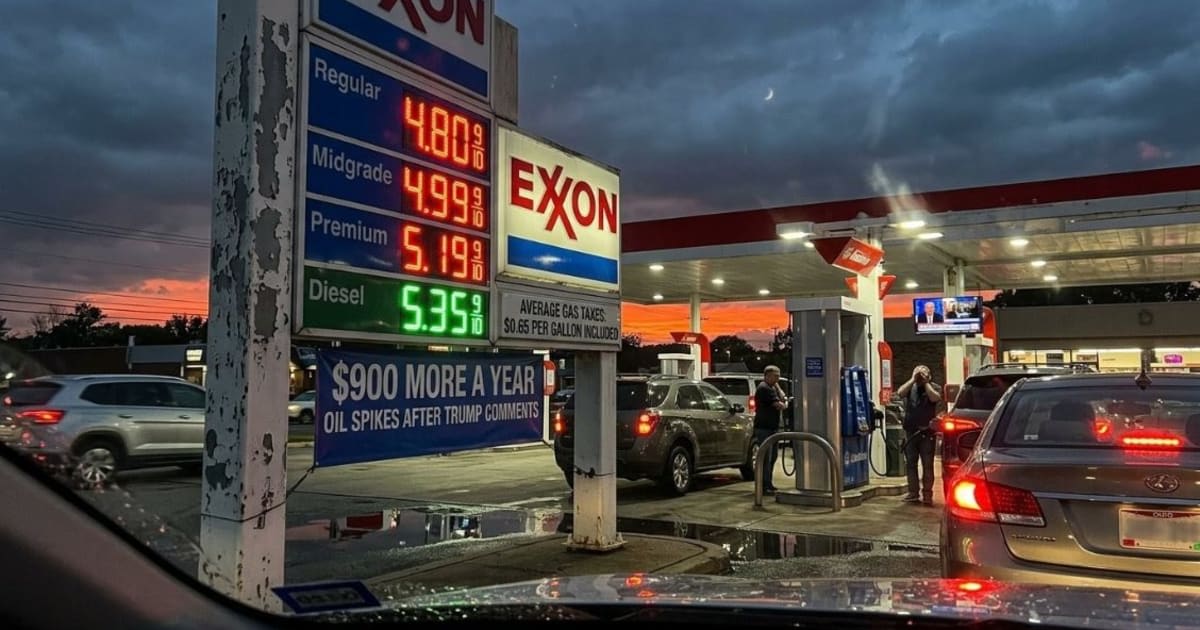
Oil is at $118 a barrel. That's not a forecast — it's already showing up on your receipt.
For the average American driving 15,000 miles a year, $118 oil translates to roughly $900 more at the pump annually compared to last spring. A family in suburban Ohio with two vehicles commuting combined 24,000 miles a year is looking at over $1,600 extra before touching food, airfare, or anything else that moves.
The trigger was President Trump. His comments implied potential action near a major oil-producing region — and traders bought oil futures within minutes of the news breaking, pushing crude from around $105 to $118 in a single afternoon.
What Changed
Oil is a globally priced commodity — 42 gallons of crude that gets refined into gasoline, diesel, and jet fuel. When it costs more, everything that moves or gets made costs more too. The US Energy Information Administration's rule of thumb: every $10 rise in crude adds about 24 cents per gallon at the pump.
Oil has risen roughly $20 from recent levels. That's 48 cents more per gallon already locked in at your station — before any further moves.
Where prices sit now:
- US national average gas price: pushing toward $4.80/gallon
- California: already $6.50+/gallon as of late March
- A 15-gallon fill-up at $4.80: $72 vs. $52 last spring — $20 extra every fill-up
- Fill up twice a month: $480 extra per year just in gas
How an Afternoon of Political Commentary Reaches Your Tank
The chain runs fast and it's worth understanding once:
- Trump's comments raise perceived supply disruption risk from a major oil-producing region
- Traders buy oil futures immediately as a hedge against potential shortages
- Supply risk + futures buying → crude goes from $105 to $118 in hours
- Refiners pay more for crude → pass cost to distributors
- Distributors pass to stations → pump price rises within 1–3 weeks
- Every downstream product using petroleum — plastics, diesel, jet fuel — follows
The three price moments that frame where we are:
| Year | Price | Driver | What followed |
|---|---|---|---|
| 2008 peak | $147/barrel | Speculation + geopolitical fear | Collapsed to $35 as recession crushed demand |
| 2020 trough | Briefly negative | COVID demand destruction | Recovery as economy reopened |
| 2026 today | $118/barrel | Trump comments + Iran/Hormuz | Unknown — depends on conflict duration |
This time is different in one critical way: the US now produces nearly 13 million barrels/day — the world's largest producer — vs. 5 million in 2008. Washington has far more ability to dampen a price shock today. The catch: shale wells take 90–120 days to meaningfully ramp up. More supply is coming. But your bill is higher today.
The Average Driver's Real Annual Hit
For different household types at $4.80/gallon:
| Driver profile | Annual miles | Gallons used | Extra cost vs. last spring |
|---|---|---|---|
| Solo commuter | 12,000 miles | 480 gal | ~$720/year more |
| Average household | 15,000 miles | 600 gal | ~$900/year more |
| Two-car suburban family | 24,000 miles | 960 gal | ~$1,620/year more |
| California driver (at $6.50) | 15,000 miles | 600 gal | Even higher premium |
The 401(k) angle compounds this. The S&P 500 has historically dropped 1.5–2% for every $10 sustained increase in oil that persists beyond 30 days. If $118 holds, that's a potential 3–4% drag on the index over the next quarter. On the average 401(k) balance for Americans in their 50s (~$127,000), a 3% paper loss is roughly $3,800 — not from a tech crash, but from one afternoon of political commentary and one commodity.
Four Common Fuel-Cost Mistakes That Add Up Fast
-
Assuming the spike is temporary and doing nothing. Doing nothing and then seeing your credit card bill in 6 weeks is the most expensive response. Even if oil eventually retreats, the damage to your monthly cash flow is real and immediate.
-
Panic-buying gas to stock up. Rushing to fill every container saves almost nothing. At $4.80/gallon, stockpiling an extra 10 gallons now versus next week is a $48 decision, not a financial strategy — and gasoline degrades if stored improperly.
-
Letting the gap land on revolving credit. If gas costs $900 more this year and you don't consciously adjust your budget somewhere else, the gap ends up on a credit card at 22% APR. That turns a $900 fuel cost into closer to $1,100 in real annual debt cost once interest compounds. The smarter move: cut one flexible line now — a streaming subscription, a dining-out habit — rather than letting the deficit compound quietly.
-
Missing the summer travel impact. Airline fares typically jump 8–12% within 90 days when oil holds above $115 for more than 30 days. If you're booking summer travel, booking now — not in May — is the one near-term action that recovers part of the cost shock.
What to Watch
Three signals tell you whether this spike reverses or digs in:
- OPEC+ production decisions — they can flood markets with supply if they choose
- Iran/Hormuz diplomatic developments — any ceasefire announcement is the fastest oil price relief valve in current markets
- EIA Weekly Petroleum Status Report — released every Wednesday at 10:30 AM Eastern, free at eia.gov; if weekly crude inventories start building, prices soften
The Exact Annual Cost for the Average American Driver
For the average American driving 15,000 miles per year in a vehicle averaging 25 MPG, oil at $118/barrel translates to approximately $900 more per year at the pump compared to last spring. On a median US household income of around $60,000, that's 1.5% of pre-tax annual earnings consumed by a single commodity move triggered by one afternoon of political commentary — before the downstream effects on food, utilities, and airfare have fully arrived.
This content is informational only and should not be interpreted as a recommendation to buy, sell, or hold any security. Seek professional financial advice before acting on anything you read here.