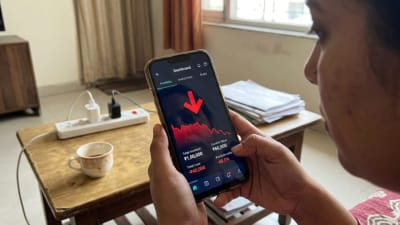
₹2.3 lakh crore. That's the combined market cap added by listed Indian defence companies over the past 18 months — a figure that sounds like a victory lap. But strip out the top three names and the picture tightens fast. The rally everyone's calling a 'sector breakout' is, in large part, a story about four or five stocks carrying the weight of an entire theme. Your portfolio's exposure may be more concentrated than your fund statement suggests.
The Breakout That's Real — and the One That Isn't
Defence stocks across the board have staged sharp technical moves in April 2026. Charts are breaking out of multi-month consolidation ranges, volumes are spiking, and momentum indicators are flashing green. Anand James, Chief Market Strategist at Geojit Financial Services, has flagged the trend — but with a sharp caveat. Select heavyweights are entering overbought territory on RSI, and chasing them at current levels is likely to mean buying someone else's exit.
The cleaner signal is coming from a tier below. Smallcap and mid-tier defence suppliers — the companies making components, electronics sub-systems, and maintenance services for the headline players — are showing breakouts that aren't yet priced for perfection. Data shows these names have moved 2 to 3 times the percentage gains of their large-cap counterparts over the same trailing window, with RSI levels still in the 55–65 range rather than the 75+ zone where the big names now sit.
What's driving this? Three things are compressing into the same window:
- India's defence capex budget rose to ₹6.21 lakh crore in Union Budget 2026, with domestic procurement share mandated above 75%
- Order backlogs for tier-2 suppliers have extended to 3–4 years, reducing revenue visibility risk
- FII flows into the broader defence ETF basket have accelerated since February, lifting even stocks with thin float
What This Means for Your Actual Portfolio
Here's the math that matters. If you put ₹1 lakh into a basket of large-cap defence names six months ago, market pricing implies you're sitting on roughly ₹1.38–1.45 lakh today. That's a 38–45% gain. Good. But the question you should be asking isn't 'how much have I made' — it's 'how much of this is price discovery versus sentiment froth.'
For investors holding across geographies, the currency dimension adds another layer:
| Investor Location | ₹1 lakh equivalent | Approx. current value | INR/FX note |
|---|---|---|---|
| India | ₹1,00,000 | ₹1,40,000–1,45,000 | Direct exposure |
| US (USD) | ~$1,190 | ~$1,666–$1,726 | USD/INR ~84 |
| UK (GBP) | ~£945 | ~£1,323–£1,367 | GBP/INR ~106 |
| EU (EUR) | ~€1,085 | ~€1,519–€1,570 | EUR/INR ~92 |
For US, UK, and EU-based investors in Indian defence funds or ETFs, your currency tailwind has been modest in 2026 — the rupee hasn't moved dramatically — so returns are close to the rupee numbers above. What you carry, though, is the risk of a sharp drawdown in a sector where liquidity can thin out quickly. Defence stocks globally — from Rheinmetall to HEICO — have also re-rated, so your alternatives aren't obviously cheaper.
What it costs you: ₹1 lakh invested 6 months ago is now ₹1.40–1.45 lakh; overbought signals raise drawdown risk to ₹1.20 lakh near-term.
The Numbers That Don't Make the Headlines
The surprising data point that most coverage is missing: the price-to-order-book ratio for India's top five listed defence PSUs has expanded faster than revenue. In plain terms, you're paying more per rupee of secured work than at any point in the last decade. That's not automatically a sell signal — long order cycles justify premium multiples — but it does mean the margin for error in execution is now priced out.
A few numbers that should be on your radar:
- HAL's trailing P/E has moved from ~22x (early 2024) to above 40x as of April 2026, per exchange data
- BEL's order book stands at approximately ₹71,000 crore — healthy, but the market is now pricing in orders that haven't been announced
- Smaller names like Paras Defence, Data Patterns, and Zen Technologies are trading at forward multiples that assume 25–30% earnings CAGR for five consecutive years
- The NSE Defence Index, since its January 2025 base, has outperformed Nifty 50 by approximately 28 percentage points
The overbought signal on select stocks is real. But the broader point is subtler: the market has front-loaded a lot of good news. Any delivery slippage — in orders, margins, or government spend timing — will be punished faster than in a sector trading at reasonable valuations.
Where the Dip-Buyers Should Actually Be Looking
The 'buy on dips' call from analysts like Anand James isn't wrong — but the dip worth buying may not be in the names getting the most airtime. If your goal is to participate in India's multi-year defence buildout without overpaying for momentum, the data points toward a specific sub-category: electronics and sensor systems manufacturers that feed into both domestic defence and export contracts.
These companies benefit from the same policy tailwind but carry lower execution risk than platform manufacturers. They're also less likely to appear in the headline 'defence theme' baskets that retail investors are currently piling into.
Watch for two specific triggers that could reset entry points across the sector:
- Any revision to the defence capex disbursement timeline in Q1 FY27 results (typically flagged in May–June earnings calls)
- A broader Nifty correction of 3–5%, which historically pulls defence names down 6–9% even without sector-specific news — creating the actual dip worth buying
For investors outside India, the practical play remains via diversified EM funds with India overweight rather than direct stock exposure, given thin ADR liquidity for most defence names.
My Call
My take: the defence sector's structural story is intact for 3–5 years, but the next 60–90 days belong to sellers, not buyers, in the large-cap names. I think a Nifty-wide correction — not defence-specific news — will hand you a cleaner entry in Q1 FY27, and that's the moment to add, not now. The one reason: you don't chase a bus that's already half a kilometre ahead when the next one is scheduled.
The views expressed here are for informational purposes and do not constitute personalized financial guidance. Readers should consult a licensed advisor before making investment decisions.