The Chai-Tapri Trap
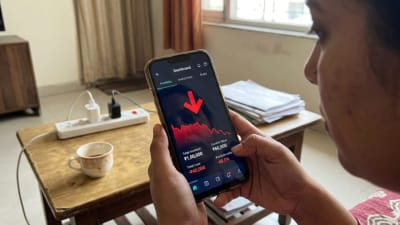
Picture this: it's 9:25 AM. You're at your office desk, chai in hand, and your phone buzzes with a WhatsApp tip—'BUY IDEA CELLULAR, TARGET 250, SL 210.' By 9:35, you've placed the order. By 11:00, the stock is down 4%. By 3:30, you've exited at a loss and told yourself you'll be more careful next time.
You weren't careless. You were following a system—just the wrong one.
This is the single most common and most expensive mistake that salaried Indians make when they try to become traders. They adopt strategies that were designed for a trending, liquid, low-volatility bull market—and they apply them to a market that is none of those things right now. The Nifty 50 has swung more than 1.5% intraday on average across 38 trading sessions in 2026 alone. That's not a market for momentum chasers. That's a market that eats them.
What the Market Is Actually Doing Right Now
India's equity market in 2026 is caught between three live wires: a global trade realignment triggered by renewed US tariff policies, domestic elections in four major states, and an RBI that has cut rates once but left everyone guessing about the next move. The result is a market that can rally 400 points on the Nifty in the morning and give it all back by the afternoon close.
This is what professional traders call a 'two-way tape'—and it's brutally unforgiving for anyone operating without a structured process. Here's what the data is showing:
- Nifty 50 average daily range (Jan–Apr 2026): 320–480 points
- F&O open interest spike: Up 28% YoY, meaning more leveraged bets, more violent reversals
- Retail participation in derivatives: 42% of all F&O volume (NSE data), the highest ever recorded
- Midcap and smallcap volatility index (India VIX proxy): Elevated above 18 for 11 consecutive weeks
- Stocks hitting 52-week highs and lows on the same week: 73 instances in April 2026 alone
More people are trading. The market is moving more. And yet most of those people are losing more. These three facts are not a coincidence—they are directly connected.
Why Your Salary Slip Is the Real Problem
Here's a truth that no trading course will tell you upfront: your monthly salary is both your biggest asset and your biggest liability as a trader.
It's an asset because it gives you the capital to start and the cushion to survive early mistakes. But it's a liability because it creates a psychological trap called 'salary confidence.' You know ₹60,000 is coming in on the 1st of next month. So losing ₹8,000 on a bad trade feels recoverable. Then ₹14,000. Then ₹22,000. Before you know it, you've burned through three months of savings in six weeks, and your SIP—the one actually building your wealth quietly in the background—is the only thing still working.
SEBI's own study found that the average retail F&O trader in India loses ₹1.1 lakh per year. For a household earning ₹80,000–₹1.2 lakh per month, that's not a rounding error. That's a destroyed emergency fund. A delayed home down payment. A skipped family vacation. Real money with real consequences.
The traders who survive—and eventually thrive—in a volatile market treat every rupee of trading capital as irreplaceable. Not because they're fearful, but because they're disciplined.
What it costs you: Avg retail trader loses ₹1.1L/year; disciplined traders cap this at ₹15,000–₹30,000/year.
What Separates the 11% Who Actually Make It
Only 11% of retail traders in India sustain profitability for two or more consecutive years, according to SEBI's multi-year analysis of derivatives traders. So what do they do differently? It's not about finding the perfect stock. It's about four unsexy disciplines that most people skip because they feel boring.
1. Position Sizing That Matches Your Risk Tolerance, Not Your Greed Profitable traders never risk more than 1–2% of their total capital on a single trade. For someone with ₹3 lakh in a trading account, that means a maximum loss of ₹3,000–₹6,000 per trade. Not ₹30,000 on a 'sure shot' tip.
2. A Pre-Defined Exit Strategy—Written Down Before You Enter The moment you enter a trade emotionally, you've already lost. Every trade needs three things decided before execution:
- Entry price
- Stop-loss level (your 'I was wrong' price)
- Target price (your 'I was right' exit)
This removes the most dangerous variable in trading: you, in the moment, under pressure.
3. Keeping a Trade Journal—In ₹, Not Percentages Writing '3% loss' feels abstract. Writing '₹4,500 lost on Reliance on April 14 because I ignored the stop-loss' is visceral and instructive. Traders who journal in rupee terms make the same mistake far fewer times.
4. Staying Out Is a Position In a volatile market, cash is a valid trade. When you can't read the direction—when the Nifty is reacting violently to every global headline—not trading is a strategy. You can't lose money you don't have in the market. The traders who understand this survive drawdowns that wipe out everyone else.
These aren't glamorous. No trading guru's Instagram reel is going to feature 'I stayed in cash today.' But data shows these four habits separate the 11% from everyone else.
If You're Still Going to Trade—Do This First
The market isn't going to become less volatile anytime soon. Global uncertainty, domestic political cycles, and elevated FII activity mean two-way swings are your new normal for at least the next two to three quarters. If you're committed to trading alongside your SIP, here's a practical structure that respects both your capital and your schedule as a working professional.
Build Your Framework Before You Touch the Market:
- Capital allocation: Never put more than 10–15% of your investable surplus into active trading. Your SIP, PPF, and emergency fund come first—always.
- Time frame clarity: Are you a positional trader (holding 2–5 days) or an intraday trader? Mixing the two destroys both strategies. Choose one and stick to it for at least 90 days before evaluating.
- Sector focus: Volatile markets reward specialists. Pick two or three sectors you understand—IT, banking, pharma—and learn their earnings cycles, global triggers, and technical levels deeply. Don't chase every tip in every sector.
- Broker fees and STT reality check: For a ₹1 lakh intraday trade in equities, your all-in transaction cost (brokerage + STT + exchange charges + GST) can easily run ₹300–₹600 per round trip. At 20 trades a month, that's ₹6,000–₹12,000 gone before you've even had a winning or losing trade. The market has to pay you before it pays your broker.
- Review your last 20 trades before placing the next one: If you don't have 20 completed trades to review, you're not ready to scale up. Paper trade first—seriously.
The market rewards process. It doesn't care about your conviction, your tip source, or how many YouTube videos you've watched. It rewards people who show up every day with a system, execute it without ego, and accept small losses as the cost of being in the game.
The Verdict
Should you try to become an active trader right now? Only if you've already secured your SIP, built a 6-month emergency fund, and are genuinely prepared to lose your entire trading capital without blinking—because in this market, that's the entry fee for education. The traders who win long-term aren't the ones with the best tips; they're the ones who survive long enough to develop a process that actually works.
Nothing in this article should be considered investment advice. The information presented is for educational purposes. Consult a licensed financial advisor before making any financial decisions.