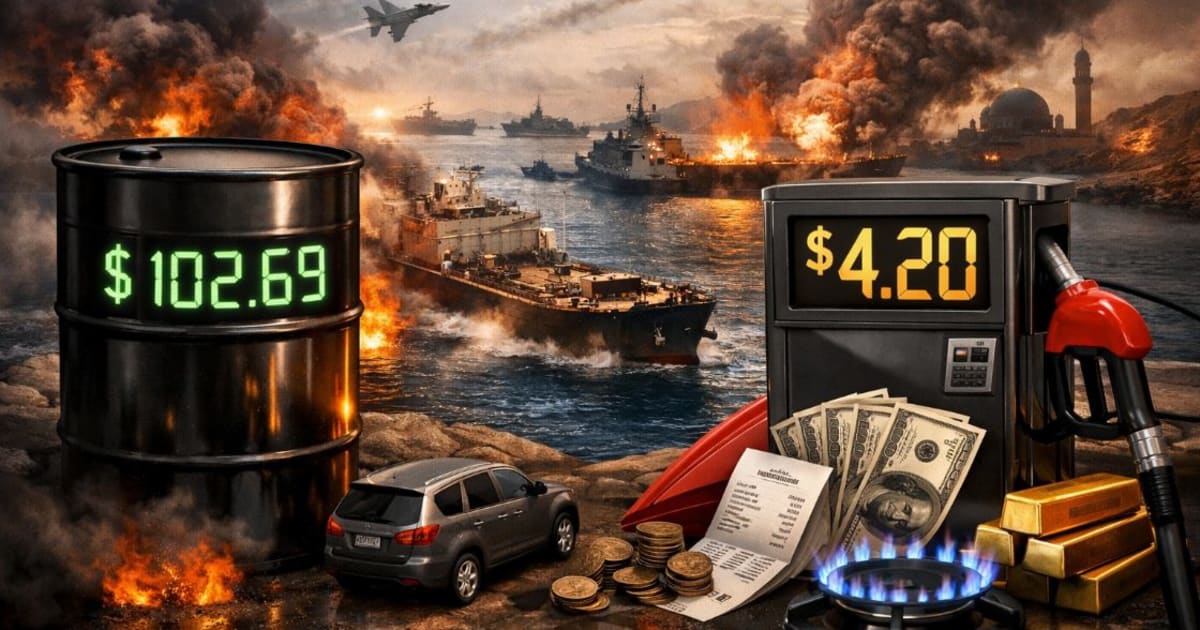
Oil just crossed $102 a barrel — up over 2% in a single session. At that price, US pump costs are heading toward $4.20 a gallon within two weeks if the move holds. The Strait of Hormuz, through which roughly 20% of global oil flows daily, is caught in the crossfire of an active US-Israeli military conflict with Iran. Markets are pricing in a supply crunch. They might be right.
Trend Breakdown
Six weeks ago, Brent crude was trading around $82 a barrel. That was already elevated — the historic five-year average sits closer to $72 — but it was manageable. Then the conflict escalated.
The US-Israeli military campaign against Iran's nuclear infrastructure began intensifying in late February. By early March, naval positioning near the Gulf had pushed prices through $90. The market noticed. By last week, Brent had cleared $100 for the first time since the 2022 Ukraine crisis peak — and today's move to $102.69 extends that run by another $2.19 in a single session.
For the average American driver filling a mid-size SUV with a 20-gallon tank, the math is straightforward and painful. At January's $82 oil, a full tank ran roughly $58 at the pump. At $102, that same fill-up costs closer to $70 — a $12 hit you feel every week. Run that out across a month, with a household doing two fill-ups a week, and you're spending about $96 more than you were in January. That's not an abstraction. That's a grocery run.
In the UK, petrol prices track Brent with a lag of seven to ten days. At current rates, forecourt prices are set to climb toward 160p per litre — meaning a 55-litre tank now costs roughly £88 versus £74 two months ago. The energy stress is building before most people have noticed it.
Comparison Breakdown
Put $102.69 in context. The last time oil stayed above $100 for a sustained period was 2022, when Russia's invasion of Ukraine sent Brent to a peak of $130.50 in March of that year. Before that, you have to go back to 2014, when $100 oil was routine. Both episodes were painful — but this one carries a structural risk neither of those did.
What's different is the geography. Ukraine disrupted Russian supply, which was significant, but Russia retained alternative export routes through Turkey and Asia. The Strait of Hormuz has none. It's 21 miles wide at its narrowest point, and Iran has demonstrated since 2019 that it can threaten tanker traffic with minimal military effort. If Hormuz closes — even partially — the International Energy Agency estimates a potential daily supply loss of 17 to 21 million barrels. That's roughly 17% to 20% of global consumption gone overnight.
Compare that to the OPEC+ cuts that rattled markets in 2023. Those amounted to around 2 million barrels per day. That move added roughly $8 per barrel. A Hormuz disruption scenario is eight to ten times larger in scale.
For a US household already running a $4.00-a-gallon baseline, the Bank of America scenario of oil reaching $120 by Q2 would push pump prices toward $4.80 to $5.10 nationally. The UK equivalent would see petrol at 170p to 180p per litre. At those numbers, inflation re-accelerates. Central banks lose breathing room. And the recession conversation, currently on pause, comes back fast.
What the Data Reveals
The data is telling a story that goes beyond a single day's price move. Three signals are flashing at once.
First, the term structure of oil futures has shifted sharply into backwardation — near-term contracts now trade at a meaningful premium to longer-dated ones. That's the market saying supply is tight right now, not just hypothetically. When backwardation steepens like this, the historical pattern is clear: the front-month price tends to stay elevated until physical barrels show up.
Second, allied navies have refused to provide escort convoys through the Gulf. That's not a symbolic gesture. Insurance premiums for tankers transiting Hormuz have reportedly tripled in the past three weeks, according to shipping industry data. Higher insurance costs get passed directly to refiners, who pass them to you at the pump. It's a hidden tax on every barrel that makes it through.
Third, the UAE — one of the Gulf's most reliable producers at roughly 3.2 million barrels per day — has already trimmed output in response to the security situation. Even a 5% cut removes 160,000 barrels from daily supply. Small in aggregate, but global commercial crude stocks already sit around 2.6 billion barrels against a five-year average closer to 2.9 billion. Every barrel missing from that buffer matters more than it did a year ago.
The pattern here isn't panic. It's pricing. And it's not done yet.
Outliers & Surprises
Not everyone is losing on this. Defense and energy stocks are the obvious beneficiaries, and the numbers reflect it — US energy sector ETFs are up roughly 11% year-to-date while the broader S&P 500 is flat. That divergence is worth watching if you hold index funds with heavy tech weighting.
The less-obvious angle is gold. Safe-haven flows have pushed the metal toward $3,180 an ounce, up about 18% since January. For UK investors with a SIPP or ISA carrying any gold allocation, that's a meaningful cushion against the energy cost squeeze hitting monthly outgoings simultaneously.
There's also a currency dynamic most retail investors miss. Oil is priced in dollars, so a stronger USD compounds the pain for UK buyers — you're paying more dollars for oil, and getting fewer dollars per pound. Sterling has slipped to around $1.27 from $1.32 in January, tightening the squeeze a second way.
The clearest loser beyond consumers is the airline sector. Jet fuel tracks crude closely, and hedging costs for carriers have spiked sharply. If crude holds above $100 through summer, fare increases are not a question of if — only how much.
Data-Based Outlook
If current trends hold, the market's next test is whether $105 becomes support or resistance. Goldman Sachs and Bank of America have both revised Q2 price targets upward — the median bank forecast now sits around $108 to $112 per barrel through June, assuming Hormuz remains partially navigable.
If escalation deepens and allied escort refusals hold firm, a move toward $120 enters the scenario models that matter. At that level, US headline inflation — currently running around 3.1% — would likely re-accelerate toward 4%, complicating the Federal Reserve's rate path and pushing 30-year mortgage rates back toward 7%.
Oil crossed $102 today. Markets called it a supply risk story. Whether it stays a supply risk story, or becomes a global recession story, is the question that gets answered in the next 30 days.
💰 What this means for your money: For the avg US household, this means ~$96 more/month on fuel vs January
"A Hormuz closure could remove 17–21 million barrels a day — ten times the scale of the OPEC cuts that spooked markets in 2023."
The Bottom Line
Oil at $102 is the market's best guess at what a Hormuz disruption is worth in dollars per barrel — and that guess keeps moving higher. The number that actually matters right now isn't the crude price itself; it's the allied refusal to escort tankers, which removes the one circuit-breaker that could calm this down fast. There's a version of this story where diplomacy steps in and prices reverse. The data right now isn't pointing there.
Frequently Asked Questions
Why did oil prices go above $102 today?
Oil surged 2.1% to $102.69 as markets priced in potential disruption to the Strait of Hormuz — the narrow Gulf waterway through which roughly 20% of global oil supply flows daily. The US-Israeli military conflict with Iran has raised the risk of tanker blockage, and allied navies have declined to provide convoy escorts, amplifying supply anxiety and pushing prices to their highest level since early 2022.
How does $102 oil affect my gas prices and energy bills?
At $102 a barrel, US regular gasoline is tracking toward $4.20 a gallon — roughly $12 more per fill-up on a 20-gallon tank versus January levels. For a US household making two fill-ups a week, that adds up to around $96 more per month. UK motorists will see petrol approach 160p per litre, adding approximately £14 to a full 55-litre tank compared to two months ago.
What should I watch to know if oil prices will keep rising?
The key triggers are whether allied navies reverse their refusal on tanker escorts (watch G7 and NATO statements), any further UAE or Gulf production cuts, and whether Brent closes above $105 — historically a level that accelerates broader commodity inflation. Federal Reserve commentary on inflation re-acceleration will also move markets, as higher energy costs complicate the rate outlook significantly.