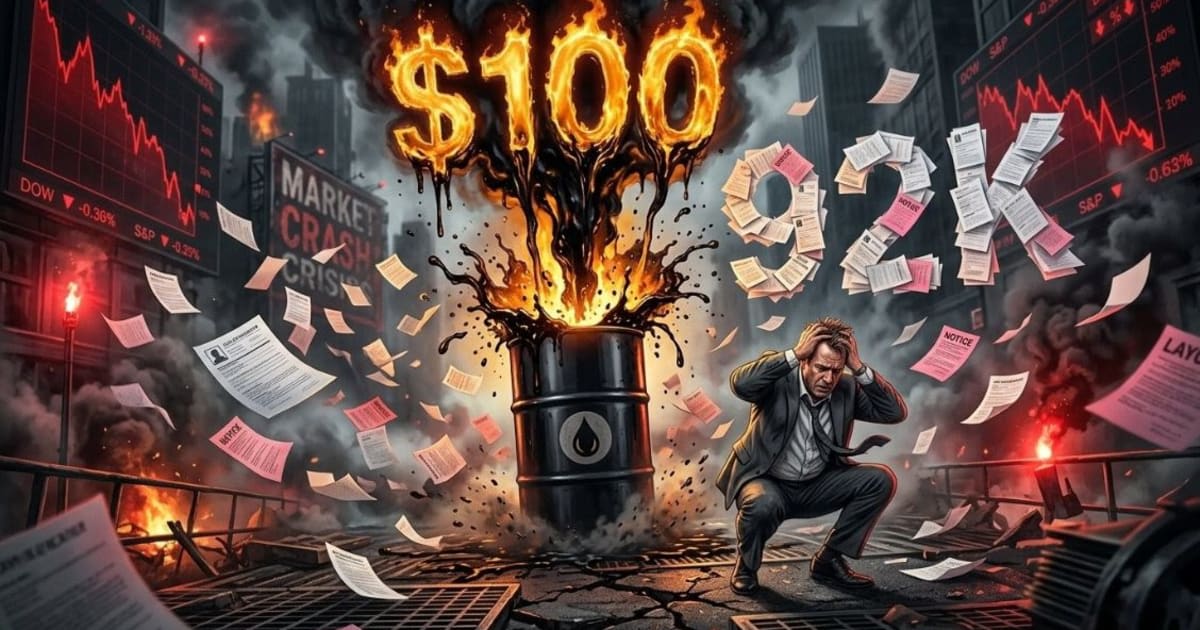
Oil crossed $98 a barrel this week. For most people, that number lands as an abstraction — a ticker on a financial news screen. But translate it to the pump, and it stops being abstract fast. Gasoline prices in the US are creeping toward $4.20 a gallon on a national average, which for a household driving 1,200 miles a month adds roughly $35 to $50 more every four weeks compared to a year ago. Not a fortune. But not nothing, either — especially when grocery bills and rent haven't come down.
What's spooking economists isn't just the oil price in isolation. It's the combination. Inflation remains stubbornly above the Federal Reserve's 2% target. Economic growth is losing altitude. And now an energy shock is arriving on top of an already fragile foundation. That specific mix — rising prices, slowing growth — has a name that most economists hoped they'd never have to use seriously again: stagflation.
The last time the US genuinely lived through it, Richard Nixon was in the White House and the phrase 'energy crisis' was on every front page. The scars it left on household wealth, real wages, and market valuations took the better part of a decade to heal. Whether 2026 is really a replay, a rhyme, or just a scare is the most important economic question of the year — and the answer will determine the direction of interest rates, your mortgage, your grocery bill, and the value of your retirement portfolio.
The Core Problem
Stagflation is not simply 'inflation that is inconvenient.' It is a specific and particularly cruel economic condition where the two standard tools governments and central banks reach for — interest rate cuts to stimulate growth, and increased government spending to cushion households — actively make the other problem worse. Cut rates to save jobs? Inflation accelerates. Raise rates to crush inflation? The already-slowing economy tips into recession. There is no clean lever to pull. That is the trap.
The numbers that have markets nervous right now are not individually catastrophic, but together they paint an uncomfortable picture. US CPI has proven stickier than the Fed's models projected, still running above 3.5% as of early 2026 — more than 75% above the official 2% target. Core services inflation, which strips out food and energy and is closely watched because it reflects domestic wage and rent pressures, has barely moved. It has been above 4% for eighteen consecutive months. Meanwhile, the Atlanta Fed's GDPNow tracker, which provides real-time estimates of quarterly growth, has been revised sharply downward, with Q1 2026 tracking close to 1% annualized — a significant deceleration from the 2.7% pace of late 2024.
An oil spike to $100 lands into that environment like a lit match thrown into dry grass. Energy touches everything. It is embedded in the cost of manufacturing, shipping, heating, cooling, and food production. When crude rises 40% over twelve months, it doesn't just show up at the gas station. It shows up four to six weeks later in the price of packaged food, six to eight weeks later in airline tickets, and within a quarter in the Producer Price Index — which is the earliest warning system for future consumer price increases. For the average US household spending approximately $6,800 a year on energy-related costs, a sustained $100 oil environment could add $900 to $1,200 annually to that bill, according to historical elasticity estimates from the Energy Information Administration.
The Federal Reserve's dilemma is almost textbook. Under Chair Jerome Powell, the Fed spent 2022 and 2023 hiking aggressively — 525 basis points in total — to break the back of post-pandemic inflation. It partially worked. But inflation never fully returned to 2%. The Fed is now stuck: it cannot cut meaningfully without risking a fresh inflation surge, and it cannot hike further into a decelerating economy without triggering a recession that millions of American workers would feel in their paychecks. The bond market has already begun pricing this paralysis in. The 10-year Treasury yield, which influences mortgage rates, auto loans, and corporate borrowing costs, has climbed back above 4.6% — translating to a 30-year fixed mortgage rate that is once again pushing 7.2% for most borrowers. A family buying a $400,000 home right now is paying roughly $520 more per month in interest compared to a buyer in 2021.
That is the real cost of the stagflation trap. Not just in headline numbers. In the specific, concrete experience of people trying to buy homes, service debts, and stretch a paycheck.
Historical Parallel
The comparison to the 1970s is not lazy shorthand. It is structurally precise — which is exactly what makes it alarming.
In October 1973, OPEC imposed an oil embargo on the United States in response to American support for Israel during the Yom Kippur War. The crude oil price quadrupled in under six months, going from around $3 a barrel to $12. That may sound trivial by today's standards, but in inflation-adjusted terms it was a shock of historic proportions — equivalent to a move from roughly $20 to $80 in today's money happening in half a year. US CPI, already elevated at around 6%, surged past 12% by 1974. Real GDP contracted. Unemployment climbed. The Dow Jones Industrial Average lost nearly 45% of its value between January 1973 and December 1974 — one of the worst sustained equity drawdowns of the twentieth century outside of the Great Depression.
The second oil shock came in 1979, triggered by the Iranian Revolution. Crude prices doubled again. This time, CPI peaked at 14.8% in 1980. Real wages — what workers' paychecks actually bought after accounting for inflation — fell by more than 10% over the decade. Household purchasing power was genuinely destroyed, not just squeezed. A family that felt financially stable in 1972 found themselves meaningfully poorer in real terms by 1980, even if their nominal salary had increased.
Federal Reserve Chairman Paul Volcker's eventual solution — hiking rates to an almost unimaginable 20% in 1981 — broke inflation, but it also broke the economy first. Unemployment hit 10.8% by late 1982, the highest since the Great Depression. The recession was deliberate, painful, and necessary. Markets eventually recovered. But it took the S&P 500 until 1980 to reclaim its 1972 peak in nominal terms — and much longer in real, inflation-adjusted terms.
So what's different in 2026? Several things — some reassuring, some not. The US economy is far less energy-intensive today than it was in 1973. It takes roughly 60% less oil to produce a dollar of GDP than it did fifty years ago. The country is also the world's largest oil producer, with shale output providing a domestic supply buffer that simply did not exist during the OPEC embargo era. And the Fed has credibility anchors — inflation expectations are still relatively contained in surveys, which limits the wage-price spiral risk that made the 1970s so difficult to escape.
The critical difference working against us, however, is starting position. The Fed entered the 1970s shocks with room to maneuver. Today it enters a potential stagflation scenario with rates already elevated, a fragile growth picture, and a federal debt load exceeding $35 trillion — which means fiscal stimulus of the kind deployed in 2020 and 2021 would add meaningfully to inflationary pressure rather than fight it.
The Data Under the Hood
The headline oil price grabs attention. The data underneath it tells the more complicated — and in some ways more worrying — story.
First, the oil move itself. Brent crude's climb toward $100 has been driven by a combination of OPEC+ production discipline, geopolitical supply risk in the Middle East, and a modest but real pick-up in emerging market demand — particularly from India, where aviation fuel consumption has surged over 20% year-on-year as its middle class expands. What's notable is that this is not a demand-led rally driven by a booming global economy. It is a supply-constrained rally happening against a backdrop of weakening growth. That distinction matters enormously for inflation dynamics, because supply-shock inflation is far harder for a central bank to address without causing a recession than demand-pull inflation.
Second, look at the breakeven inflation market — the spread between nominal Treasuries and inflation-protected TIPS. Five-year breakevens have moved from 2.15% at the start of 2026 to approximately 2.65% as of this week. That 50-basis-point move is not enormous in absolute terms, but it represents a meaningful repricing of inflation expectations in a market that is generally slow to shift. Professional money managers who set breakeven rates are telling you, in the language of bond markets, that they now think inflation over the next five years will average materially higher than they did two months ago. Your retirement account's real returns are being quietly marked down.
Third — and this is the number most mainstream coverage misses — look at the labor market's internal composition rather than the headline unemployment rate. The unemployment rate has risen to 4.3%, up from 3.4% at its trough. Ordinariy that would signal easing wage pressure, which would be disinflationary and give the Fed room to cut. But when you disaggregate the data, job losses are concentrated in rate-sensitive sectors: construction, mortgage lending, manufacturing. Services employment — the segment most directly tied to domestic wage inflation — remains tight. The workers being laid off in housing are not the same workers who set services prices. So the Fed is looking at a labor market that is simultaneously too weak to justify holding rates high and too hot in the wrong places to justify cutting them.
Fourth, corporate profit margins are beginning to compress. S&P 500 operating margins peaked at just over 13% in 2021. They have been grinding lower, and with input cost pressures from energy now re-intensifying, the earnings season due in April is expected to show further deterioration in manufacturing, transportation, and consumer staples sectors. Companies facing margin compression face a binary choice: absorb the costs and report lower earnings — which pressures stock prices — or pass costs on to consumers and contribute to the inflation problem. For a household with a broadly diversified 401(k), both of those outcomes cause pain.
Finally, look at the dollar. The US Dollar Index (DXY) has softened roughly 4% since the start of the year, partly on growth concerns. A weaker dollar makes oil imports more expensive in dollar terms — a feedback loop that amplifies the oil shock. UK readers feel this differently: sterling has strengthened slightly against the dollar, which offers marginal relief on dollar-denominated energy imports, but the underlying Brent price rise overwhelms that benefit at UK petrol forecourts, where pump prices are pushing toward 155p per litre in many regions.
Two Sides of the Coin
The bear case is not difficult to construct right now. It practically builds itself.
If oil holds above $90 through the summer — the period of peak gasoline demand in the US — headline CPI will almost certainly re-accelerate toward 4% or beyond. The Fed will be unable to cut rates in that environment without triggering a sell-off in Treasury bonds and a fresh credibility crisis. Rate cuts off the table means mortgage rates stay above 7%, housing stays frozen, construction stays depressed, and a large segment of the economy that normally lubricates growth — home purchases, renovations, related consumer spending — remains in suspended animation. Meanwhile, businesses facing high borrowing costs and slowing consumer demand start cutting capital expenditure and eventually headcount. Recession risk climbs. The textbook stagflation feedback loop begins to spin. Goldman Sachs economists have previously estimated that each $10 per barrel sustained increase in oil prices shaves approximately 0.2 percentage points off US GDP growth over a twelve-month period — which, at $100 crude, represents a potentially meaningful drag on an economy already tracking near 1% growth.
The bull case requires somewhat more intellectual work — but it is real.
US shale producers are famously responsive to price signals. At $80 a barrel, production is solidly profitable. At $100, the incentive to drill aggressively intensifies sharply, and the US can realistically add 500,000 to 800,000 barrels per day of additional production within six to nine months. History has shown that supply responses of this scale can cap oil price rallies and reverse them faster than most expect. If crude pulls back to $75 to $80 on the back of fresh US supply, the inflation math changes dramatically — the energy component drops out of CPI, giving the Fed room to make one or two cuts before year-end, which would unlock some housing activity and provide a modest growth tailwind.
The bull case also draws comfort from household balance sheets. Despite everything, the US consumer entered 2026 in better structural shape than in the 1970s. Household debt service ratios — the share of after-tax income going to debt repayments — are elevated but not at crisis levels. Savings accumulated during the pandemic years have been largely run down, but they provided a buffer that softened what could have been a sharper economic downturn. For a UK household, the equivalent buffer is thinner: the savings rate has already fallen back toward pre-pandemic norms, and mortgage refinancing pain in the UK is more acute because a far larger share of UK mortgages are on two- or five-year fixed terms that are rolling over at rates three to four times higher than their original deals.
The honest read: the bull case depends on things going right simultaneously — shale supply responding quickly, geopolitical risk not escalating, and consumer spending holding steady. The bear case requires only one or two of the current stresses to compound. Asymmetric risk, in the direction of pain.
Scenarios & What-Ifs
Project forward three plausible paths from here — not predictions, but probability-weighted scenarios that matter for how you think about the next twelve months.
Scenario One: The Supply Response Saves It. US shale and allied producers ramp output aggressively through Q2. Brent crude retreats to $80 to $85 by autumn. CPI drifts back toward 3%, giving the Fed political and economic space to cut rates twice by December 2026. Mortgage rates ease toward 6.5%. Equity markets, which have been pricing in a stagflation premium, re-rate upward. This is the market's base case — barely. Fed funds futures currently imply one to two cuts by year-end, suggesting markets assign perhaps a 40 to 45% probability to something in this neighborhood. For your portfolio, this is the scenario where the current dip looks like an opportunity in retrospect.
Scenario Two: Muddle Through With Persistent Pain. Oil oscillates between $85 and $100 for the remainder of the year. Inflation stays stuck between 3.5% and 4.5%. The Fed holds rates flat, delivering neither the stimulus of cuts nor the demand destruction of hikes. Growth bumbles along near 1%, unemployment edges toward 5%, but no outright recession materializes. Corporate earnings disappoint but don't collapse. This low-drama scenario is arguably the most likely individual outcome — and it is quietly corrosive in a way that headline-grabbing crises are not. A family watching their real wages stagnate for another twelve months while their costs creep higher doesn't appear in the recession statistics. They just feel poorer, incrementally, month by month.
Scenario Three: The Spiral. A fresh geopolitical disruption — a significant escalation in the Middle East, a severe hurricane season affecting Gulf of Mexico production, or an unexpected OPEC cut — sends crude through $110 or beyond. CPI jumps to 5% or higher. The Fed faces a genuine forcing decision: hike into a recession to defend its inflation mandate, or hold and accept that the 2% target is functionally abandoned. Bond markets sell off, the 10-year yield spikes above 5%, and 30-year mortgage rates push toward 8%. Housing transactions freeze. Credit card delinquencies, already rising, accelerate. This scenario is not the base case — but it is not a tail risk either. If it materializes, the average US household could be looking at $1,500 to $2,000 more in annual energy and debt-servicing costs compared to today. The kind of number that changes behavior, delays retirement plans, and reshapes spending for years.
💰 What this means for your money: For the average US household, this means up to $1,200 more per year in energy costs at $100 oil.
"The Fed can fight inflation or it can fight recession. Right now, it may have to watch both happen at once."
The Bottom Line
Oil at $100 doesn't guarantee a 1970s rerun — the US economy is more energy-efficient and the Fed has more institutional credibility than it did under Arthur Burns. But the combination of sticky services inflation, slowing growth, and an oil shock arriving simultaneously is not a problem that resolves itself quickly or cleanly. The scenario where this ends well requires multiple things going right at once. The scenario where it doesn't only requires one or two things going wrong. That asymmetry is the real story here — and the market hasn't fully priced it yet.
Frequently Asked Questions
What is stagflation and why is it so hard to fix?
Stagflation is the combination of high inflation and weak economic growth occurring simultaneously. It's particularly difficult to address because the standard fix for inflation — raising interest rates — slows growth further, while the standard fix for slow growth — cutting rates or spending — makes inflation worse. The Fed's last serious stagflation battle in 1981 required rates of 20% and deliberately caused a recession with 10.8% unemployment.
How does $100 oil actually affect my household budget?
Directly, sustained $100 crude pushes US gasoline toward $4.20 a gallon nationally — roughly $35 to $50 more per month for an average-mileage household. Indirectly, energy is embedded in food production and logistics, meaning grocery prices follow oil up by 4 to 8 weeks. The EIA estimates a sustained $100 oil environment could add $900 to $1,200 to an average US household's annual energy-related costs.
What economic signals should I watch to know if stagflation is getting worse?
Watch three numbers: the 5-year Treasury breakeven inflation rate (above 2.7% signals markets expect persistent inflation), the Atlanta Fed GDPNow tracker (below 1% annualized confirms growth is stalling), and US shale rig count data published weekly by Baker Hughes (a rising rig count signals the supply response that could cool oil prices and ease the pressure). The next CPI print, due mid-April, will be the most important single data point of Q2.