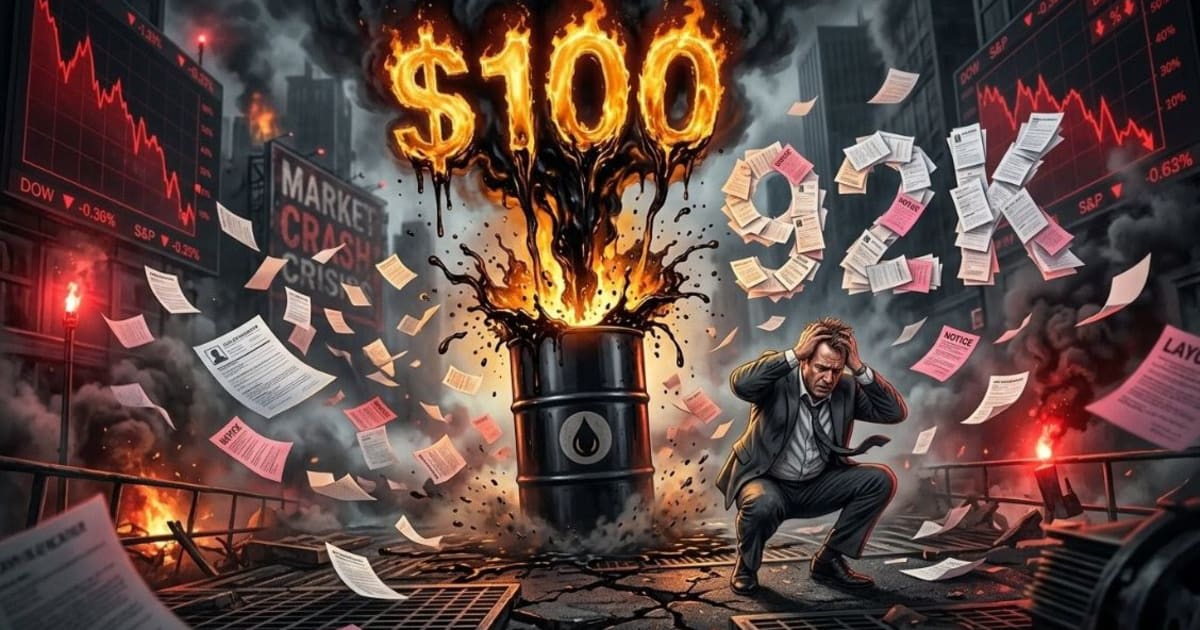
Oil crossed $100 a barrel last week. At the same moment, the U.S. economy was quietly hemorrhaging jobs — 92,000 of them gone in February alone, against a consensus forecast of a 50,000 gain. Two bad numbers arriving together is a coincidence. Two bad numbers that lock the Federal Reserve in a policy trap is something worse.

Stagflation is the word markets don't want to say out loud. It describes an economy where prices rise and growth stalls simultaneously — the worst of both worlds, because the standard toolkit breaks down. Cut interest rates to rescue growth, and you pour fuel on inflation. Raise rates to crush inflation, and you accelerate the recession you were trying to avoid. There is no clean move.

For the average American household spending around $5,500 a month, a sustained oil-driven inflation spike toward 3.5% — the projection Capital Economics puts on the table if $100 oil holds — translates to roughly $193 more drained from the monthly budget, with nothing additional to show for it. Not a raise. Not a better service. Just gone. The question now is whether this is a short shock to be absorbed, or the opening act of a longer, uglier story. The answer, as it almost always is, depends almost entirely on how long the Iran conflict runs.

The Core Problem

The mechanism here matters, because it is subtle and genuinely dangerous. Most economic slowdowns give policymakers room to maneuver. Demand falls, the Fed cuts rates, borrowing gets cheaper, businesses invest, workers get hired, and the cycle restarts. That logic held more or less reliably for four decades. Stagflation dismantles it entirely.

When a supply shock — like an oil spike — drives inflation higher while simultaneously crushing growth, the Fed faces what economists sometimes call its dual-mandate trap. Jerome Powell's institution is legally required to pursue both price stability and maximum employment. Right now, price stability demands restraint. Maximum employment demands stimulus. These two directives are pointing in opposite directions, and the Fed cannot satisfy both at once.

Core PCE inflation — the Fed's preferred measure — was sitting at 3.0% at the start of 2026, a full percentage point above the central bank's 2% target. The CPI print for February came in at 2.4%, unchanged from January and in line with expectations. Neither number is catastrophic in isolation. But the oil shock arrived on top of an economy already running hotter than the Fed wanted, not on top of one that had cooled back to target. That sequencing is important. The base was already flammable.

The job market tells a parallel story. February's loss of 92,000 positions wasn't a one-month aberration — it capped a full year of stagnant hiring. Total job growth for all of 2025 was just 116,000, which is roughly what the economy used to add in a single average month during its 2014–2019 expansion. The unemployment rate has now ticked up to 4.4%, not alarming by historical standards, but moving in the wrong direction at exactly the wrong time.

This is the core of the problem: the economy entered this oil shock already weakened. GDP growth estimates for late 2025 had already slipped to 1.4%. That is not recessionary territory, but it is uncomfortably thin — a number that offers almost no buffer against an external supply hit. Markets are pricing in this fragility. Bond yields have mostly risen through the Iran crisis, meaning investors are betting that the inflation dimension of this shock dominates in the near term. But market veteran Ed Yardeni warned this week that if bond yields start falling instead, it signals the growth scare has taken over — and at that point, as he put it, you are already in stagflation mode.

For UK readers watching transatlantic spillover, the picture is uncomfortable too. Oxford Economics and Deutsche Bank both flagged this week that if Brent crude holds near $100 or climbs toward $140, the UK faces a mild contraction — its economy is more energy-import-dependent than America's, and the pound has limited room to absorb additional pressure. A UK household on a fixed mortgage refinancing later this year into an environment where the Bank of England is frozen between inflation and growth has very little room for error.

Historical Parallel

The 1970s comparison gets deployed lazily, but the precise mechanics of 1973 are worth revisiting, because they reveal both why the parallel is compelling and where it genuinely breaks down.

In October 1973, OPEC imposed an oil embargo against the United States in response to American support for Israel during the Yom Kippur War. The price of oil quadrupled within a matter of months. The S&P 500 plummeted more than 40% as a recession coincided with the shock, and what followed was, by any measure, a lost decade for equity investors. Between 1973 and 1982, the S&P 500's inflation-adjusted annual return was approximately negative 2% per year — meaning a portfolio lost roughly a fifth of its purchasing power over that stretch. Gold, by contrast, delivered about 9% in real annual returns over the same period. The lesson from that era was brutal and clear: in a genuine stagflation environment, traditional 60/40 portfolios get punished from both ends simultaneously.

By the summer of 1980, U.S. inflation had climbed to 14.5% and unemployment was above 7.5%. The Fed's Misery Index — the simple sum of the two — was deep into double digits, and public confidence in economic management was near its lowest postwar point. It took Paul Volcker's deliberately engineered recession, with the Fed funds rate eventually pushed above 20%, to finally kill the inflation psychology that had embedded itself across the economy over a decade.

Today's Misery Index sits at roughly 7.3 — the sum of 4.4% unemployment and approximately 2.9% inflation. That is nowhere near 1970s territory. And that is precisely the distinction most serious economists are making right now. The structural preconditions for a decade of stagflation are missing. Inflation expectations remain anchored at levels that would have seemed unimaginably stable to a policymaker in 1978. The Fed's institutional credibility — the thing that Volcker had to reconstruct from scratch — is, for now, intact.

What is different in 2026 is also the nature of the supply shock itself. The 1973 OPEC embargo was a politically motivated act by sovereign producers acting in concert over a sustained period. The current disruption stems from the Strait of Hormuz being effectively blockaded amid U.S.-Israeli military operations against Iran — a geopolitical event that, by most forecasters' central scenario, resolves within weeks rather than years. If the Iran situation ends quickly, the supply shock fades. If it doesn't, the 1970s parallel gets meaningfully closer, not because the underlying inflation dynamics are identical, but because duration is everything in these episodes.

The Data Under the Hood

The numbers most coverage is glossing over tell a more granular — and more alarming — story than the headline oil price alone.

Start at the pump. Average U.S. gasoline prices hit $3.50 per gallon as of Monday, their highest level since 2024, according to the EIA. That figure is up 57 cents per gallon, or 19%, from just $2.94 on February 23 — a two-week move of an intensity that typically takes six months under normal supply conditions. For the average American household driving roughly 15,000 miles a year at 25 miles per gallon, that works out to 600 gallons consumed annually. At the current jump, that is $342 more per year just in gasoline, before a single other input price has moved. And they are moving. Diesel costs are feeding into food transport. Jet fuel cost inflation could surge to 20% in CPI terms by the second quarter, according to Capital Economics — an estimate that will make itself felt in airfares before the summer travel season.

The equity market is pricing fear, not yet catastrophe. The Nasdaq Composite suffered its worst single-day loss of 2026 on March 12, falling 1.78% to close around 22,343 — roughly 6.5% below its 2026 highs. The S&P 500 fell 1.52% the same session. These are not 2008-scale moves, but the composition of the selloff matters. Growth and technology stocks — long-duration assets whose present value is mechanically crushed by higher discount rates — bore the brunt. In a benign environment, a guidance miss from a mid-cap tech company might cause a 5–8% drop; in the current climate, the same miss is generating 15–20% single-session drawdowns. That amplification signals something structural in investor positioning, not just a temporary risk-off mood.

Bond markets are equally instructive. Yields have generally risen through the Iran crisis, which tells you markets are pricing an inflation shock rather than a growth collapse — for now. The moment that reversal happens, when yields fall because investors are fleeing to safety, is the moment the stagflation signal turns from amber to red. The VIX fear gauge was sitting at 26 as of this week — elevated, but not at crisis-level readings.

The Misery Index reading of 7.3 draws knowing glances from macroeconomists, but another figure deserves attention: the recession probability on Polymarket surged above 40% on Sunday, its highest reading since last autumn. Ed Yardeni, the founder of Yardeni Research, has raised his personal odds of 1970s-style stagflation to 35%. These are not fringe views. Morgan Stanley's chief investment officer of portfolio solutions put it plainly this week: a brief oil shock produces an inflation scare; a sustained one turns into a growth scare — and when both are happening at once, bond yields become the most important signal to watch in real time.

For UK investors and households, the spillover operates through two channels: energy import costs and sterling. The pound has limited room to absorb a sustained dollar-strengthening episode driven by safe-haven flows, and a weaker pound makes a $100 oil world even more expensive in domestic currency terms. A UK mortgage holder refinancing into this environment is navigating a Bank of England that is, functionally, as paralyzed as the Fed.

Two Sides of the Coin

The bull case is not nothing. In fact, it is the consensus view — just barely.

The United States is today the world's largest oil producer and a top exporter, a structural reality that did not exist in 1973 and changes the calculus fundamentally. An oil price spike that devastated the U.S. economy fifty years ago now delivers material benefits to American energy producers, upstream suppliers, and the communities built around them. The Permian Basin does not mind $100 oil. Domestic energy revenues flow back into the U.S. economy in ways they never did during the embargo era. Oxford Economics and Capital Economics both hold, as their central scenario, that the Iran conflict resolves within weeks and oil drifts back toward $60 by the third quarter of 2026 — roughly where prices were before hostilities began. In that scenario, the damage is real but manageable: a few tenths of a percentage point shaved from GDP, inflation nudging up temporarily before reversing, and the Fed sitting on its hands for an extra quarter before resuming its gradual easing path.

There is also the economy's sectoral composition to consider. Services represent approximately 78% of U.S. GDP. Services are less energy-intensive than manufacturing or heavy industry. The oil transmission mechanism into the broader economy is therefore weaker now than in the 1970s, when industry consumed a far larger share of every barrel produced.

The bear case, however, has sharper edges than the bulls are acknowledging. Duration is the killer variable — and prediction markets currently give a 48% probability that no ceasefire is reached by end of April. If oil holds at $100 or above for two months or more, Capital Economics projects CPI inflation rising to 3.5% by year-end. The Fed, already holding rates steady in a holding pattern, would face explicit pressure not just to delay cuts but potentially to consider a hike — a scenario Cleveland Fed President Beth Hammack has already publicly flagged as non-trivial.

There is a second layer to the bear case that is not getting enough attention. The 2026 oil shock is not arriving in isolation. The Trump administration's April 2025 tariff wave is still working its way through supply chains and consumer prices. These are two simultaneous supply shocks hitting an economy that was already running below trend growth. The interaction effect — tariff-driven cost-push inflation layered with oil-driven cost-push inflation — is not simply additive. It erodes business pricing confidence and consumer spending simultaneously. That combination is precisely what the 1970s most resembled at its worst: multiple overlapping supply constraints, each one manageable in isolation, collectively overwhelming the policy response.

Scenarios & What-Ifs

Three scenarios are worth mapping explicitly, because the range of outcomes here is genuinely wide — and the market moves associated with each are materially different.

Scenario one: short, sharp shock. This is the base case held by most forecasters. The Iran conflict resolves within four to six weeks, the Strait of Hormuz reopens to normal traffic, and oil gradually retreats toward $60 by Q3. In this scenario, the stagflation scare remains exactly that — a scare. Inflation gets a temporary bump, the Fed skips one rate cut, and equity markets recover. The cost to the average American household is real but finite: roughly an extra $300–400 in gasoline over a six-week period, plus a modest lift in food and travel prices. This is painful but not structurally damaging.

Scenario two: prolonged conflict at $100 oil. If hostilities drag on through May and June, with oil averaging $100 per barrel for two months or more, the picture changes. Capital Economics estimates CPI inflation at 3.5% by year-end under this scenario. Gasoline flirts with $5 per gallon in Q2. Mortgage rates, already back above 6%, climb further as bond markets price in a Fed that cannot cut. The average US household carrying a variable-rate debt load feels this immediately, and the housing market — already fragile — faces a meaningful spring season freeze. This is not the 1970s, but it rhymes uncomfortably.

Scenario three: escalation toward $140 oil. Oxford Economics ran the simulation. At $140 Brent for eight weeks, the UK and Eurozone tip into mild contraction, the U.S. edges toward a standstill, and layoffs push unemployment materially higher. At that point, the question is no longer whether stagflation is a risk — it has arrived. The Fed's dual mandate collapses into open contradiction, and the policy paralysis that is currently theoretical becomes operational. This remains a tail risk, not a forecast. But the 48% prediction-market probability of no April ceasefire suggests the tail is fatter than markets were pricing two weeks ago.

The oil shock that lit this conversation did not come from nowhere. It came from a geopolitical flashpoint that has been building for months. Whether it ends in weeks or stretches into summer will determine whether 2026 is remembered as the year stagflation was narrowly avoided — or the year policymakers discovered they had run out of room.

💰 What this means for your money: For the average US household, this means roughly $342 more per year in gasoline alone.

"The Fed can't cut to save growth without feeding inflation. That's not a dilemma. That's a trap."

The Bottom Line

The 1970s parallel is overdrawn — but only if the Iran conflict ends quickly, and 'quickly' is no longer the safe assumption it was ten days ago. The real threat isn't that stagflation has arrived; it's that the Fed is sitting on an economy with almost no buffer and almost no good options. The oil spike that rattled markets this week didn't create that fragility. It just exposed it.

Frequently Asked Questions

What is stagflation and why is it hard to fix?

Stagflation is when high inflation and slow economic growth occur simultaneously. It is uniquely difficult because the normal remedy for slow growth — cutting interest rates — makes inflation worse, while the normal remedy for inflation — raising rates — makes slow growth worse. The U.S. Misery Index, a rough combined measure, currently sits at about 7.3.

How does $100 oil affect my wallet right now?

Gasoline prices in the U.S. jumped 57 cents per gallon in just two weeks, from $2.94 to $3.50. For the average American driving 15,000 miles a year, that adds roughly $342 annually in fuel costs alone — and food and airfare are starting to follow as diesel and jet fuel prices climb.

What should I watch to know if this gets worse?

The clearest signals are whether U.S. 10-year Treasury yields start falling (that would mean markets are pricing a growth collapse, not just inflation), whether gasoline approaches $5 per gallon by Q2, and whether the Strait of Hormuz remains disrupted past April. A ceasefire announcement would be the single fastest relief valve for energy markets.