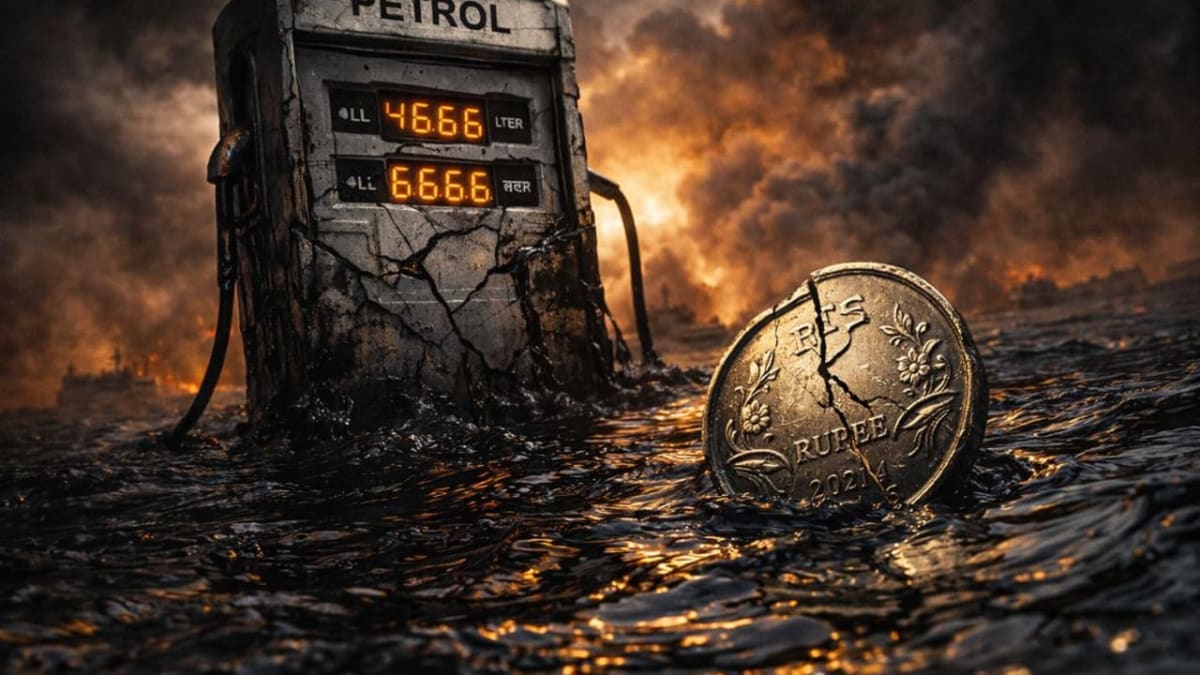
Petrol in Delhi is still ₹94.77 per litre. It was the same price in April 2022. While global crude has swung from $60 to $147 and back — and is now at $120 per barrel again — the number at India's fuel pumps has barely moved. That price stability is not an accident or a market outcome. It is a policy choice with a very specific cost. And as Brent crude breaches $120 per barrel for the first time since 2022, that cost is being absorbed somewhere in the financial system — spread silently across oil marketing company balance sheets, the rupee, the current account deficit, and ultimately the fiscal arithmetic that every Indian taxpayer sits behind.
The Core Problem
The core financial tension is this: India imports 88% of its crude oil requirements, per Ministry of Petroleum data, yet retail fuel prices have been effectively frozen since April 2022. State-run oil marketing companies — Indian Oil Corporation (IOCL), Bharat Petroleum (BPCL), and Hindustan Petroleum (HPCL) — are the financial shock absorbers in this arrangement. When crude rises sharply and retail prices do not, their marketing margins compress until they turn negative.
That compression is now severe. UBS, in a research note published on 10 March 2026, cut its FY27 and FY28 marketing margin estimates for Indian OMCs by 43–45% and 22–26% respectively, and slashed FY27 profit-after-tax forecasts by 19% for IOCL, 15% for BPCL, and a striking 46% for HPCL — the last figure sitting 48% below consensus. HPCL has been downgraded to 'Sell'.
The macroeconomic damage runs wider. ICRA chief economist Aditi Nayar, in a Business Standard note on 9 March, calculated that every $10 per barrel increase in average crude pushes India's net oil import bill up by $14–16 billion annually, adds 30–40 basis points to the current account deficit as a share of GDP, and raises WPI inflation by 80–100 basis points. At $120 per barrel sustained through FY27, DSP Mutual Fund estimates India's oil trade deficit could reach $220 billion — pushing the current account deficit beyond 3% of GDP for the first time since 2013.
The rupee is already signalling distress. On 9 March, the USD/INR rate touched ₹92.33 — a record low — compared to ₹79 during the 2022 oil shock, per UBS data. A weaker currency makes every barrel of imported crude more expensive in rupee terms. The freeze protects the consumer. The question is for how long.
Historical Parallel
India has navigated this exact dilemma before, and the 2022 Russia-Ukraine oil shock is the most instructive precedent. Brent crude surged from roughly $80 per barrel in January 2022 to above $130 per barrel by March 2022. Retail petrol and diesel prices in India were held for months through state election season, with OMCs silently accumulating under-recoveries. When the government finally moved, it raised petrol by ₹10 per litre and diesel by ₹7 per litre in a single day in May 2022 — and immediately cut central excise duty by ₹8 per litre on petrol and ₹6 per litre on diesel to soften the blow, at an estimated annual revenue cost of ₹1 lakh crore to the Treasury.
The outcome? Inflation peaked at 7.79% in April 2022, per RBI data. The current account deficit widened to 3.7% of GDP in Q2 FY23. The rupee depreciated past ₹82 per dollar. ONGC and Oil India benefited from upstream realisations, but OMC stocks fell sharply as marketing margin losses crystallised.
The parallel today is sharper in several ways. The Indian basket crude was $60.56 per barrel as recently as 2 January 2026, per PPAC data. Finance Minister Nirmala Sitharaman confirmed in Lok Sabha on 9 March that it rose to $80.16 per barrel by 2 March — and MCX crude oil futures hit an all-time high in rupee terms of ₹10,119 per barrel. The starting point is worse than 2022. The policy options are narrower. And the rupee enters this shock at ₹92.33, not ₹79.
The Data Under the Hood
The numbers from the past ten days construct an alarming financial picture across multiple dimensions.
Crude: Brent crude surged more than 25% intraday on the first Monday of the conflict, touching $116 per barrel for the April 2026 futures contract, per Business Standard. Government sources cited by BusinessToday confirm the current level near $120 per barrel. MCX crude futures hit ₹10,119 per barrel — an all-time high in rupee terms, per Business Upturn data from 9 March.
OMC stocks and margins: UBS cut HPCL's target price from ₹540 to ₹340 — a 37% markdown. IOCL's target was cut from ₹190 to ₹175, BPCL from ₹425 to ₹365. OMC stocks had already fallen 5–13% in the month before the downgrade, per UBS data, yet the brokerage argued the market was still not pricing in the full earnings damage. BSE oil & gas index fell nearly 3% in a single intraday session on 9 March.
Current account: ICRA's quantification is stark — at $110–115 per barrel average in FY27, India's net oil import bill rises by $56–64 billion. India imported 206 MT of crude worth $100 billion through January 2026, per Business Standard, when Brent averaged $66 per barrel. At $120, the annualised cost difference is enormous. Emkay Global puts it more precisely: every $10 per barrel rise causes a 0.5% widening of CAD as a share of GDP.
LPG — the crack in the freeze narrative: The government has not held all prices. Domestic LPG cylinders (14.2 kg) rose ₹60 on 7 March 2026, per Business Upturn data. Commercial 19-kg cylinders rose ₹115, taking the Delhi price to approximately ₹1,883. The government confirmed it has issued orders to refineries to increase LPG production to compensate for supply constraints — a direct acknowledgment that the energy market is under stress. The petrol and diesel freeze is holding. LPG has already cracked. That sequence matters for what comes next.
Inflation headroom: Finance Minister Sitharaman told Lok Sabha on 9 March that January 2026 headline CPI stood at 2.75% — near the lower bound of the RBI's 4% ±2% target band. Average CPI for April–January FY26 was 1.8%, per the Finance Ministry. That low base is the government's primary justification for absorbing the oil shock without retail price transmission. The RBI's own October 2025 Monetary Policy Report estimated that a 10% crude price rise, with full pass-through, pushes inflation up by only 30 basis points. The government is using that cushion as cover for holding prices. The question is whether the cushion survives a $120 crude environment.
Two Sides of the Coin
The case for holding prices — the government's position — rests on three genuine financial pillars. First, India's CPI inflation at 1.8% for April–January FY26 provides real room to absorb a crude shock without breaching the RBI's 4% target even if some pass-through occurs. Second, India has diversified its crude import sourcing: government sources on 7 March confirmed that the share of crude arriving via non-Hormuz routes has increased from 60% to 70%, providing a partial supply buffer. Third, India holds approximately 250 million barrels of oil reserves — roughly 7–8 weeks of buffer stock, per Sarkaritel data from 7 March — meaning the physical supply is not immediately threatened. ONGC and Oil India, meanwhile, see direct earnings benefits from higher crude realisations, partially offsetting national-level pain.
The bear case, however, is where the financial weight sits. UBS has already cut OMC marketing margin forecasts by 43–45% for FY27. HPCL's PAT estimate for FY27 is down 46% — 48% below market consensus. The rupee at ₹92.33, compared to ₹79 during the 2022 shock, means every barrel of crude costs materially more in domestic currency terms today. Emkay Global's model shows the crude spike will hurt corporate margins across petrochemicals, paints, aviation, and specialty chemicals — sectors that link 30% of production costs to crude prices, per Business Standard, with limited ability to pass on costs. The fiscal mathematics are uncomfortable: if OMCs continue to absorb losses, a government bailout — as happened in 2022 — adds directly to the fiscal deficit. And the LPG price hike on 7 March shows the freeze is already selective, not absolute.
Scenarios & What-Ifs
Three financial paths diverge from here, each with materially different outcomes for India's macro and equity markets.
First, rapid de-escalation within 2–4 weeks — the scenario that Trump's 10 March statements gesture toward: Brent retreats toward $80–85 per barrel. OMC marketing margins stabilise. The rupee recovers toward ₹88–89. The RBI proceeds with rate cuts already pencilled in for FY27, supporting equity valuations. CAD stays within 2% of GDP. IOCL, BPCL, and HPCL stocks recover from their downgrade-driven lows. This is the base case that current government communication is implicitly pricing in.
Second, conflict persists through Q2 2026 at $100–115 per barrel: India's oil import bill increases by $40–55 billion annually, per ICRA's $10-per-barrel formula. The RBI pauses rate cuts to manage imported inflation. The rupee slides further, potentially past ₹94. Crisil, which had forecast CPI at 4.3% for FY27 even pre-conflict, revises that higher. A partial excise duty cut becomes the most likely government response — costing ₹70,000–1,00,000 crore in revenue, similar to 2022.
Third, sustained $120-plus crude through FY27: DSP Mutual Fund's scenario plays out — oil trade deficit crosses $220 billion, CAD breaches 3% of GDP, the rupee faces sustained pressure, and a forced fuel price hike before state elections becomes unavoidable. This is the tail risk. But the distance between scenario two and three is smaller than the market is currently pricing, with MCX crude already at a rupee all-time high.
The Bottom Line
The petrol price freeze is real — Delhi is still at ₹94.77 today — but it's not free. The cost is sitting on IOCL/BPCL/HPCL balance sheets (marketing margins down 43–45% per UBS), on the rupee (₹92.33 and counting), and quietly on the fiscal deficit if crude stays elevated long enough to force a government bailout. LPG already cracked on March 7. Petrol is next if Brent holds above $100 for another 4–6 weeks. Watch the Hormuz shipping data — that's the actual variable driving everything.