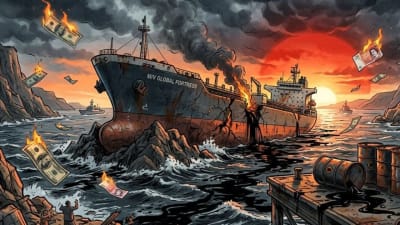
Picture a 21-mile-wide bottleneck — barely wider than the English Channel at its narrowest — and imagine that roughly 90% of the cooking gas for 332 million Indian households flows through it every single month. That is the Strait of Hormuz. And since hostilities in the Middle East effectively closed that corridor on February 28, India has been running a quiet emergency behind a very loud reassurance campaign. The government's latest offer — a 10% bump in commercial LPG allocation to any state that accelerates its piped natural gas rollout — sounds, on paper, like exactly the kind of incentive-driven policy that economists love. Reward good behaviour. Redirect demand. Buy time. But here's what that headline number doesn't tell you: the commercial sector has already been hammered down to just 20% of its normal monthly supply. A 10% increment on a figure that small is not relief. It is arithmetic dressed as action. For UK and US investors watching energy markets — and the broader India equity story — this crisis is more than a domestic inconvenience. It is a live stress test of one of the world's most import-dependent energy economies.
The Shift
The trigger was sharp and fast. When Middle East hostilities escalated at the end of February, tankers carrying LPG through the Strait of Hormuz stopped moving. Suppliers invoked force majeure. India, which imports roughly 60% of its total LPG needs and sources 85–90% of those imports from the Gulf, suddenly found itself staring at a supply structure that had never been seriously stress-tested. The government moved quickly — to its credit. On March 9, the Ministry of Petroleum and Natural Gas issued the Natural Gas Supply Regulation Order 2026 under the Essential Commodities Act, establishing a hard priority queue. Domestic PNG connections and hospitals get 100% allocation. Refineries dropped to 80% of their six-month average. Petrochemical facilities — think ONGC Petro additions, GAIL's Pata complex, Reliance's oil-to-chemicals operations — fell to 70%. Everyone else landed at 65%. Then came the commercial hammer: on March 12, Petroleum Minister Hardeep Singh Puri announced in the Lok Sabha that commercial LPG supply would be capped at just 20% of the average monthly requirement. That is an 80% cut. For context, a 14.2kg domestic cylinder in New Delhi now costs ₹913 — up ₹60 since March 7 — while a 19kg commercial cylinder jumped ₹115 in the same move. For a street-food vendor running three burners, that extra cost on an already rationed supply can mean the difference between opening and shutting. Around 100 million migrant workers in India's cities depend on low-cost neighbourhood dhabas for their daily meals. When those dhabas run short on gas, the knock-on to household food security is real and fast. On global markets, India's scramble to reroute LPG tankers around the Cape of Good Hope — a detour that adds weeks and significant freight cost to every cargo — is already nudging shipping rates upward on routes that UK and US commodity desks watch closely.
What Everyone Thinks
The official narrative is holding, just about. The shipping ministry insists there is no port congestion. Supply is 'stable'. Consumers are urged not to panic-book. The government points — correctly — to genuine diversification moves: a 2.2 million tonne-per-annum LPG deal with the US signed earlier this year, sourcing ramp-ups from Norway, Canada, and Russia, and domestic LPG production increased by somewhere between 25% and 30% through emergency refinery diversion. States like Gujarat have ramped up weekly distribution by 20%, deployed revenue officials and police at gas agencies, and converted 3,504 new PNG connections since March 1 alone. The consensus reading among most Indian market commentators is that the crisis is serious but manageable — a temporary shock to a system that was already building resilience. That view has a factual basis. India's crude import sources have expanded from 27 countries in 2006–07 to 40 today. The 10% commercial LPG incentive for states that push PNG is read, broadly, as a sensible structural nudge. And the mandatory surrender of LPG connections by existing PNG households — enforced by a March 14 amendment to the LPG Regulation Order — does free up real cylinder volume for those without grid access. For the average UK investor with exposure to Indian energy or consumer stocks, that consensus says: temporary disruption, policy response adequate, move along. The problem is that the maths underneath that consensus is quietly terrifying.
The Contrarian Take
Here is the number that does not fit the reassuring story. India's total normal LPG supply — domestic production plus imports — can be roughly indexed at 100. The Strait of Hormuz corridor carries approximately 54 of those units. Emergency domestic production increases raise the domestic share to about 50 from 40. Non-Hormuz imports account for roughly 6 units. That leaves India running at around 56% of normal availability before alternative import cargoes arrive and before demand compression fully kicks in. That is not a gap. That is a chasm. The 10% commercial allocation incentive — offered to states willing to accelerate PNG rollout — sounds like structural policy. In practice, converting a household to PNG requires laying physical pipelines, installing regulators, completing safety certifications, and integrating into city gas distribution networks. That process takes months at minimum, years at scale. India's PNG network, while growing, covers a fraction of the country. As of now, the PNGRB has directed city gas distributors to prioritise PNG connections in areas where pipeline infrastructure is already laid — which means the 10% incentive mostly helps cities that were already ahead. Rural and semi-urban households, who are also the most financially exposed, get very little of this benefit. For US and UK investors, here is the comparable stress: imagine the UK government offering a 10% discount on heat pump installations to ease a gas shortage, when 70% of homes have no access to the heat pump grid. The direction is right. The timescale is wrong. There's a version of this policy story where it ends well — but only if the crisis lasts long enough for the infrastructure to catch up, which is precisely the outcome no one wants.
The Uncomfortable Math
The government is not wrong to push piped gas. PNG is structurally better — safer, cleaner, harder to hoard or black-market. The Essential Commodities Act enforcement, the mandatory LPG-PNG double-dipping ban, the deployment of police at gas agencies: these are rational emergency measures. The discomfort sits in the timeline mismatch. The Strait of Hormuz disruption is a today problem. PNG is a three-to-five year solution being marketed as a bridge. Between those two points sits a population of 332 million active LPG connections — and a sub-population of 104 million Pradhan Mantri Ujjwala Yojana connections, the government's flagship scheme that gave free gas cylinders to rural poor households who had previously cooked on firewood. Those are the households least likely to be near a PNG grid. They are also the households with the least financial cushion to absorb the ₹60 per cylinder price hike — which, on a monthly basis, could represent as much as 4–5% of a low-income family's food budget. In dollar terms that foreign investors can feel: the LPG price hike is roughly equivalent to a $0.70 increase on a cylinder that was already the primary cooking source for families earning under $200 a month. India's government is absorbing part of that through subsidy continuation under the PAHAL scheme, but the subsidy mechanism does not fully offset black-market premiums in areas where supply has dried up. On equity markets, the pressure is landing unevenly: GAIL, which manages gas diversion and pooling under the new order, faces margin compression as it absorbs rerouting costs. Petrochemical companies running at 70% gas allocation face output hits that will show up in Q1 earnings. The companies you might expect to benefit — city gas distributors rolling out PNG connections faster — face installation bottlenecks that cap any near-term revenue upside.
Where This Actually Goes
The question is not whether India weathers this crisis. It probably will, through a combination of alternative import routes, demand compression, and the slow but real expansion of PNG coverage. The question is what price it pays — in rupees, in political capital, and in the structural vulnerabilities that this shock has exposed for anyone watching from outside. India's energy import dependence is not a new story. But the Strait of Hormuz disruption has made it a live, priced-in risk in a way that boardroom presentations about 'diversification strategy' never quite managed. For UK and US portfolio managers with India exposure, this is the number to watch: freight costs on the Cape of Good Hope LPG reroute are running significantly above normal, adding a persistent cost layer to every alternative cargo India pulls in. If the Hormuz corridor stays closed through the second quarter, those costs stop being a crisis charge and start being a structural margin drag on the entire Indian economy. The government opened this story by promising stability. Whether that promise holds — or whether the 10% PNG incentive is remembered as a sensible first step or a symbolic gesture — depends entirely on a geopolitical situation that New Delhi cannot control.
💰 What this means for your money: For low-income Indian families under $200/month, the ₹60 cylinder hike takes 4–5% of their food budget.
"A 10% increment on a supply that has already been cut 80% is not relief. It is arithmetic dressed as action."
The Bottom Line
India's government is doing the right things — they're just doing tomorrow's things to solve today's problem. The PNG push is correct in direction, wrong in timescale, and the 332 million households caught in the middle don't have the luxury of waiting for pipelines to be laid. Watch GAIL margins and Cape reroute freight costs — those two numbers will tell you more about how this ends than any ministerial press conference.
Frequently Asked Questions
Why is there an LPG shortage in India in 2026?
Conflict in the Middle East has disrupted shipping through the Strait of Hormuz since late February 2026. Around 90% of India's LPG imports normally pass through this 21-mile-wide corridor. With tankers halted and suppliers invoking force majeure, India is running roughly 56% of normal LPG availability before emergency imports and demand cuts are factored in.
How does India's LPG crisis affect my money or investments?
For Indian consumers, a 14.2kg domestic cylinder now costs ₹913 — up ₹60 since March 7. For UK and US investors with India exposure, companies like GAIL face margin pressure from rerouting costs, petrochemical firms are running at 70% gas allocation, and city gas distributors face pipeline installation bottlenecks that limit any near-term revenue benefit from the PNG push.
What should I watch to know if India's LPG crisis is getting better or worse?
Three signals matter: freight rates on the Cape of Good Hope LPG route (a sustained spike signals a prolonged crisis), weekly PPAC gas allocation data from GAIL (shows whether the supply gap is narrowing), and the pace of PNG connection approvals from PNGRB. If Hormuz remains blocked past April, the crisis shifts from temporary to structural.