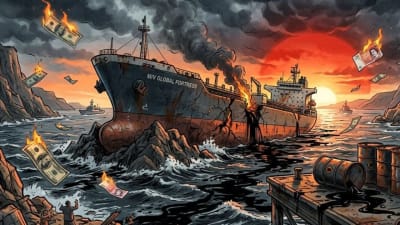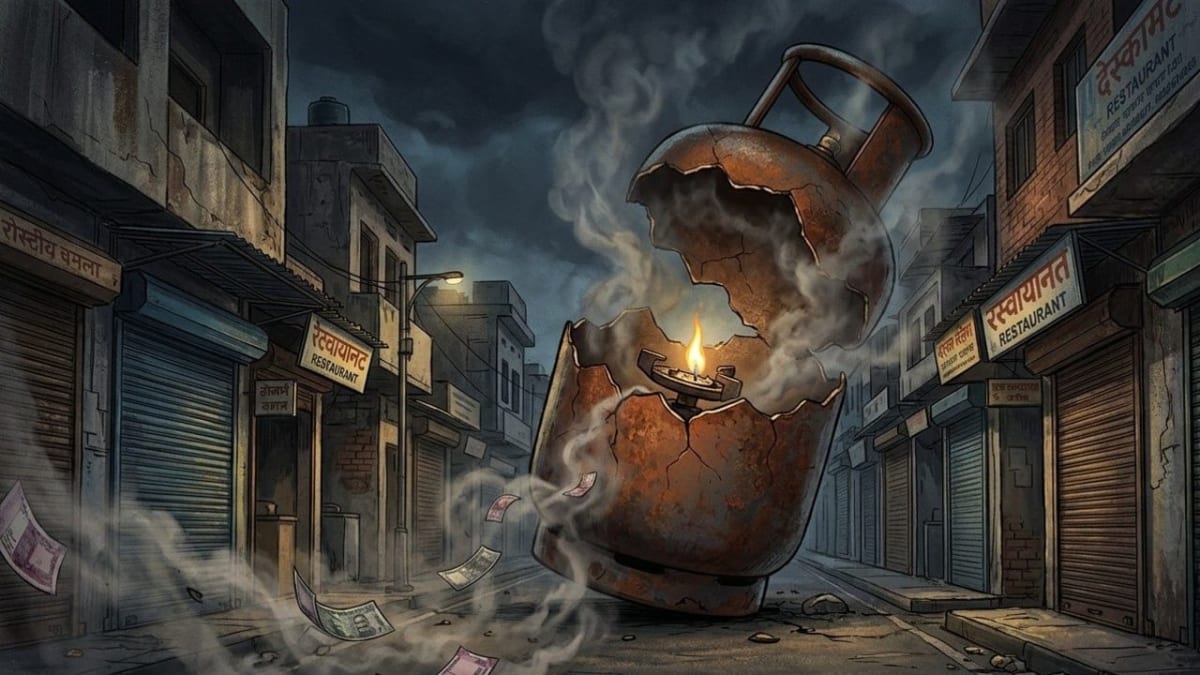
On March 7, 2026, a 14.2-kg domestic LPG cylinder in Delhi cost ₹853. By March 11, it costs ₹913—a ₹60 hike enacted overnight, the first price revision since April 2025, per the Ministry of Petroleum and Natural Gas. Commercial cylinders absorbed a ₹115 jump in the same period. These numbers are not abstract inflation statistics. They represent the threshold at which India's 500,000 restaurants, employing over 8 million people and generating ₹5.7 trillion in annual turnover per NRAI data, started making an impossible choice: keep buying gas at any price, or close the kitchen. From Coimbatore's iconic Annapoorna Hotel—cutting its menu for the first time in 50 years—to Hyderabad's 74,000 eateries warning of shutdowns within 48 hours, a financial shock originating in the Strait of Hormuz has landed squarely on India's dining tables.
The Core Problem
India's structural LPG vulnerability is simple to state and expensive to fix. The country consumes approximately 31.3 million metric tonnes of LPG annually, per an S&P Global report published March 10, 2026. Of that total, roughly 62–65% is imported, the majority sourced from Gulf nations—Saudi Arabia, Qatar, the UAE, and Kuwait—that route their cargoes directly through the Strait of Hormuz. Per Onmanorama's reporting, India receives 85–90% of its LPG imports via this single maritime corridor. The Hormuz closure, triggered by Iranian retaliation against US-Israeli strikes, has not merely tightened supply. It has severed it.
The government's response amplified the commercial crisis rather than resolving it. On March 7, the Ministry of Petroleum and Natural Gas directed public sector oil marketing companies—Indian Oil Corporation, BPCL, and HPCL—to prioritise domestic household cylinder supply over all commercial users. Non-domestic LPG, the category that powers every commercial kitchen in India, was effectively suspended without a formal replacement mechanism in place. Distributors across Punjab, Maharashtra, Karnataka, Tamil Nadu, and Telangana began turning away restaurant owners with a simple message: no stock available.
The financial stakes are immediate and quantifiable. The NRAI, which represents over 500,000 restaurants, called the situation a potential 'catastrophic closure' in its March 9 letter to Petroleum Minister Hardeep Puri, per Business Standard. The restaurant industry ranks as the third-largest services sector in India—behind only retail and insurance—with ₹5.7 trillion in annual turnover and direct employment for over 8 million workers. The NRAI's president told CNBC on March 10 that 90% of restaurants across India run entirely on LPG cylinders. There is no viable short-term alternative fuel source for most operators, especially the small and medium establishments that dominate the sector's employment base.
Historical Parallel
India has been here before—not with this severity, but with the same structural dynamic. Between 2012 and 2014, the UPA government struggled to contain LPG subsidy costs as crude oil prices remained elevated above $100 per barrel. The government imposed a cap of six subsidised cylinders per household per year in September 2012, triggering significant political backlash and public disruption. The cap was later revised upward to nine and eventually twelve cylinders. The economic cost of that period was not production shutdowns—it was fiscal erosion. The Centre's LPG subsidy bill peaked at approximately ₹44,000 crore in FY2013–14, a burden that contributed to India's fiscal deficit widening to 4.9% of GDP in the same year, per Ministry of Finance data.
The more direct international parallel is the 1973 Arab oil embargo, when Gulf nations cut petroleum exports and triggered cascading energy shortages across consumer economies. In the United States, restaurants in several states began rationing cooking fuel. In Japan, which imported nearly 80% of its energy from the Middle East at the time, the government invoked emergency supply controls and prioritised household energy over industrial users—the exact policy mirror of what India's petroleum ministry executed on March 7, 2026.
What separates 2026 from those precedents is the speed of transmission. In 1973, the supply shock took weeks to reach kitchen-level operations. Today, with just-in-time LPG delivery logistics—most small Indian restaurants hold less than 48 hours of fuel reserve, per Tribune India reporting—a maritime disruption converts into a commercial shutdown within days, not months. The financial damage accumulates at the same accelerated pace.
The Data Under the Hood
The financial exposure embedded in India's LPG supply chain is layered across multiple dimensions, and each layer compounds the others.
Starting with import geography: India's LPG import dependence rose from 49% in FY2016–17 to 64% by FY2022–23, per J.M. Baxi shipping data—a 15-percentage-point structural deterioration over six years driven by domestic consumption growing 32% while local production grew only 14%. By March 2026, that figure stabilised near 62–65%, per Business Standard and Outlook India reporting. Of that imported volume, approximately 85–90% transits through Hormuz, per Onmanorama. In simple terms: if Hormuz remains closed, India must replace roughly 53–58% of its total LPG consumption from alternative sources, on short notice, using longer shipping lanes.
On the timeline mismatch: Gulf cargoes reach Indian ports in 7–8 days. US LPG cargoes take approximately 45 days. Brazil or Guyana shipments require 25–45 days, per Business Standard's March 10 supply chain analysis. India signed contracts for 2.2 million tonnes per annum of US LPG in February 2026—roughly 10% of total imports—but those cargoes cannot bridge an immediate gap. The government has turned to ADNOC of the UAE and Algeria's Sonatrach for emergency alternative supply, per a senior government source quoted by Moneycontrol, but delivery timelines remain unclear.
On the price escalation already underway: domestic 14.2-kg cylinders jumped ₹60 to ₹913 in Delhi as of March 7, per MoPNG data. Commercial 19-kg cylinders absorbed a ₹115 hike in the same round. For a mid-size restaurant burning three to five 19-kg cylinders daily, this translates to an operating cost increase of ₹3,000–₹5,000 per month at the new price—before factoring in the additional cost of black-market purchases, which were being reported in Chandigarh per Outlook India as formal supply collapsed entirely.
The IRCTC's directive to its catering units—instructing them to switch to microwave and induction cooking—signals that even government-run food service is repricing its entire infrastructure calculus in real time, per BusinessToday reporting.
Two Sides of the Coin
The bull case for rapid sector recovery rests on one powerful variable: the disruption may be short-lived, and the government's intervention has been faster and more decisive than in prior energy crises. PM Modi's direct intervention on March 10—his statement that 'war should not impact the common man', per WorthvieW—coupled with the invocation of the Essential Commodities Act 1955, the formation of a three-executive-director OMC panel to manage commercial allocations, and active engagement with ADNOC and Sonatrach for alternative supply, suggests a government treating this as an emergency, not a policy discussion. India also holds a strategic petroleum reserve of 5.33 million metric tonnes at Visakhapatnam, Mangaluru, and Padur, per Policy Circle. If Hormuz reopens within two to three weeks, existing domestic refinery output—now being maximised by curtailing petrochemical streams, per MoPNG—combined with emergency imports could restore commercial LPG supply before permanent closures materialise.
The bear case carries considerably more financial weight. It starts with a brutal geography fact: 85–90% of India's LPG import corridor runs through a strait that is currently closed, and the fastest alternative supply source takes 45 days to arrive. Small restaurants—the ones that employ most of those 8 million workers—carry less than 48 hours of LPG inventory, per Tribune India. They cannot survive a two-week supply gap by switching fuels or accessing credit lines. Black markets are already forming in Chandigarh and Delhi, per Outlook India, which historically signals that formal rationing systems are failing. The political risk is also asymmetric: five state elections are due in the first half of 2026, per CNBC, and the price of cooking gas is, in the words of CNBC's own reporting, 'a hotly debated issue during elections.' Any extended commercial shutdown rolls directly into voter sentiment in Tamil Nadu, West Bengal, and Kerala.
Scenarios & What-Ifs
Three scenarios now define the financial trajectory of India's LPG and hospitality sectors over the next 30 days.
Scenario one—highest near-term probability: Hormuz reopens within two weeks following US-Iran negotiations. ADNOC and Sonatrach emergency cargoes bridge the gap. The MoPNG panel begins restoring commercial LPG allocations by March 15–18. Restaurants absorb a 10–15 day disruption, losing roughly ₹1,500–2,500 crore in collective revenue based on a pro-rata share of the sector's ₹5.7 trillion annual turnover. Small operators draw down savings or access emergency credit. Permanent closures remain below 5% of the sector.
Scenario two—moderate probability: The conflict continues for four to six weeks with partial Hormuz access. Alternative LPG supply from the US and Africa arrives in late April. Commercial LPG rationing continues through most of March. Between 15–25% of small restaurants—primarily those with no alternative fuel access and minimal cash reserves—permanently close or suspend operations. The hospitality sector GDP contribution contracts meaningfully in Q4 FY26.
Scenario three—lower probability but high consequence: A two-month-plus Hormuz closure combined with Iraq and Kuwait supply disruptions keeps India's import coverage at 30–40% of normal. Mass restaurant closures occur across Tamil Nadu, Telangana, Karnataka, and Maharashtra. The government faces intense pressure to expand subsidies to commercial users, adding ₹8,000–12,000 crore in unanticipated fiscal outflow. The political cost of inaction in an election year becomes the forcing function for an emergency policy response that should have come sooner.
The Bottom Line
India just discovered that 62% import dependence from a single maritime corridor is not a supply chain statistic—it's a vulnerability, and it's materialising in real time. The restaurant sector has about 48 hours of buffer in most cities, the government is scrambling, and alternative supply is 45 days away by ship. Watch the MoPNG's commercial LPG allocation announcements and any Hormuz de-escalation signals—those two data points will determine whether this is a two-week revenue hit or a structural shock that reshapes how India prices food-service energy for the next decade.