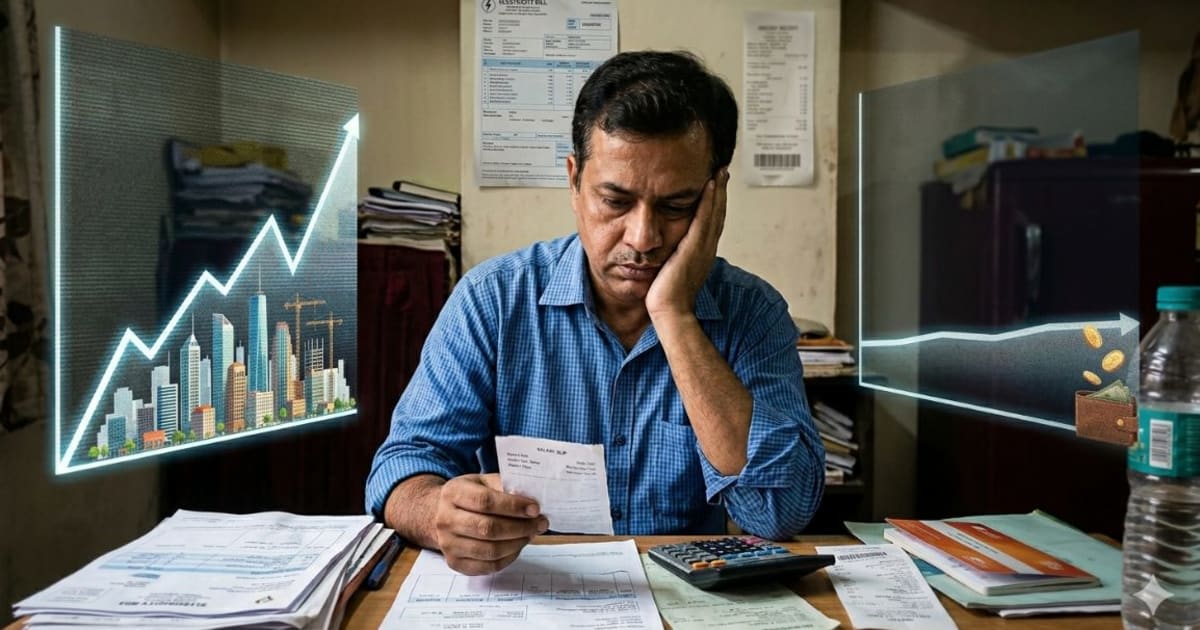
The Number They're Celebrating — And the One They're Not
Seven percent. That's the number S. Mahendra Dev, chairman of the Economic Advisory Council to the Prime Minister, wants you to feel good about. India's GDP, he says, will grow at 7% in FY27, driven by domestic demand and a revival in investment activity. He also pointed to the narrowing of India's trade deficit to $20.67 billion in March as evidence of the economy's resilience — proof, we're told, that India is weathering the West Asia war without breaking stride.
On the surface, that sounds like a story worth celebrating. India is one of the fastest-growing large economies in the world right now. The IMF agrees. The World Bank largely agrees. And the domestic data — from GST collections to PMI readings — does support the broad narrative that the economy is holding up better than expected.
But here is the question no one in North Block seems to be asking: if the economy is growing at 7%, why does your household budget feel tighter than it did two years ago?
That's not a rhetorical trick. It's a structural reality. India's GDP growth is real, but it is not being distributed evenly across income groups, asset classes, or economic sectors. And for India's salaried middle class — roughly 5–6 crore formal-sector workers who file income tax returns, run monthly SIPs, carry home loan EMIs, and pay school fees that rise 10% every year — the gap between the GDP headline and lived financial experience is wide, persistent, and worth understanding before you make your next financial move.
The 7% number is not a lie. But it may be the most selectively told truth of FY27.
GDP Grows Up. Wages Crawl Along.
India's growth story, at its core, is an investment and capex story right now — not a broad-based consumption boom. When the EAC-PM says domestic demand is driving growth, he's correct. But 'domestic demand' in macro-economics includes government spending on roads, bridges, and defence equipment. It includes the real estate transactions of upper-income urban households. It includes the capex decisions of large Indian corporates flush with improved balance sheets. It does not specifically mean your purchasing power has improved.
Here is what's actually driving the 7% projection in concrete terms:
- Government capital expenditure: The Union Budget for FY26 allocated ₹11.11 lakh crore for capex — the highest ever. FY27 is expected to maintain or exceed that. Roads, railways, ports, defence — all of it counts in GDP.
- Private investment revival: After years of under-investment, some large Indian corporates are finally expanding capacity. This shows up in credit growth numbers and order books of capital goods companies.
- Services exports: India's IT sector, GCCs, and financial services exports continue to grow. But these benefit a relatively narrow band of highly skilled, urban workers — not the median salaried employee.
- Urban consumption: Upper-middle and affluent households are spending — on travel, premium goods, lifestyle. This lifts consumption numbers but doesn't capture what's happening for the ₹30,000–₹70,000 per month income bracket.
Meanwhile, wage growth across the formal private sector has been averaging 8–9% nominally. That sounds reasonable — until you strip out 4–5% consumer inflation and account for the silent tax of bracket creep, where modest nominal pay hikes push you into a higher income tax slab without making you meaningfully richer. Your real wage gain, after inflation and taxes, is closer to 3–4% per year.
The economy grows at 7%. You grow at 3–4%. The difference — that 3–4 percentage point gap — flows somewhere. Into corporate profits. Into asset price appreciation. Into the balance sheets of the people who own the land, factories, and infrastructure that government capex is paying for. This isn't a conspiracy. It's just how capex-led growth distributes its gains. And if you're not positioned to capture the asset-side returns, you'll feel like you're watching a prosperity story from the outside.
What the Trade Deficit Data Is Really Saying
The narrowing of India's merchandise trade deficit to $20.67 billion in March — down from elevated levels earlier in FY26 — has been presented as a resilience signal. And to be fair, it partly is. A shrinking deficit in the middle of a West Asia conflict, with oil supply chains under pressure, does indicate that India's economy has absorbed external shocks better than expected.
But any time a trade deficit narrows, you need to ask why. Because not all narrowing is created equal.
| Reason for narrowing | What it signals | Net verdict |
|---|---|---|
| Exports rising fast | Indian goods gaining global market share | Strongly positive — jobs and forex |
| Oil import bill falling | Crude prices softening, fiscal relief | Conditionally positive |
| Non-oil, non-gold imports slowing | Industrial input demand cooling | Mixed — may signal investment slowdown |
| Gold imports moderating | Domestic demand caution setting in | Neutral to slightly negative |
In March, the picture was a mix of all four. But the component that analysts are watching most closely is non-oil, non-gold imports — because that category tracks the raw materials, machinery, and industrial inputs that factories order when they're ramping up production. When that number cools, it sometimes means the investment revival that policymakers are counting on hasn't yet translated into actual factory-floor activity.
In plain language: the trade deficit narrowed partly because imports slowed, and import slowdowns can reflect caution as much as efficiency. The government's capex is flowing, but private sector investment — the kind that creates jobs and raises wage bills — is still building momentum, not yet at full stride.
For you as an investor, this distinction matters directly. Government-capex-led growth has a very specific set of sectoral winners. Private-consumption-led growth has a different set entirely. Your SIP's actual performance in FY27 will depend far more on which growth engine is running hotter — and right now, the government is doing more heavy lifting than it typically would in a healthy, broad-based growth cycle.
Bottom line for your wallet: For a ₹60K/month household: ~₹1,500–₹2,200 extra monthly headroom in FY27
Follow the Money: Who Is Actually Winning the 7% Economy
This is where the investigator's instinct pays off. When an economy's growth is concentrated in government capex and infrastructure buildout, the benefits flow to a very specific set of players — and most of them are not the salaried professionals reading economic forecasts over morning chai.
The clear winners in India's FY27 growth story:
- EPC and infrastructure contractors: Companies executing highway, metro, port, and defence projects are sitting on multi-year order books. Their revenue and margins are locked in. The government's ₹11 lakh crore+ capex commitment is their guaranteed income stream.
- PSU banks: They're funding the capex cycle, collecting government deposits, and benefiting from improving asset quality. Net interest margins are holding up. The credit growth story is real for them.
- Real estate developers in Tier 1 and Tier 2 cities: Urban housing demand — particularly in the ₹80 lakh to ₹2 crore segment — has been sticky. Government infrastructure investment makes land around new corridors and transit hubs more valuable, and developers are the ones who own that land.
- Defence sector PSUs and their supply chains: The indigenisation push, rising defence budgets, and long-cycle order visibility make this sector a multi-year beneficiary that most retail SIP investors are underweight on.
- Promoters of listed capital-heavy companies: Rising asset valuations — driven partly by infrastructure investment — improve the net worth of those who own the underlying assets. Promoter wealth grows faster than employee salaries in a capex cycle. Every time.
Who gets the smaller slice:
- Salaried employees in the non-tech private sector: Wage growth is moderate, employer caution is high, and the labour market in mid-level white-collar roles is not particularly tight. You don't have pricing power over your employer right now.
- Gig and platform economy workers: No direct transmission from government capex to their earnings. They're exposed to consumer wallet constraints, and food and fuel inflation hits their cost base hard.
- Fixed-income-dependent households: If RBI cuts rates further to support growth — which is the direction the cycle is heading — FD yields shrink. Senior citizens and conservative investors on fixed deposits feel this acutely. A 50 basis point cut translates to roughly ₹5,000 less annual income per ₹10 lakh in an FD.
- Small business owners in consumption-linked sectors: The growth story is real, but if it's not yet showing up in broad consumer spending on discretionary goods, these businesses are waiting for a recovery that hasn't fully arrived.
The 7% GDP number is an average. You are not average — you're at a specific point in the income and asset distribution. Your actual share of this growth depends on where that point is.
Your ₹ Reality Check: Exact Numbers for a ₹60,000-a-Month Household
Enough with abstractions. Here is what India's FY27 growth story translates to in actual rupees for a salaried professional earning ₹60,000 per month — roughly ₹7.2 lakh annually — which puts you in the aspirational middle class, likely carrying a home loan, running SIPs, and managing a family of three or four.
FY27 financial picture under the 7% GDP scenario:
| Item | Current (FY26 est.) | FY27 projection | Change |
|---|---|---|---|
| Gross salary | ₹60,000/month | ₹64,500/month (7.5% hike) | +₹4,500 |
| Inflation erosion on spending basket | ₹2,400/month | ₹2,500/month (4% CPI) | -₹2,500 |
| Home loan EMI (₹40L at 8.5%, 20yr) | ₹34,700/month | ₹33,400 (if 50bps cut) | -₹1,300 relief |
| School fees inflation (8–10% avg) | ₹8,000/month | ₹8,700/month | -₹700 added pressure |
| SIP corpus growth (₹5,000/month equity) | Existing corpus | +12–14% expected return | +₹45,000–₹55,000 gain |
| Net monthly surplus change | — | — | +₹1,500–₹2,200/month |
So yes, you benefit from the 7% economy. But the benefit is modest — roughly ₹18,000–₹26,000 of additional annual financial headroom for a household at this income level. That's not irrelevant. But it's also not the transformative prosperity moment the headline suggests.
Here's the more interesting calculation: your SIP. A ₹5,000 monthly SIP running through all 12 months of FY27 — in a quality flexicap or infrastructure-oriented equity fund — has a reasonable expectation of generating ₹45,000–₹55,000 in market gains on a ₹60,000 annual deployment. That's a 75–90% return on your annual contribution, assuming markets price in the GDP growth story as expected.
Your employer will give you ₹4,500 more per month. The market could give your SIP ₹4,000–₹4,500 more per month in effective wealth creation. Think about that asymmetry. The equity market, not your HR department, is the primary transmission channel through which salaried Indians actually participate in GDP growth. If your SIP is dormant or undersized, you're watching this growth cycle from the bleachers.
One more number to keep in mind: if you're not investing the surplus from an EMI reduction (should RBI cut rates), you're leaving ₹15,600 per year — ₹1,300 per month for 12 months — sitting idle when it could be compounding. Small decisions compound too.
The Inflation Comfort Is Real — But Don't Stop Reading There
EAC-PM's assertion that inflation will 'remain in range' through FY27 is backed by recent data and is not wishful thinking. India's headline CPI came in at 3.61% in February 2026 — well within RBI's 2–6% tolerance band, and near the lowest reading in several years. Food inflation, the perennial villain, had moderated. Core inflation — stripping out food and fuel — was also behaving. On the macro dashboard, inflation looks controlled.
But 'in range at the macro level' and 'comfortable for your specific household budget' are not the same thing. Several pressures sit beneath the surface:
- Food inflation is structurally volatile: India's vegetable prices can swing 40–60% in a single quarter depending on monsoon patterns and supply chain disruptions. Last year's onion crisis isn't a distant memory. One bad kharif season rewrites the inflation story completely, and no advisory council can prevent it.
- Urban services inflation runs hot: Healthcare costs are rising 8–12% annually. School and college fees are increasing 8–15% depending on institution type. Rent in major metros is up 10–18% year-on-year in several micro-markets. None of this shows up prominently in the CPI basket, which underweights urban services.
- Fuel price risk is not zero: The West Asia conflict has not yet produced an oil price spike, partly because global demand has been soft and OPEC has managed output. But the risk premium is real. A $10 per barrel increase in crude would add roughly 0.4–0.6% to India's CPI and widen the current account deficit meaningfully.
- The base effect will reverse in H2 FY27: The low inflation readings of early 2026 are partly a base effect from elevated prices in early 2025. As that base normalises, year-on-year comparisons will look less flattering.
For your personal financial planning, the key takeaway is this: don't budget FY27 assuming 4% inflation across the board. If you have children in school, a rental agreement up for renewal, or routine healthcare expenses, your personal inflation rate is likely 5.5–7%. Plan your salary increase expectations and SIP sizing accordingly.
My Call
I think by Q3 FY27, consistent SIP investors will have captured more real wealth from this growth cycle than any salary revision will deliver — and that gap will be large enough to be uncomfortable for those who stayed on the sidelines. The equity market is the most accessible transmission mechanism for salaried Indians to participate in 7% GDP growth, and those not using it are essentially subsidising the gains of those who are. Stay invested, automate the surplus from any EMI relief, and don't wait for your pay slip to do the heavy lifting that your portfolio can.
What People Are Asking
If India grows at 7%, will my salary also grow at 7%?
Almost certainly not in real terms. Formal sector salary increments in FY27 are projected at 7.5–8.5% nominally across most industries, but after 4% headline inflation and the silent drag of income tax bracket creep, your real purchasing power gain is closer to 3–4%. GDP growth reflects total output, not wage growth — and in a capex-led cycle like India's current one, capital owners and infrastructure contractors capture a disproportionately large share of the growth dividend compared to salaried employees.
Should I increase my SIP amount given this growth forecast?
The equity market tends to price in positive GDP trajectories ahead of the actual data, so timing a SIP increase to a growth forecast is less important than consistency. That said, if you're generating any surplus from an EMI reduction (likely if RBI cuts another 25–50bps in FY27) or from your salary hike, routing even ₹1,000–₹2,000 of that into your SIP rather than lifestyle spending could add ₹15,000–₹30,000 to your portfolio corpus over 12 months at expected equity returns. The compounding math favors acting early in the financial year.
When will the RBI rate cut happen and how much will it reduce my EMI?
RBI began its rate cut cycle in early 2026 and is widely expected to cut by another 25–50 basis points through FY27, contingent on inflation staying within range. On a ₹40 lakh home loan at 8.5% with 15 years remaining, a 25bps cut reduces your monthly EMI by approximately ₹600–₹700, and a 50bps cumulative cut saves you ₹1,200–₹1,400 per month. Alternatively, many borrowers prefer to keep the EMI constant and reduce tenure — a 50bps cut could shave 10–14 months off a 20-year loan, saving you several lakh in total interest.
This content is informational only and should not be interpreted as a recommendation to buy, sell, or hold any security. Seek professional financial advice before acting on anything you read here.