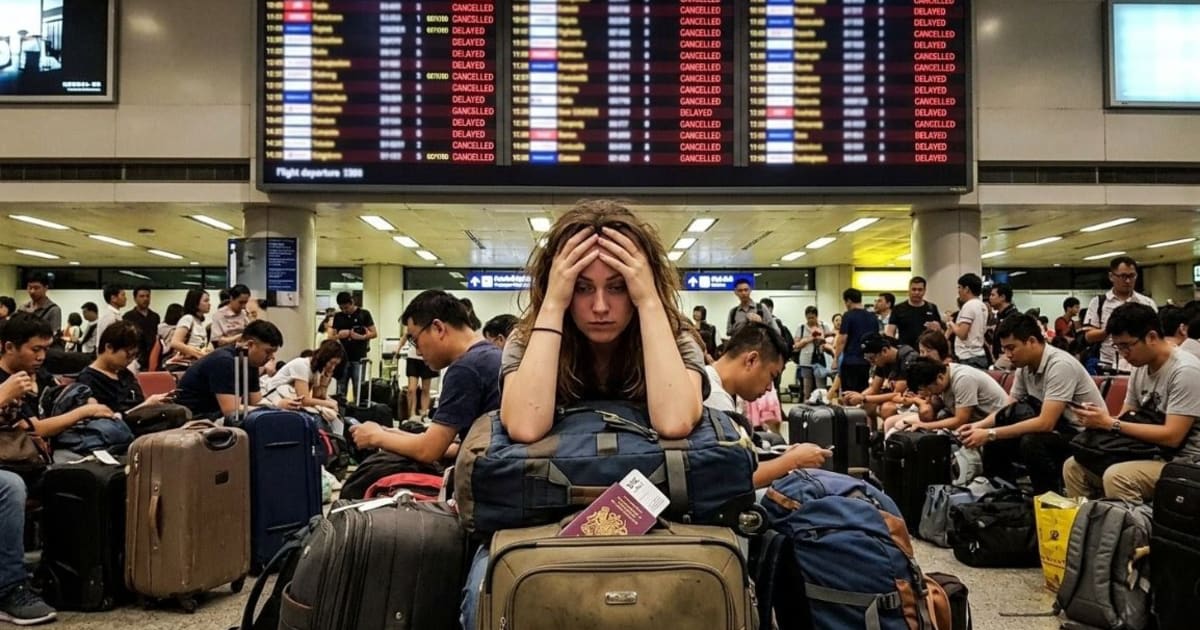
Three thousand flights don't fail in a single day by accident.
As of this morning, 3,176 flights across Asia — 3,102 delayed, 74 outright cancelled — have left an estimated 100,000-plus passengers stranded, rerouted, or staring at departure boards that refuse to update. Thailand, Singapore, Türkiye, China, India, and the Philippines are all simultaneously affected. That isn't a weather event. That isn't a pilot strike. That is a continent-wide aviation system showing its stress fractures at the worst possible moment.
For UK travellers, the timing cuts particularly deep. This is the final Sunday of March — the opening salvo of the Easter getaway season. Millions of British households spend between £1,200 and £2,400 on long-haul Asian holidays, and the airlines and package operators sitting inside your workplace pension fund are already watching the situation with tightly held breath. If these disruptions extend into the Easter peak window, the consequences for holiday costs, airline compensation liabilities, and British travel stocks will be felt far beyond any departure gate.
The Core Problem
The Collapse Behind the Numbers
Six countries. Six separate aviation systems. One catastrophic day.
What you are looking at with today's 3,176 disruptions is not a localised failure — it is the visible symptom of a systemic problem that has been building inside Asian aviation since the pandemic emptied every major hub in the region. When Covid shuttered operations, airlines mothballed aircraft, shed technical staff, and quietly ran down maintenance pipelines. The short-term logic was rational: no passengers, no planes needed. The long-term consequence is what operators and travellers are now paying for, in the most immediate and literal sense.
The return of demand outpaced the return of capacity. Air India has been operating at measurable maintenance crew deficit levels for over eighteen months, according to aviation industry data. Pegasus Airlines — Turkey's dominant low-cost carrier, with routes connecting Istanbul to South and East Asia — has been expanding aggressively into new markets at a pace that stretches ground handling resources dangerously thin. Thai AirAsia, one of the region's highest-frequency operators out of Phuket and Bangkok, runs on some of the tightest turnaround margins in commercial aviation: a 25-minute gate-to-gate clock that leaves virtually no operational buffer when weather, air traffic control delays, or technical holds begin cascading through the network.
And cascade they do. This is the critical mechanic that most coverage skips entirely. A 40-minute delay on a morning departure from Beijing doesn't disappear — it compounds. The same aircraft is late into its next sector, then the next. By evening, what began as a single technical hold at Capital International Airport has multiplied into dozens of knock-on delays touching passengers in Manila, Delhi, and Singapore who have no idea why their connection to Heathrow is suddenly broken.
For British travellers caught in today's disruption, the compensation landscape is more complicated than many realise. The UK's retained version of EU Regulation 261/2004 guarantees compensation of between £220 and £520 per passenger for cancellations and significant delays — but only on flights departing UK airports, or on UK- or EU-registered carriers arriving into the UK. Disruptions originating in Bangkok, Beijing, or Manila on Asian-registered carriers typically fall entirely outside that protection. You may have paid £850 for your return to Heathrow and be entitled to nothing beyond a re-route, depending on your airline and booking structure.
That gap in consumer protection amounts to roughly £200 million annually in unclaimed or ineligible compensation across British holidaymakers flying on non-UK carriers, based on industry estimates of disruption frequency and average fares. Regulators have noticed. The airlines are hoping you haven't.
Historical Parallel
What History Says About Days Like This
The instinct is to reach for April 2010 — the Eyjafjallajökull eruption that grounded 107,000 flights across Europe over six days and cost airlines a combined £1.3 billion in losses. That event permanently reshaped how the entire industry thought about resilience planning. Carriers were forced to create volcanic ash protocols, diversify route structures, and hold larger cash reserves against operational catastrophe.
But today's disruption is structurally different — and in some ways more troubling.
The 2010 ash cloud had a single, identifiable cause. Airlines, governments, and insurers could model it, respond to it, and eventually price it into their risk frameworks. What is happening across Asia today is multi-causal, distributed, and — crucially — not easily attributed to any one force majeure event. That matters enormously for affected passengers. When an airline cannot point to an extraordinary circumstance clearly defined in law, compensation claims become harder to resist. When it can — and 'extraordinary circumstances' remains a fiercely litigated category — passengers lose.
A closer structural parallel is the 2018-2019 Boeing 737 MAX crisis. When 387 MAX aircraft were grounded globally following two fatal crashes, the knock-on effect wasn't confined to the grounded planes — it rippled through connected operations across the entire network. Airlines flying competing routes suddenly faced demand they had no capacity to serve. Passengers rerouted onto already-stretched alternatives. Fares on certain Asia-Pacific corridors spiked by 18% within weeks of the initial grounding.
For a UK household booking an April half-term trip to Thailand or India in that environment, that kind of demand-shock fare increase meant an extra £160 to £320 on a family-of-four booking — before factoring in hotel and transfer costs. History suggests that when disruption is sustained beyond 72 hours, fares on affected corridors move sharply upward. We are currently at hour zero.
The Data Under the Hood
The Numbers Most Headlines Are Missing
Three thousand one hundred and two. That's the delay count. But 74 — the cancellation number — is where the real financial pain concentrates, and it deserves more scrutiny than it's getting.
At an average aircraft load factor of 85% and a typical Asian medium-haul capacity of 180 seats, 74 full cancellations translates to approximately 11,300 passengers with no flight at all. Not delayed. Gone. Each of those passengers now faces a chain of secondary costs: hotel accommodation at short notice (running at 40-60% premiums near major Asian hub airports on peak-season weekends), rebooking fees, and in many cases the cost of missed onward connections that the original carrier has no legal obligation to cover.
The aggregate passenger cost across those 74 cancellations is not easily pinned down, but aviation industry benchmarking suggests each long-haul cancellation generates between £800 and £1,400 in total passenger loss when all secondary costs are counted. Applied to today's figure, that is somewhere between £9 million and £16 million in aggregate passenger impact from cancelled flights alone — before the economic drag of 3,102 delays enters the picture.
For the airlines themselves, the arithmetic is equally painful. Delay compensation under applicable frameworks, crew overnight costs, ground handling overruns, and aircraft repositioning together average £120 to £200 per delayed passenger-hour across the industry. At an average delay of 90 minutes across 3,102 disrupted flights, and assuming a mean load of 150 passengers per aircraft, total operator costs today sit north of £80 million. That is a single-day figure.
Now consider the FTSE angle — because this reaches into your savings whether or not you're booked on a flight. International Consolidated Airlines Group, the FTSE 100-listed parent of British Airways, operates extensive code-share and partner agreements with several carriers affected today, including Air India. The FTSE 250 includes TUI AG, easyJet, and Jet2, all of which run significant Asia-Pacific programmes through partner carriers. When a disruption day of this scale occurs, institutional investors watch forward booking data carefully. A sustained disruption through Easter could trim 2-4% from the share prices of the UK-listed travel and leisure sector — a segment that accounts for roughly 3.5% of a typical FTSE All-Share tracker inside your ISA or workplace pension. It is a small weighting. The effect on your balance sheet is small. It is not zero.
Two Sides of the Coin
Two Ways to Read the Same Day
The optimistic reading, such as it is, goes like this: today is an anomaly, not a trend.
Asian aviation handled over 4.8 million flights in March alone, based on pre-disruption trajectory data. Seventy-four cancellations and 3,102 delays, while acutely painful for those caught up in them, represents a disruption rate well below 0.1% of monthly operations across the region. The major hubs — Changi in Singapore, Suvarnabhumi in Bangkok, Indira Gandhi in Delhi — are all functioning. Air China and Air India have both confirmed contingency operations are active. By tomorrow, the statistical model of normalised operations reasserts itself, forward Easter bookings remain intact, and the FTSE travel sector opens flat or mildly positive. For UK investors in airline or travel stocks, that reading is relatively comfortable. Hold positions, avoid panic, wait for the operational update.
The bear case is considerably more grounded in structural reality — and considerably less comfortable.
Three thousand flights don't fail in a single day by accident. This is what happens when a continent's aviation infrastructure gets rebuilt in a hurry after four years of neglect, and the seams show precisely when passenger volumes are at their seasonal peak. The six-country spread is the detail that should give you pause. This is not one nation having a difficult weather day. It is Thailand, Singapore, Türkiye, China, India, and the Philippines all reporting significant disruption on the same Sunday. The common thread is systemic: understaffed air traffic control operations, maintenance pipelines that haven't recovered from Covid-era cuts, and aggressive airline expansion strategies that consistently prioritise seat growth over operational buffer.
For the average UK household with Easter flights booked on Thai AirAsia, Pegasus, or Air India — three of the carriers most visibly affected today — the risk is immediate. If you are within 14 days of departure on a route through any of the six affected countries, reviewing your travel insurance policy this evening is not an overreaction. A cancelled Easter holiday for a family of four averages £3,400 in total financial exposure, including flights, hotel, and transfers. Your insurer will ask whether you had reasonable notice of disruption risk. After today, you do.
Scenarios & What-Ifs
Three Ways This Could Go
Scenario one: Contained within 48 hours. Probability: moderate.
Operational disruptions at this scale often self-correct within two to three days as carriers reshuffle aircraft and prioritise highest-demand routes. If weather is a contributing factor — and late-March pre-monsoon conditions across Southeast Asia are historically volatile — the stabilisation window is broadly predictable. In this scenario, Easter travel proceeds normally, fare prices hold steady, and the financial damage is absorbed by airlines and insurers rather than passed to passengers. UK holidaymakers departing after 2nd April face minimal additional risk.
Scenario two: Disruption extends through the Easter peak window. Probability: rising with each passing hour.
If the systemic causes — ATC capacity constraints, maintenance backlogs, crew shortages — remain unresolved beyond 72 hours, the Easter window becomes structurally compromised. In this scenario, UK-facing travel agents begin issuing advisories by mid-week. Fare surcharges on remaining April seats could jump 12-20%, adding £80 to £200 per person on a typical UK-to-Asia ticket. FTSE-listed travel stocks face a sector correction of 3-6%. For the UK consumer, rebooking costs, insurance excess fees, and the real cost of a cancelled family holiday represent a painful and largely uncompensated hit.
Scenario three: Sustained disruption forces structural route changes. Probability: low but non-trivial.
Some affected corridors touch airspace adjacent to zones of ongoing geopolitical sensitivity, particularly around the South China Sea and Eastern Mediterranean approaches to Istanbul. Should any disruption factor carry a geopolitical dimension, even partial rerouting adds hundreds of miles to flight paths, pushing fuel costs up and fares with them. That is the tail risk. It hasn't materialised today. But today's numbers remind you — as they always do, just before the cost shows up on your booking confirmation — that it is never entirely off the table.
💰 What this means for your money: For UK households, this means up to £3,400 Easter holiday exposure if disruption extends into April.
"A cancelled Easter holiday for a family of four averages £3,400 in total exposure. After today, check your insurance."
The Bottom Line
Today's 3,176-flight meltdown is being reported as a disruption story. It should be read as a structural warning. The numbers are too large, too geographically spread, and too badly timed — right at the opening of the Easter travel season — to dismiss as coincidence. If you have flights booked to Thailand, India, or Istanbul in the next three weeks, pull out your travel insurance policy tonight and read the cancellation clause carefully. And remember: three thousand flights don't fail in a single day by accident. They fail because the system was never properly rebuilt after the years it spent standing still.
Frequently Asked Questions
Am I entitled to compensation if my Asia flight is cancelled or delayed today?
It depends on where your flight departs and which airline you're flying. UK261 regulations entitle you to between £220 and £520 per person for cancellations on flights departing UK airports or on UK/EU-registered carriers. Flights departing Bangkok, Beijing, or Manila on Asian-registered carriers typically fall outside this protection, leaving you with only a re-route entitlement regardless of the inconvenience.
How does this Asia flight chaos affect my UK pension or ISA?
Indirectly but measurably. If disruption extends through Easter, FTSE-listed travel and leisure stocks — including IAG (British Airways' parent), TUI, and Jet2 — could fall 2-4%. That sector accounts for roughly 3.5% of a typical FTSE All-Share tracker fund inside a workplace pension or stocks-and-shares ISA, so sustained disruption has a small but real balance sheet effect.
What should I watch in the next few days to know if this gets worse?
Monitor whether TUI, Jet2, or British Airways issue formal travel advisories for Thai, Indian, or Turkish routes — that is the clearest market signal that Easter disruption is materialising. Also watch IAG's share price on Monday's open; a drop of more than 2% would indicate institutional investors are pricing in a sustained disruption scenario rather than a one-day event.