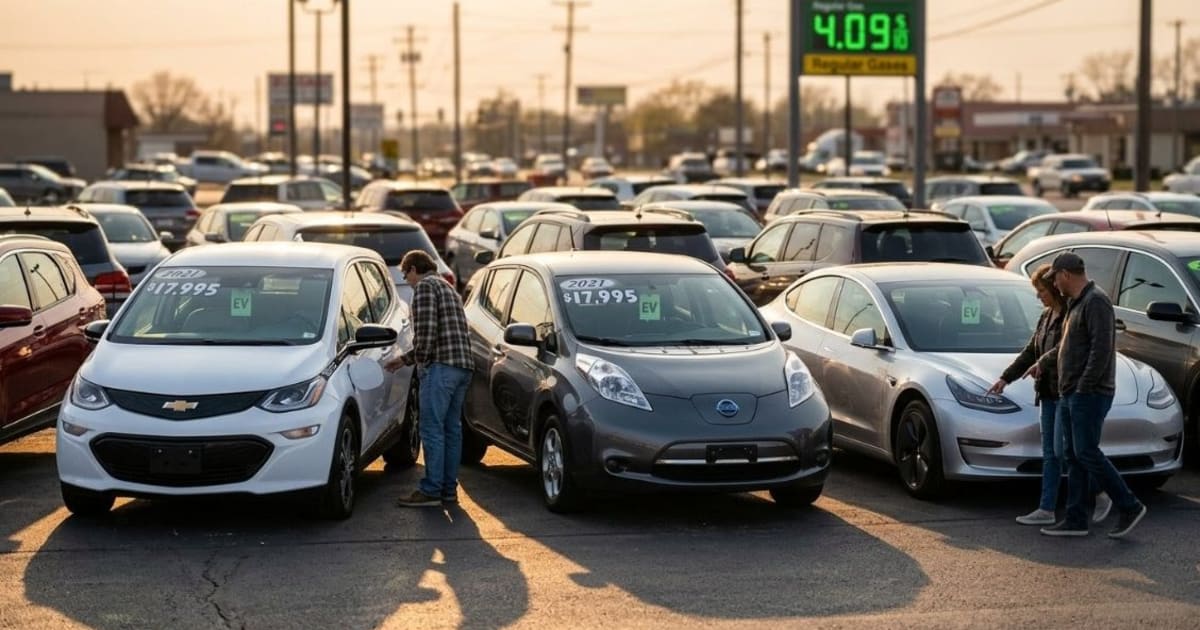
In 1979, Americans waited in line for hours to fill a tank they couldn't afford. Overnight, fuel-efficient Japanese cars went from curiosity to necessity. Now it's happening again — different technology, same panic at the pump. Gas has crossed $4 a gallon nationally, and suddenly that used Tesla or Chevy Bolt sitting on a dealer's lot doesn't look like a political statement. It looks like a $100-a-month raise.
What's Happening
In [year], [similar event]. Now it's happening again — that's the oldest pattern in consumer economics. When fuel hurts, Americans don't wait for permission. They adapt.
What's unfolding right now is a tale of two markets pulling in opposite directions. New EV sales have stalled badly. Uncertainty around federal tax credits, ongoing tariff disruptions on imported battery components, and sticker prices that still clear $40,000 on average have kept showroom traffic thin. Automakers are sitting on inventory. Some have quietly idled EV production lines.
But the used market? It's moving. Rapidly. Prices on two- and three-year-old EVs have come down sharply from their 2022 peaks — in many cases 25% to 35% — as early adopters trade up, lease returns flood lots, and dealers discount aggressively to clear space. A used Chevy Bolt that listed near $30,000 new can be had for under $18,000 today. A 2022 Tesla Model 3 Standard Range is sitting at dealerships in the mid-$20,000s.
Meanwhile, gas hasn't cooperated. National average prices crossed $4 a gallon in early April, driven by a tighter OPEC supply posture and seasonal refinery switchovers. In California and parts of the Northeast, you're already looking at $4.60 to $4.80. The pump is squeezing. And Americans are doing what they always do — they're running the numbers.
Why Your Money Cares
Here's the math your commute is forcing on you. If your household fills up a 15-gallon tank twice a week at $4.10 a gallon, that's roughly $246 a month — close to $2,950 a year — just in gasoline. That's money not going into your 401(k). It's not going toward your mortgage. It's burning.
Switch to a used EV purchased for $19,000, and your monthly 'fuel' cost — electricity to charge at home — typically runs $40 to $60 depending on your utility rate. That's a swing of roughly $185 to $200 a month. Over a full year, you're looking at saving $1,200 to $2,400 in fuel costs alone. For a household already stretched by grocery bills that haven't come back down and insurance premiums that keep climbing, that's real money.
You'd also be buying at something close to the floor. Used EV values stabilized in late 2025 after the dramatic post-pandemic correction, and analysts watching the Manheim Used Vehicle Index see early signs of a bottom forming. Buying a depreciated asset at or near its trough, while the operating cost advantage is widening — that's a setup worth understanding.
The Numbers That Matter
The spread between owning a gas car and a used EV has never looked quite like this. A few figures worth anchoring to:
| Metric | Figure | What It Means for You |
|---|---|---|
| National avg. gas price | $4.10/gal | Up ~18% from a year ago |
| Used EV avg. transaction price | ~$26,500 | Down from ~$38,000 in late 2022 |
| Est. annual fuel savings (EV vs. gas) | $1,200–$2,400 | Depends on driving habits and utility rates |
| Used EV sales YoY growth (Q1 2026) | ~22% | New EV sales flat to down |
| Federal used EV tax credit (if eligible) | Up to $4,000 | Income-capped; check IRS Form 8936 |
That federal credit is worth flagging. It's not guaranteed — it phases out above $75,000 adjusted gross income for single filers, $150,000 for joint — but if you qualify, it effectively brings a $22,000 used EV down to $18,000 out of pocket. That changes the payback period dramatically.
Bottom line for your wallet: For the average American household, this means up to $2,400/year back in your pocket.
The Street Mood
Consumer sentiment data doesn't paint a rosy picture overall. Confidence readings have softened as tariff anxieties bleed into everyday purchasing decisions, and big-ticket item hesitation is real. But the used car segment is bucking that trend in a specific way.
Cox Automotive and Edmunds data both show used EV search traffic surging through Q1 2026 — up more than 40% year-over-year in some categories. That's not casual browsing. People are comparing monthly payments against what they're spending at the pump. Dealers report that conversations are converting faster than they were even six months ago, when the same car sat longer on lots.
It's worth watching what this does to insurance costs, though. EV insurance premiums run roughly 15% to 25% higher than comparable gas vehicles — partly because repair costs on battery systems remain elevated, partly because the actuary tables are still thin on long-run claims data. Your $185 monthly fuel savings could shrink to $130 or $140 once you account for that. Still a real gain. Just not quite as clean as the headline number.
The Short Version
Gas crossing $4 a gallon isn't just a headline — it's a trigger, and history shows these triggers move consumer behavior faster than any policy ever could. Used EVs are cheap, savings are tangible, and the window of low prices won't stay open indefinitely as demand picks up. You don't have to believe in the energy transition to believe in the math.
Common Questions
Is now a good time to buy a used EV with gas prices rising?
Used EV prices are roughly 25–35% below their 2022 peaks, and federal tax credits of up to $4,000 are still available for qualifying buyers. With gas above $4 a gallon, the fuel savings alone can run $1,200 to $2,400 a year depending on how much you drive.
How much can I actually save switching from a gas car to a used EV?
A typical American driver spending around $2,900 a year on gasoline could cut that fuel bill to $500–$700 in electricity costs, saving roughly $1,200 to $2,400 annually. Your actual number depends on your utility rate, driving distance, and whether you charge at home or publicly.
What should I watch for in the used EV market over the next few months?
Three triggers matter: whether gas prices hold above $4 (driving more buyers in), what Congress does with EV tax credit eligibility rules, and whether automaker lease-return volumes continue flooding the used market through mid-2026 — which would keep prices compressed.
This content is informational only and should not be interpreted as a recommendation to buy, sell, or hold any security. Seek professional financial advice before acting on anything you read here.