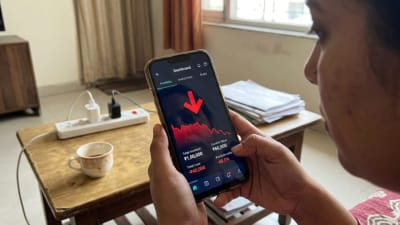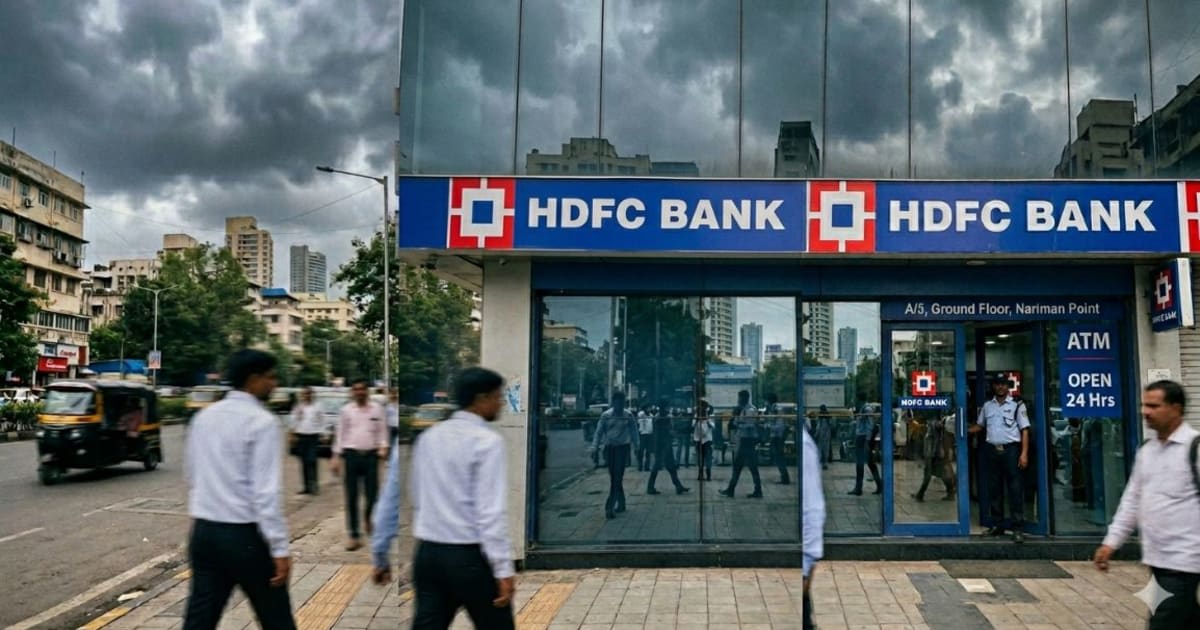
India's largest private bank is in bear territory. That isn't a phrase used lightly — HDFC Bank's shares have plunged more than 21% from their all-time high of ₹1,020 (hit on October 23, 2025), closing at ₹780.45 on Friday, March 20. If you hold a Bank Nifty ETF or a large-cap mutual fund — and most retail SIP investors do — a slice of your money just shrank 21% in a single quarter. That translates to roughly ₹2,100 erased off every ₹10,000 invested in this period alone.

The trigger? Eight words filed as a regulatory disclosure on a Wednesday evening. Atanu Chakraborty, HDFC Bank's part-time chairman since 2021 and a former Economic Affairs Secretary of India, wrote that certain happenings and practices in the bank were not in congruence with his personal values and ethics. He didn't name names. He didn't cite specific incidents. He offered no clarification when the board asked. Eight words, no context, and ₹1 lakh crore in market capitalisation gone in 48 hours.

That is the real story here — not the share price fall, markets fall all the time. The story is that India's biggest private lender's own chairman couldn't say, in plain language, what went wrong inside. And when investors and analysts demanded answers on Thursday's emergency concall, the board couldn't tell them either.

The Core Problem

The resignation itself isn't the problem. Chairmen resign. The problem is the nature of this one — and the timing it chose to arrive.

Chakraborty's letter, dated March 17 and submitted to HDFC Bank's Governance, Nomination and Remuneration Committee, was addressed to the very body responsible for overseeing the bank's governance. His term had been extended until May 2027. He was five years into the role, had seen the bank through its historic merger with HDFC Ltd in July 2023 — a deal that created the second-largest bank in India by assets — and was in his second term when he chose to walk. In the same letter, he noted that the benefits of the merger are yet to fully fructify. That single line, buried inside a resignation, deserves far more scrutiny than it has received.

Here is what makes this uniquely difficult for retail investors. On the emergency concall held Thursday, CEO Sashidhar Jagdishan said: we are not sure what triggered the resignation. The board, per interim chairman Keki Mistry, was told it was a personal relationship issue — nothing more. Mistry confirmed that Chakraborty provided no evidence, no specific instances, and no documented concerns to the board. This is an extraordinary situation: India's largest private bank's chairman resigns citing governance and ethics, and the institution that is supposed to be governing the bank has no clarity on what exactly went wrong.

Eight words destroyed more value than three bad quarters could. The real problem isn't what Chakraborty said — it's what he didn't.

JPMorgan's analysts noted that while no misconduct was alleged, the perception issue alone would weigh on the stock until clarity emerges. Macquarie went further — removing HDFC Bank from its marquee buy list and flagging governance concerns as a near-term headwind, even while acknowledging that fundamentals remain intact with strong return on assets.

The timing makes everything structurally worse. CEO Jagdishan's term comes up for RBI renewal in October 2026. In Indian banking, RBI approval for CEO succession is not a rubber stamp — Yes Bank investors learned that lesson painfully in 2020. If the RBI conducts its regular supervisory assessment of HDFC Bank while this governance cloud hangs overhead, the market has every right to be cautious about the renewal process. Nomura flagged this directly: clarity on CEO reappointment is now a key monitorable alongside the search for a permanent chairman.

There is a third angle most coverage has missed entirely. HDFC Bank carries the single heaviest weight in both the Nifty 50 and Bank Nifty indices — roughly 12-13% of the banking index. When it crashed 8.7% intraday on March 19, hitting a 52-week low of ₹770 on the NSE, it pulled Bank Nifty down nearly 1,900 points in that session alone. Every Bank Nifty ETF investor, every Nifty 50 index fund SIP holder, every large-cap fund running benchmark allocation — all took a hit they did not choose. For a salaried professional putting ₹5,000 a month into a Bank Nifty ETF, that single session cost the equivalent of roughly one full monthly SIP contribution in paper losses.

Historical Parallel

Indian banking has seen chairman-level governance turbulence before. The closest parallel is not the 2020 COVID crash — that was a macro shock, indiscriminate and external. The better comparison is the ICICI Bank governance crisis of 2018.

In 2018, ICICI Bank's CEO Chanda Kochhar came under scrutiny for an alleged conflict of interest in a loan extended to Videocon Group. The bank's stock declined roughly 17% during the period of maximum uncertainty. For a retail investor holding ₹5 lakh in ICICI Bank shares at the peak of that crisis, the notional loss touched ₹85,000. But here is the instructive part: once Sandeep Bakhshi was appointed as the new CEO in October 2018 and KV Kamath joined as non-executive chairman, the stock began a multi-year re-rating. Within eighteen months, ICICI Bank had recovered all those losses — and then went on to significantly outperform the broader market for the next three years.

The structural lesson from ICICI: governance concerns, once resolved through credible leadership appointments and clean, direct communication, do not permanently impair a bank's core business. Credit books, deposit franchises, and return ratios don't vanish because of a boardroom dispute.

The second historical parallel is HDFC Bank's own worst quarter. In January-March 2020, the stock fell 32% as COVID-19 shut down the Indian economy and fears of a credit collapse gripped markets. A salaried professional who held ₹5 lakh in HDFC Bank shares in January 2020 watched it fall to roughly ₹3.4 lakh on paper in 90 days. The recovery, however, was complete within twelve months — and by late 2021, the stock had surpassed pre-COVID levels.

The current 21% decline is severe but not historically unprecedented for this bank. What is different this time is the nature of the trigger. In 2020, the cause was external — a pandemic, a macroeconomic shock that hit every lender in India equally. In 2026, the cause is internal: a governance question mark with no publicly stated answer, arriving precisely when HDFC Bank is navigating a complex post-merger integration, an approaching CEO succession event, FII outflows exceeding ₹1.19 lakh crore from Indian equities year-to-date, and a new regulatory proposal threatening one of its most profitable revenue streams.

Both the ICICI 2018 episode and HDFC's own 2020 crash had a visible resolution path relatively early. This one does not — at least not yet. That difference in resolution visibility is exactly why Macquarie pulled the stock from its marquee list while Jefferies, looking past the fog, maintains a ₹1,240 target. Both views are internally consistent. They simply disagree on how long this governance cloud will take to clear.

The Data Under the Hood

Let's look at what the numbers are actually telling you — including a few that most market coverage hasn't highlighted.

HDFC Bank's all-time high was ₹1,020, reached on October 23, 2025. The stock closed at ₹780.45 on March 20, 2026. That is a 23.5% decline from peak if you measure against the intraday 52-week low of ₹770 hit on March 19 — officially bear market territory, defined as a 20% or greater drop from peak. This is the bank's worst quarterly performance since January-March 2020, when it fell 32% during the COVID crash. The scale of that comparison should not be underestimated: Q1 2020 was a pandemic. Q1 2026 is a boardroom dispute.

The technical picture adds context. The Relative Strength Index (RSI) now stands at 24 — below 30 signals an oversold condition, and at 24 the stock is in deep oversold territory by any standard measure. All major moving averages have been breached. For retail investors tracking this on Zerodha or Groww, RSI readings at this level typically precede either a sharp bounce-back or a capitulation selloff, and the market has not yet decided which direction to take.

Here is the data point most retail investors miss entirely: FII ownership in HDFC Bank exceeds 47%. The Government of Singapore's sovereign wealth fund and Norway's Government Pension Fund Global together own approximately 3.5% of the bank. When a stock with this institutional profile takes a governance hit, the selling dynamic is mechanically different from a retail-heavy counter. Foreign funds operating under ESG mandates and governance-screened frameworks have pre-defined triggers — a chairman resigning over ethics can force automatic selling regardless of fundamentals. That is mechanical selling pressure layered on top of sentiment-driven selling, and it explains why the stock's American Depositary Receipts on the NYSE fell 7.3% overnight on March 18, before Indian markets even opened Thursday morning.

The market cap destruction in concrete terms: in two trading sessions, HDFC Bank lost close to ₹1 lakh crore in market capitalisation. For reference, ₹1 lakh crore is approximately the annual state budget of Rajasthan — gone from one bank's valuation in 48 hours. If you hold even a modest ₹2 lakh SIP portfolio that is 10% weighted to HDFC Bank through large-cap funds (a fairly typical allocation), this two-day drop cost you roughly ₹1,400 in notional terms.

The macro data adds a further layer of pressure that extends well beyond HDFC Bank. Brent crude has spiked to $119.13 per barrel amid the escalating US-Iran conflict — a direct hit for an oil-importing economy like India. The Indian rupee touched a record low of ₹92.80 to the US dollar this week, making FII returns less attractive and accelerating outflows. FIIs were net sellers in every single trading session of March 2026 through March 17, with total outflows of ₹70,990 crore in those 17 days alone. Year-to-date FII outflows stand at over ₹1.19 lakh crore.

On valuation: the stock now trades at approximately 1.7x FY27 estimated adjusted book value — close to five-year lows. The trailing P/E stands at 16.3x, meaningfully below its long-term historical average of 20-22x. The consensus average target price across 29 brokerage reports currently sits at approximately ₹1,139 per share, implying 46% upside from current levels — if the governance situation resolves cleanly.

Two Sides of the Coin

The bull case begins with what the bank can actually control: its own balance sheet and business momentum.

Gross advances grew 11.9% year-on-year to approximately ₹28.4 lakh crore for the December 2025 quarter. Average deposits rose 12.2% year-on-year. The loan-to-deposit ratio — a persistent concern since the 2023 merger with HDFC Ltd inflated it — has been gradually improving. Management expects credit growth to outpace the system's projected 12-13% in FY27. The RBI, in an unusually direct public statement, affirmed that HDFC Bank has sound financials and is run by a professional board and competent management — the regulator going out of its way to reassure markets is not a trivial signal. Return on assets is estimated at 1.9% for FY27, with return on equity projected at 14.5% — numbers that any large-cap banking investor would welcome in normal times.

Jefferies holds the most bullish position among major brokerages, maintaining a Buy rating with a target of ₹1,240 — a 57% upside from ₹790. Motilal Oswal's ₹1,100 target implies 38% upside, with the brokerage noting that the RBI's clean governance endorsement and Keki Mistry's interim appointment reflect stability in leadership and oversight. Mistry himself put it plainly on the Thursday call: he would not have taken this responsibility at 71 if it did not align with his principles and integrity expectations for the bank. For investors, that is credibility that can't be manufactured.

The bear case, by contrast, is not purely about governance perception. There is structural complexity embedded in the near-term outlook.

CEO Jagdishan's term expires in October 2026. RBI approval for bank CEO renewals involves supervisory scrutiny, and the current governance ambiguity — however temporary — adds friction to that process. Macquarie removed HDFC Bank from its marquee buy list for exactly this reason: not because the bank is fundamentally broken, but because uncertainty on CEO succession plus the chairman search creates a sustained overhang of six to nine months. JPMorgan, with a Neutral rating and ₹1,090 target, warned that board-management alignment concerns may weigh on sentiment until clarity on both leadership questions emerges. Nomura cited the leadership visibility gap as a key reason near-term underperformance could persist.

Then there is the regulatory dimension. The RBI's proposed bancassurance regulations — announced on March 6, requiring explicit active consent for every insurance product sold alongside a loan — would effectively end automatic bundling of credit protection insurance. Fee income from insurance sales is a high-margin, low-capital revenue stream for HDFC Bank. Losing it materially, or even partially, would compress non-interest income in FY27. That is a domestic headwind on top of the governance cloud and the global macro pressure from elevated crude and a weakening rupee. For a salaried professional holding HDFC Bank in their portfolio, the question is not whether to hold or exit — that depends entirely on individual risk appetite and investment horizon. The question is: does the 46% potential upside justify sitting through what could be six to nine months of grinding underperformance?

Scenarios & What-Ifs

Three paths from here, and they lead to very different outcomes for your portfolio.

Scenario one is the fastest resolution. A permanent chairman is named within six to eight weeks, RBI approves Jagdishan's term extension well before October, and no further senior management exits occur. HDFC Bank delivers strong Q4 FY26 results in April, demonstrating that merger benefits are beginning to materialise in the numbers. In this scenario, the governance discount unwinds, and the stock re-rates toward ₹950-1,000 by year-end 2026. For a salaried professional holding a Bank Nifty ETF SIP, the ₹2,100 quarterly loss would effectively be recovered within two to three quarters. This is the scenario Jefferies and Motilal Oswal are implicitly building their targets around — a temporary overhang, not a permanent impairment.

Scenario two is the grind. The permanent chairman search drags on for four to six months. RBI's approval for CEO renewal remains uncertain through the third quarter of 2026. The bancassurance regulation bites into Q1 FY27 non-interest income. No catastrophe, but no clarity either. The stock stays range-bound between ₹750 and ₹850 for much of the year — a slow, frustrating underperformance against Nifty 50. This is what Macquarie and Nomura's measured language implies: not a collapse, but a prolonged wait. For a ₹10,000 monthly SIP investor, this means continued opportunity cost — money that could be working harder in sectors without governance overhangs.

Scenario three is the tail risk. Crude oil sustains above $115-120 per barrel through H1 2026, forcing the RBI to abandon its nascent rate-cutting cycle. Home loan EMIs rise again — on a ₹50 lakh floating-rate loan, even a 25 basis point hike means roughly ₹900-1,100 extra per month. Credit demand slows, the rupee weakens further, and FII outflows continue. In this environment no bank escapes unscathed, but HDFC Bank — carrying its governance discount on top of sector-wide macro pressure — could test ₹700 or below. This is not the base case. But after this week, it is no longer an impossible one either.

The most likely near-term outcome sits between scenarios one and two. And that ambiguity is itself the problem — the clock ticking toward October 2026 is the one variable that neither management reassurances nor brokerage targets can stop.

💰 What this means for your money: Bank Nifty ETF SIP investors lost ~₹2,100 per ₹10,000 invested this quarter.

"Eight words destroyed more value than three bad quarters could. The real problem isn't what Chakraborty said — it's what he didn't."

The Bottom Line

HDFC Bank's fundamentals are not broken — but the governance cloud is real, and the CEO succession clock ticking toward October 2026 is a problem that management assurances alone cannot fix. The 46% consensus upside looks compelling on paper; whether you can sit through six to nine months of uncertainty to get there is the actual question. Markets priced the risk fast. The resolution will be slower.

Frequently Asked Questions

Why did HDFC Bank shares fall so sharply in March 2026?

HDFC Bank's part-time chairman Atanu Chakraborty resigned on March 18, 2026, citing 'certain happenings and practices' that were 'not in congruence with his personal values and ethics' — without specifying what those were. The ambiguity spooked investors, and the stock fell over 8.7% intraday on March 19, wiping nearly ₹1 lakh crore in market cap in two sessions. Macro headwinds — FII outflows of over ₹70,990 crore in March and crude oil spiking to $119 a barrel — added to the pressure.

How does the HDFC Bank fall affect my SIP or mutual fund?

If you invest in a Bank Nifty ETF, large-cap fund, or Nifty 50 index fund via SIP, you are almost certainly exposed to HDFC Bank. It holds 12-13% weight in Bank Nifty. The bank's 21% fall this quarter means a ₹10,000 monthly SIP in a Bank Nifty ETF has seen roughly ₹2,100 in notional losses on that investment alone this quarter.

What should I watch for with HDFC Bank stock going forward?

Three key triggers: (1) Appointment of a permanent chairman — the sooner and more credibly, the better for sentiment; (2) RBI approval for CEO Jagdishan's term renewal, which is due in October 2026 — this is the most time-sensitive governance event; (3) Q4 FY26 results expected in April 2026, which will indicate whether post-merger fundamentals are improving. Watch Nomura and Macquarie for sentiment shifts — they are currently the most cautious among major brokerages.