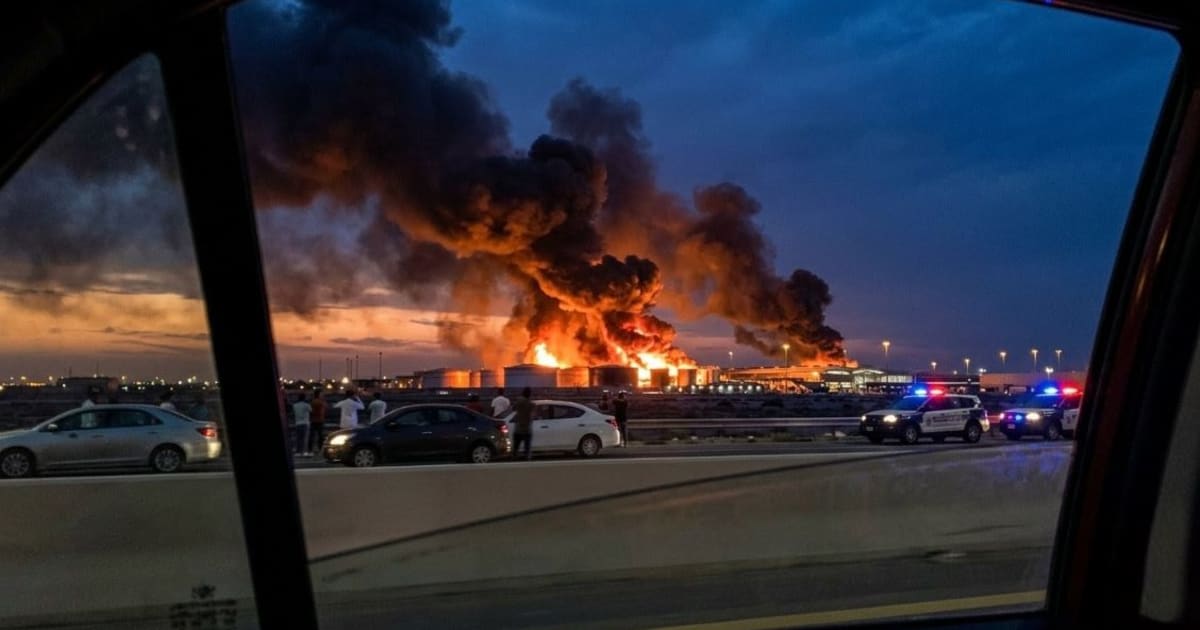
Brent crude is back above $100 a barrel — and Iran just slammed the door on any quick fix. Tehran dismissed America's 15-point ceasefire proposal Wednesday, sending oil bouncing above the $100 mark after briefly dipping on peace hopes. For drivers in New Jersey, Northampton, or Navi Mumbai, this isn't abstract. It's money leaving your wallet every time you fill up, with no clear end in sight.
What's Happening
The US handed Iran a 15-point ceasefire plan through Pakistani intermediaries — a sweeping proposal covering sanctions relief, nuclear rollbacks, missile limits, and crucially, reopening the Strait of Hormuz. Iran's response was flat rejection. Foreign Minister Abbas Araghchi stated publicly that his government has not engaged in talks and does not plan to. Iran's military dismissed the diplomatic effort entirely, then launched fresh strikes on Kuwait International Airport, triggering a massive fire visible from miles away.
Oil markets whipsawed violently. Brent fell as much as 7% intraday on ceasefire hopes — touching $97.30 at its session low — before Iran's rejection hit the wires. Brent snapped back above $100 and settled at $102.22. WTI, the US benchmark, closed at $90.32.
Both contracts are now logging volatility not seen since April 2022. Brent is still up roughly 35% since the US-Israeli military campaign against Iran began on February 28. The Strait of Hormuz — which normally moves about one-fifth of global crude supply — has been virtually shut. The IEA has called it the biggest oil supply disruption ever recorded.
Why Your Money Cares
That 35% oil spike connects directly to your wallet, whether or not you follow commodity markets. Before the war, the US national average sat around $3.30 per gallon. At current levels, you're looking at approximately $4.45 per gallon. Fill a 15-gallon tank twice a month — you're spending roughly $68 more every month just to get around.
In the UK, petrol has climbed from around 140p per litre to near 190p. A typical 50-litre fill now runs close to £95 versus £70 before the war — an extra £25 every time you pull up to the pump. Fill up twice monthly and that's £50 more landing on already-stretched budgets.
India is holding pump prices artificially flat right now, but the pressure on state oil companies is unsustainable. A ₹8–12 per litre revision is widely expected in the coming weeks — adding ₹400–600 per tankful for anyone running a car or small business. The S&P 500, FTSE 100, and Nifty 50 all face mounting earnings pressure as sustained energy costs shred corporate margins across every sector that moves goods or people.
The Numbers That Matter
$120 — Brent's peak during the worst days of the conflict. $100 — the psychological level markets keep returning to like a magnet. $97.30 — Brent's intraday low Wednesday, the brief window when ceasefire hopes surged. $102.22 — where it settled after Iran said no. WTI closed at $90.32.
20 million barrels per day. That's the daily crude supply effectively knocked offline by the Hormuz chokepoint. Over 500 million barrels have been lost since the war began — roughly five full days of global supply gone in under a month. Put that in historical context: the 1973 Arab Oil Embargo cut global supply by about 4 million barrels per day. This disruption is five times worse by volume, and the IEA has said so explicitly.
Oil's actual 30-day volatility just hit its highest reading since April 2022. That kind of price swing is brutal for households running budgets built on stable energy. The S&P 500 briefly climbed 1% on peace hopes Wednesday morning before Tehran's rejection trimmed those gains back. Your 401(k), your pension fund, and your SIP are all watching the same numbers you are.
The Street Mood
Markets wanted peace. They didn't get it. The intraday 7% crash in Brent — followed by a full bounce back above $100 — captures exactly how brittle sentiment is right now. Energy sector funds and defense-linked equities have been among the only consistent winners since February 28. Airlines, logistics firms, and consumer discretionary stocks have quietly bled value as fuel costs shred margins and forward guidance looks increasingly unreliable.
The S&P 500's 1% morning rally faded after Tehran's rejection landed. Oil volatility hit levels last seen in April 2022 — the kind of environment that punishes passive investors just trying to stay the course. Your S&P 500 ETF, your Nifty 50 SIP, your FTSE 100 pension exposure — all of them are fighting an oil headwind that shows no sign of softening. Gold is rising on uncertainty. That tells you everything about where the smart money thinks this is headed.
What to Watch
Three triggers matter in the days ahead. First: a possible in-person US-Iran meeting in Pakistan as early as Friday, March 27 — if it happens, expect Brent to drop sharply back toward $95. Second: US military escalation is accelerating, with at least 1,000 troops from the 82nd Airborne heading to the region alongside 5,000 Marines. Any clash that broadens the conflict pushes Brent back toward $120 within days. Third: Hormuz tanker traffic. Iran opening even a fraction of normal shipping capacity would send prices falling fast. Watch freight tracking data daily. The $100 level that defined this week's chaos is now the floor — not the ceiling — unless diplomacy moves.
💰 What this means for your money: For the average US household, this means $68 more per month in fuel costs alone.
"Iran rejected the biggest oil supply fix in history. Brent bounced from $97 to $102 in hours. Markets want peace. Tehran has other plans."
The Bottom Line
Iran's rejection of the US ceasefire isn't just geopolitics — it's a direct monthly tax on households from New York to London to Mumbai. Brent moved from $97 back to $102 in a matter of hours after Tehran said no, which tells you exactly how much of this market is running on hope. The $100 oil level that kicked off this week's chaos is now the floor, not the ceiling — and there's a version of this story where it ends quickly. This isn't it.
Frequently Asked Questions
Why did oil prices go up after Iran rejected the ceasefire?
Oil had briefly fallen as much as 7% on hopes the US-Iran ceasefire deal would reopen the Strait of Hormuz and restore about 20 million barrels per day of supply. When Iran rejected the proposal, those supply hopes vanished and Brent snapped back above $100, settling at $102.22.
How does $100 oil affect my gas or petrol price?
Oil up 35% from pre-war levels means US drivers are paying roughly $4.45/gallon versus $3.30 before the conflict — about $68 more per month for a typical household. UK motorists are paying near 190p/litre versus 140p previously, adding roughly £50/month. Indian pump prices haven't officially moved yet, but a ₹8–12/litre hike is expected soon.
What could bring oil prices down from here?
The most immediate trigger is a US-Iran in-person meeting reportedly possible by Friday, March 27 in Pakistan. Any confirmed progress on reopening the Strait of Hormuz could send Brent below $95 quickly. A full ceasefire deal would likely push prices down 20–30% within days, but Iran's five-point counteroffer — which includes retaining control of the strait — makes that scenario unlikely in the near term.