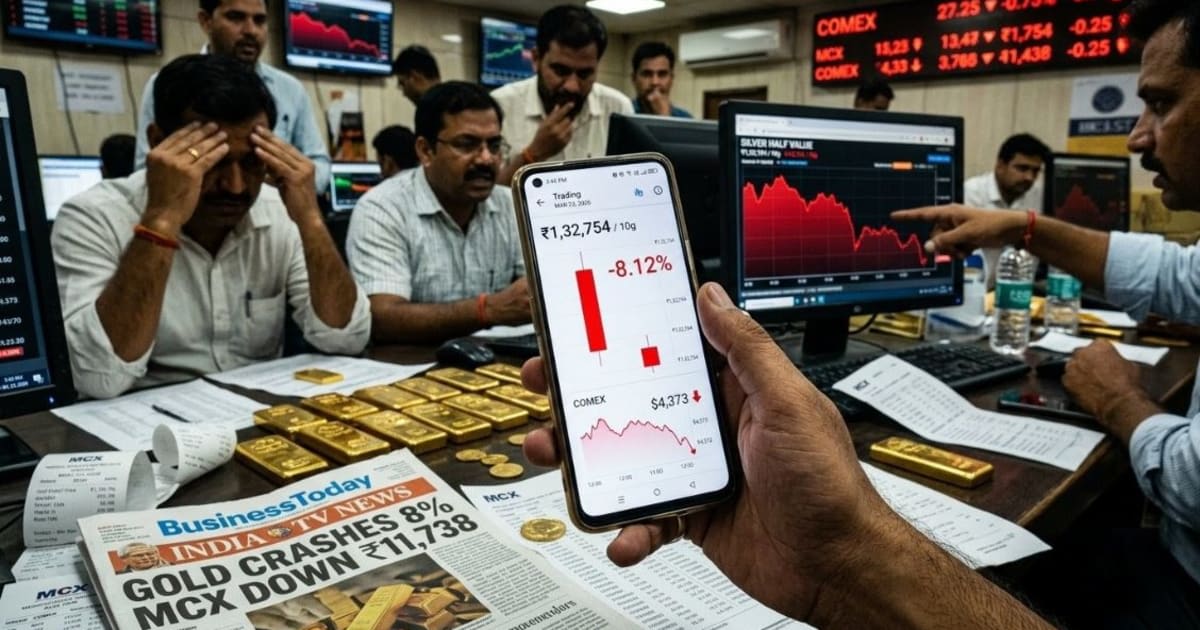
Gold does not crash 8% in a single session without a story behind it. On March 23, MCX gold nosedived ₹11,738 — or 8.12% — to ₹1,32,754 per 10 grams, brushing an intraday low of ₹1,31,508. On COMEX, the yellow metal dropped to $4,373 per ounce — its ninth straight losing session — meaning April US futures have shed roughly $641 from their mid-March peak near $5,014. Whether you hold a sovereign gold bond, a gold ETF, or a jewellery box inherited from your grandmother, Monday delivered a number that stings across every currency on the planet.
Trend Breakdown
Gold peaked near $5,014 per ounce on March 17 — a level that felt bulletproof two weeks ago, powered by safe-haven demand as the US-Israel-Iran conflict escalated and global uncertainty spiked. Then the economic calculus flipped. As the conflict deepened, oil prices surged, and US inflation expectations reset sharply higher. Traders began pricing in not just a Federal Reserve pause — but a potential rate hike toward year-end. That single shift rewrote gold's entire near-term story.
Higher rates are the kryptonite of non-yielding assets. When US 2-year Treasury yields climbed to 3.93% — a level not seen since January — capital rotated out of bullion at speed. The dollar index held firm near 100, compounding the pressure on rupee-denominated metals. In India, that combination arrived with full force: MCX gold collapsed from ₹1,44,492 on Friday to ₹1,31,508 at intraday lows on Monday — a ₹13,000 wipeout in 72 hours. For a standard 10-gram holding, that is roughly ₹13,000 evaporated over a long weekend, or about $155 or £122.
Silver was hit even harder in percentage terms. MCX silver fell 6.05% to ₹2,13,045 per kg. The metal had surged to an extraordinary ₹4,39,337 per kg in late January 2026 — a record high driven by industrial demand optimism and safe-haven stacking. Since then, it has shed more than half its value. COMEX silver settled at $65.61, down 3.2% on the session, after testing the critical support zone near $65.55.
Comparison Breakdown
The numbers tell a stark, side-by-side story. COMEX gold at $4,373 today compares to $5,014 just six sessions ago — a $641 fall in under two weeks. In pound terms, Monday's price of roughly £3,443 per ounce compares to a mid-March peak near £3,948 — a £505 drop per ounce. In rupee terms, the distance between the March 2 all-time high of ₹1,67,471 per 10 grams and today's ₹1,32,754 is a ₹34,717 collapse. For someone who bought 100 grams of gold at that ATH — a common wedding-season purchase — the paper loss stands at ₹3.47 lakh, or roughly $4,150.
Silver's relative fall is even more dramatic. COMEX silver at $65.61 per ounce is down from its January peak near $87 — a 25% decline. In India, the metal has more than halved from ₹4,39,337 per kg to approximately ₹2,13,000 per kg, a loss of ₹2,26,000 per kilogram in roughly eight weeks. Buy 1 kg at January's peak, and your holding is worth about ₹2.26 lakh (~$2,700 or £2,125) less today.
Now compare this to where equities stand. The Nifty 50 fell to 22,484 on Monday — down roughly 1,900 points in a single session, with Sensex shedding nearly 1,800 points and ₹8 lakh crore in market cap wiped within minutes of opening. The S&P 500 and FTSE 100 logged their own losses as the Iran conflict stoked rate-hike anxiety globally. Normally, gold is the safe harbour when equities sell off hard. Both falling simultaneously is not normal — and that asymmetry is the real story here.
What the Data Reveals
The paradox is the headline itself. Gold is supposed to rise when geopolitical risk rises. Iran, missiles, Middle East conflict — that has been the classic trigger for a bullion rally since the 1970s. It worked, briefly: gold hit record levels above $5,000 in the first week of March precisely because of that fear trade.
But the data reveals a deeper mechanism at work. The Iran conflict is not just a geopolitical event — it is an inflationary shock. Surging oil prices feed directly into transportation costs, input costs, and a stickier CPI reading across the US and Europe. That forces the Fed's hand. When the market prices in a rate hike, gold — which earns nothing and costs money to store — becomes an expensive position to maintain. Institutions cut it first.
Look at three data points reading in lockstep: US 2-year Treasury yields at 3.93%, the dollar index near 100, and MCX gold down nearly 5% on the session. That is a unified capital rotation signal — money moving into yield-bearing dollar assets, away from bullion. For an Indian investor with a gold ETF SIP, the hit is compounded: every 1% the dollar strengthens reduces the rupee value of COMEX gold by roughly the same proportion, piling on top of the underlying dollar-price decline.
The real signal buried in all this data: markets are no longer treating this as a conflict that ends quickly. That is a meaningful shift from three weeks ago.
Outliers & Surprises
Here is what the consensus narrative misses. Silver's collapse is not purely investor sentiment — it is an industrial demand anxiety trade. Silver's split personality, half precious metal and half critical industrial input, makes it uniquely exposed when a war drives oil prices up and threatens global manufacturing supply chains. If factory output slows in Europe and Asia — and early PMI data suggests it already is — the industrial half of silver demand weakens sharply, hitting price from an angle gold simply does not face.
Meanwhile, gold mining stocks sold off sharply several sessions before the broader spot price fully caught up. Mining equities often lead the physical market because institutional money moves there first. That early institutional exit was a readable signal — one that retail investors holding spot gold or ETFs did not have the benefit of seeing until the morning their holding was already down 8%.
One more anomaly worth noting. Bitcoin dropped to $67,864 on March 22 — a 3.55% decline in a single day. The narrative of crypto as digital gold, as an alternative safe haven, collapsed precisely when you needed it to hold. Both assets fell together. That is the market behavior you see when rate expectations shift fast and raw liquidity — cash in hand — becomes the only asset investors actually want.
Data-Based Outlook
If current trends hold, the next key marker is the Fed's next policy communication. With US 2-year yields at 3.93% and the dollar near 100, any explicitly hawkish signal would likely pressure COMEX gold toward the $4,200–$4,300 range. The ₹1,30,000 level on MCX is the number to watch — a sustained breakdown there would signal continued institutional selling, not just intraday panic.
Silver's recovery depends heavily on manufacturing activity data over the next four to six weeks. Below $65 on COMEX, the metal has limited near-term support until $62.
Gold's structural long-term case — central bank buying, global debt levels, dollar diversification — has not disappeared. But none of that matters in the short run. The crash happened fast. Whether your gold recovers that ground depends on which arrives first: a ceasefire that reverses oil prices, or a Fed signal that rate hikes are off the table.
💰 What this means for your money: Monday's crash wiped ₹11,738 (~$140/£110) per 10g gold holding in one session.
"Silver has shed over half its value in 8 weeks — and gold just posted its 9th straight losing session."
The Bottom Line
Gold crashing while geopolitical risk rises is the market saying this is not a traditional safe-haven trade — it is a rate-hike scare wearing war clothes. The Fed's next move matters more right now than the next missile strike. Whether your gold recovers that ground depends entirely on which comes first: a ceasefire, or a Fed that blinks on rates.
Frequently Asked Questions
Why is gold falling when there is a war going on?
Normally gold rises during geopolitical crises. But this conflict is simultaneously pushing oil higher and stoking inflation fears, which raises the probability of Fed rate hikes. Higher rates make gold — which earns no yield — less attractive compared to US Treasuries now offering 3.93%. Institutional investors sold bullion to rotate into rate-bearing dollar assets.
How much money has a typical gold investor lost this week?
On MCX, gold has fallen from ₹1,44,492 per 10 grams (Friday close) to roughly ₹1,32,754 on Monday — a loss of about ₹11,738 per 10 grams, or approximately $140 / £110. Someone holding 100 grams since the March 2 all-time high of ₹1,67,471 is sitting on a paper loss of around ₹3.47 lakh (~$4,150 / £3,270).
What should I watch next for gold and silver prices?
Watch the US Federal Reserve's next statement for any rate-hike language, the US 2-year Treasury yield (currently at 3.93%), and oil prices — which are the direct driver of the inflation fear trade. On MCX, ₹1,30,000 for gold and ₹2,08,000 for silver are the key support levels analysts are monitoring this week.