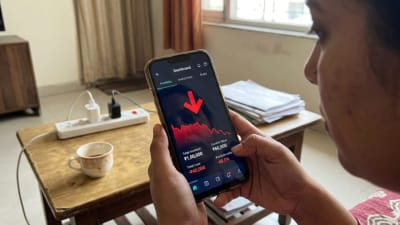
US government bond yields are creeping toward 5%. When they cross that line, something quiet but significant happens to Bitcoin — and it doesn't announce itself with a headline. The pressure builds slowly, then prices move fast.
So what exactly is the connection? Why does a number on a government bond affect your digital wallet — whether you're checking it in New York, London, or Mumbai?
Short Answer
When US bond yields cross 5%, safe money suddenly has somewhere better to be. You can earn 5% a year — guaranteed — just by lending money to the US government. That's a real, risk-free return. Bitcoin offers no guaranteed return. So large investors managing billions start asking: why take the risk of crypto when I can earn 5% doing nothing?
The answer: less demand for Bitcoin, lower prices. Analysts are currently pricing in a potential fall below $50,000 if yields cross 5% and hold there.
How It Works — The Seesaw Analogy
Think of it like a seesaw. On one side: risky assets like Bitcoin, tech stocks, and startup investments. On the other: safe assets like US government bonds.
When bonds pay almost nothing — say 2–3% — nobody wants to sit on the safe side. Money flows into risky bets. That's part of what pushed Bitcoin past $60,000 in recent bull runs.
Now flip it. When bond yields hit 5%, the seesaw tilts. A pension fund in London, a sovereign wealth fund in Singapore, a family office in Chicago — all face the same simple maths: pull money out of Bitcoin, park it in bonds, collect 5% without sweating a Sunday night price crash.
There's a second layer most people miss. When US yields rise, the US dollar tends to strengthen. Bitcoin is priced in dollars globally. A stronger dollar makes Bitcoin more expensive in other currencies — and in a market downturn, that dual pressure compresses prices fast.
The mechanical chain:
- Bond yields rise → bonds become attractive vs. risky assets
- Institutional capital rotates out of Bitcoin → selling pressure
- US dollar strengthens as yields rise → Bitcoin gets more expensive internationally
- Higher borrowing costs → businesses invest less, consumer risk appetite falls
- Bitcoin — still classified as speculative by most institutional mandates — takes the earliest hit
Real Example — The 2022 Rate Cycle
The data on this isn't speculative. In 2022, the Federal Reserve raised rates at the fastest pace in four decades. Bond yields climbed sharply throughout the year. By January 2023, Bitcoin had crashed from around $47,000 to under $16,500 — a 65% drop in roughly 12 months.
Not all of it was bonds — the collapse of FTX made things dramatically worse. But the rate environment set the stage long before any exchange went bankrupt.
What the numbers look like for your portfolio:
| Holder | Current position | At -30% drop |
|---|---|---|
| US investor | $50,000 in BTC | Loss of ~$15,000 |
| UK holder | £15,000 in crypto | Loss of ~£4,500 |
| Indian investor | ₹40 lakh in BTC | Loss of ~₹12 lakh |
As of March 2026, the 10-year US Treasury yield is hovering between 4.5% and 4.7%. Markets are watching 5% closely — crossing it would be the highest sustained yield in over 15 years. If it happens and holds, analysts currently see Bitcoin falling below $50,000 as a realistic scenario, not a fringe prediction.
Mistakes to Avoid
-
Ignoring bond yields entirely. Many people track Bitcoin's price every hour but can't tell you where the 10-year US Treasury yield sits today. As of late March, it's near 4.5–4.7%. That number is one of the single most important signals for crypto prices.
-
Panic-selling near the bottom. If Bitcoin drops toward $50,000 or below, retail investors historically sell hardest right before the recovery begins. The people who sold in December 2022 at $16,000 missed the entire 2023–2024 rally that pushed prices above $80,000. Selling in fear is how you crystallize a loss that might have been temporary.
-
Assuming a regular Bitcoin SIP is automatically safe. A monthly ₹5,000 SIP loses real money in a sustained bear market. Rupee-cost averaging helps — but a 30% drop still means your portfolio is down 30%. Averaging down only works if you have the runway to wait out the cycle.
-
Treating Bitcoin as a hedge against everything. It isn't. In a rising yield environment, Bitcoin and stocks tend to fall together. It's not diversification if they move the same direction.
3 Steps to Protect Your Portfolio Right Now
-
Set a Google Alert for "bond yields 5 percent." When that phrase starts trending in headlines, markets will already be moving. Getting the alert early — not after the drop — is the only edge a non-professional investor realistically has.
-
Review your total crypto exposure as a percentage of savings. If it's more than 10–15%, a 30% Bitcoin drop creates a real dent in your overall wealth. Also track the DXY (US Dollar Index) — a rising DXY adds extra downward pressure on Bitcoin. Both TradingView and Google Finance show it free.
-
If you're an Indian investor, remember you have two risks stacked. Bitcoin's dollar price falling and the rupee potentially weakening can move against you simultaneously. Keep at least a portion of savings in rupee-denominated instruments as a cushion against this dual exposure.
This content is informational only and should not be interpreted as a recommendation to buy, sell, or hold any security. Seek professional financial advice before acting on anything you read here.