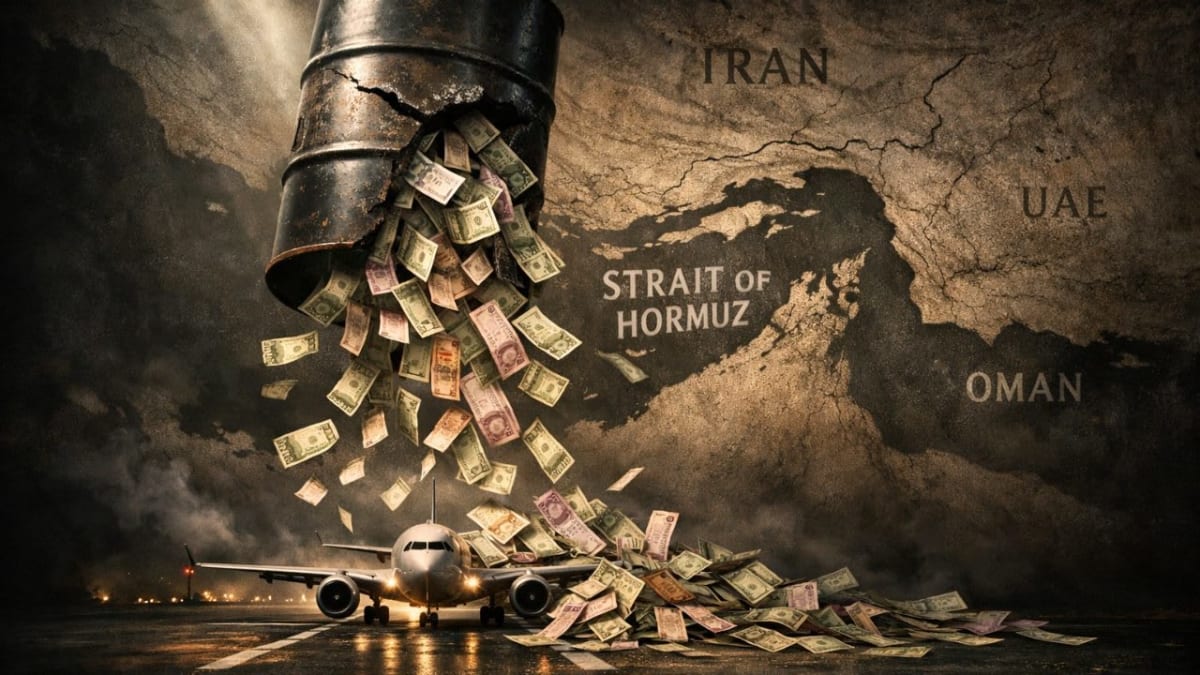
A barrel of Brent crude entered 2026 priced at roughly $61. By March 9, it briefly kissed $119.50—an almost 96% surge in under ten weeks. For passengers booking flights, this is now personal: Air India has announced a phased fuel surcharge that ranges from ₹399 on domestic routes all the way to $200 on flights to North America and Australia. The Tata-owned carrier did not bury the lead—it stated plainly that without the surcharge, certain routes could become commercially unsustainable and face cancellation. That sentence should matter to every investor watching India's aviation sector.
The Core Problem
The mechanics are straightforward. Aviation turbine fuel, or ATF, accounts for nearly 40% of an airline's operating costs, according to Air India's own disclosures. When the underlying commodity—crude oil—doubles in price within weeks, the cost structure of every flight in the network shifts dramatically. India compounds this problem with a structural tax burden: high excise duty and state-level VAT on ATF in major hubs like Delhi and Mumbai mean that Indian carriers absorb a premium over and above the global spot price.
The trigger this time is the ongoing US-Israel-Iran conflict, which has effectively closed the Strait of Hormuz—the narrow waterway through which approximately 20% of the world's seaborne crude exports typically transit, according to Kpler data. Iran has threatened to attack any tanker attempting passage, sending maritime insurers fleeing and tanker operators into a wait-and-see standoff. Goldman Sachs estimated that tanker traffic through the strait had fallen by roughly 90%, temporarily removing about 18% of global oil supply from accessible markets.
The knock-on effects inside India's aviation sector are already visible and measurable. Air India's phased surcharge structure tells its own story: ₹399 for domestic and SAARC routes, $10 for West Asia, $60 for Southeast Asia, $90 for Africa, $125 for Europe, and $200 for North America and Australia under Phase 2. Air India Express, the group's low-cost subsidiary, has not yet followed suit—offering a narrow buffer for budget travelers, but one that may not last long.
The central financial question is not whether fares rise—they already are—but whether surcharges can move fast enough to outpace the cost curve. History suggests they rarely do, at least not in time to protect quarterly earnings.
Historical Parallel
The closest modern precedent is Russia's invasion of Ukraine in February 2022, when Brent crude broke above $100 per barrel for the first time since 2014 and held the triple-digit range until mid-July of that year. Indian carriers took direct margin hits in Q1 and Q2 of FY23, with IndiGo reporting a quarterly net loss of ₹1,064 crore in Q1 FY23, partly attributed to fuel cost escalation. The airline industry globally took months to push surcharge levels high enough to offset those costs, and many never fully recouped the margin compression in that cycle.
But the current disruption is structurally larger. Rapidan Energy Group noted that the estimated 20% of global supply disrupted by the Hormuz closure is roughly twice as large as the record supply shock set during the Suez Crisis of 1956–57. In 1973, the Arab oil embargo sent Brent-equivalent prices up approximately 300% over several months, eventually forcing governments worldwide to ration fuel and ground non-essential flights. Airlines globally took years to restructure around that shock.
The 2022 Russia-Ukraine parallel carried one saving grace: Russian oil found alternative buyers, particularly China and India, limiting the actual physical supply withdrawal from global markets. The Hormuz situation is different—physical tanker access is blocked, not merely rerouted diplomatically. Iraq's oil production collapsed 70% to 1.3 million barrels per day from its pre-conflict level of 4.3 million barrels per day, per Reuters. Kuwait cut output. The UAE was managing offshore production levels cautiously. This time, the barrels simply aren't moving—and that distinction matters enormously for pricing.
The Data Under the Hood
WTI crude oil opened 2026 at $57.42 per barrel, per Capital.com data. By March 9, the US benchmark posted its biggest single-week gain in recorded history—35.6%—hitting an intraday high of $119.48, according to CNBC. Brent touched $119.50 in the same session. These are not ordinary volatility events. To put the speed in context: WTI moved more in ten days than most commodity markets move in a full year.
For Indian airlines, the translation into costs is mechanical and brutal. HSBC Global Investment Research estimates that every $1 per barrel increase in jet fuel prices raises IndiGo's annual fuel bill by approximately ₹300 crore. A $5 per barrel sustained increase compresses IndiGo's earnings per share by roughly 13%, according to brokerage estimates. Under a seven-day disruption scenario, HSBC calculated IndiGo's profit before tax impact at approximately ₹32 crore—equivalent to about 6% of its Q4 FY26 estimate. These numbers were modeled before Brent surged past $100.
On the equity side, the damage registered fast. InterGlobe Aviation shares fell 8% intraday on March 9, touching ₹4,050, and are down approximately 20% year-to-date as of that date. SpiceJet fell 5.29%, while GMR Airports declined 3.89%. The Indian aviation sector's P&L sensitivity to crude is now impossible to ignore—IndiGo's P/E ratio, hovering around 53x in early March 2026, was priced for a growth-and-efficiency story that a $100+ crude environment fundamentally disrupts.
Brent crude was trading near $88–$90 on March 10, easing after Trump signaled the conflict could end soon, triggering a partial IndiGo and SpiceJet rally of up to 8% on the same day. SpiceJet's CMD Ajay Singh, however, stated plainly that even $90 per barrel crude is 'unsustainable' for Indian carriers, per Bloomberg. The market's relief rally may be ahead of the underlying economics.
Two Sides of the Coin
The bull case for Indian aviation rests on the assumption that the Hormuz disruption is short-lived. Oil markets priced in significant de-escalation risk on March 10 when Trump signaled openness to talks with Tehran, and Brent retreated sharply from its peak. If the Strait reopens within two to four weeks, the oil shock could reverse almost as fast as it appeared—similar to how the initial Ukraine war premium partially dissipated within months as supply routes were rerouted. In that scenario, Indian airlines absorb one bad quarter of margin pressure, surcharges partially offset the hit, and the structural demand story for Indian aviation—one of the world's fastest-growing travel markets—remains intact. HSBC maintained its Buy rating on IndiGo through the turbulence, with a ₹5,500 price target implying significant upside from current levels.
The bear case is harder to dismiss. Rystad Energy's vice president for oil markets estimated in a March note that if current disruption conditions persist for two months, Brent would rise above $110. A four-month scenario pushes the target to $135 per barrel. Kpler's lead crude research analyst warned Brent could test $150 by end of March if Hormuz remains closed—a level last seen never in nominal terms. At those prices, no surcharge structure can fully protect airline margins. The Indian aviation industry was already projected to post net losses of ₹170–180 billion for FY2025–26, per analyst estimates. A prolonged $110–$135 crude environment doesn't compress that number—it blows it apart. SpiceJet, already financially strained, faces the sharpest balance sheet risk. The question is not just whether fares rise—it's whether some carriers survive the duration.
Scenarios & What-Ifs
Three credible scenarios are visible from current data, each with meaningfully different financial outcomes.
Scenario one, highest near-term probability: A ceasefire or credible de-escalation emerges within two to three weeks. Tanker traffic resumes gradually. Brent retreats toward the $75–$85 range as physical supply returns. Airlines absorb a one-quarter margin hit; surcharges are reduced in Phase 2 before full implementation. IndiGo recovers toward analyst targets. Travel demand remains resilient.
Scenario two, moderate probability: The conflict continues for four to six weeks without full closure of the Strait, but partial tanker movement resumes with naval escorts. Brent stabilizes in the $95–$110 range. Air India's phased surcharge structure runs to completion. IndiGo and SpiceJet face sustained EPS pressure of 15–25%. Route cancellations increase. The Indian rupee, exposed to import cost inflation from higher crude, weakens modestly, adding a currency layer to airline cost structures.
Scenario three, lower probability but non-negligible: The conflict extends to two months or more, Iraq and Saudi Arabia face production shut-ins, and Brent crosses $130. Emergency G7 strategic petroleum reserve releases provide partial relief but cannot replace physical throughput. Indian carriers facing route cancellations and a government ATF policy response becomes unavoidable. In this scenario, SpiceJet's financial resilience becomes the critical variable to watch.
The Bottom Line
Air India's surcharge isn't the story—it's a symptom. The real issue is that 20% of the world's oil is stuck behind a military standoff, and India's airlines, sitting on a 40% fuel cost structure with high domestic ATF taxes, are among the most exposed carriers globally. Watch Brent's 30-day trajectory and any Hormuz tanker traffic data—those two numbers will determine whether this is a one-quarter earnings miss or a sector-wide crisis.