The Number No One Is Telling You
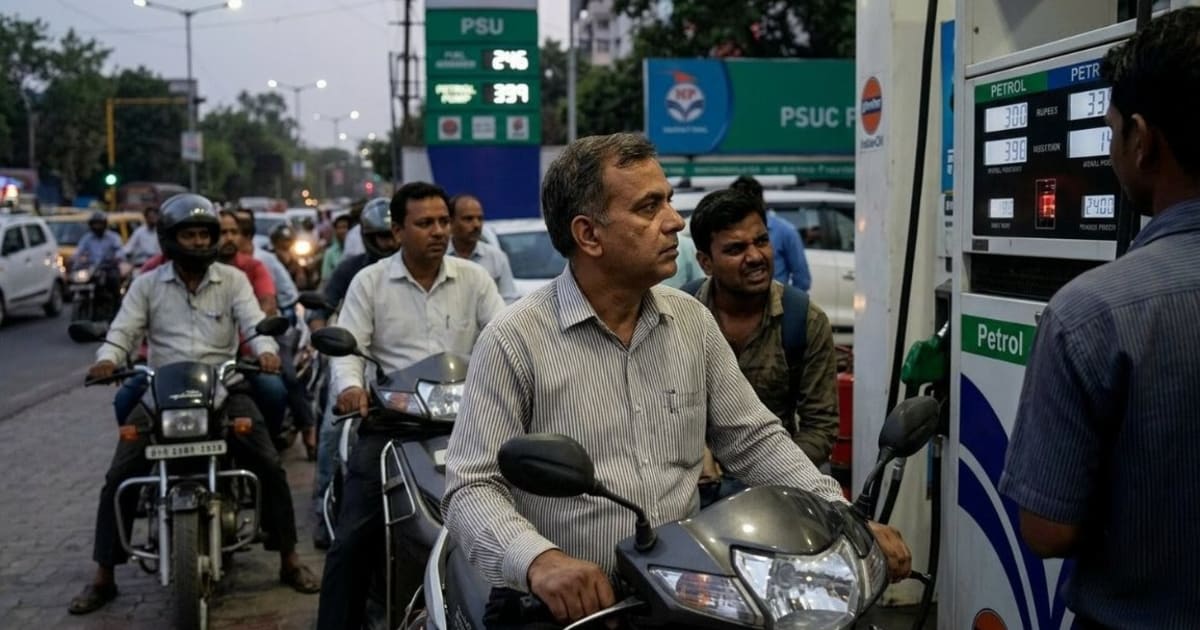
₹4,200. That is how much more a median salaried Indian household spends annually for every $10 rise in crude oil prices — when you account for fuel, cooking gas, food transport costs, and the electricity tariff creep that follows. Not per month. Per year, compounding quietly across your grocery bags, your auto-rickshaw fare, and your home loan EMI.
The Strait of Hormuz handles roughly 21% of global oil trade. It is 33 kilometres wide at its narrowest point. And right now, with West Asia tensions at a multi-year high, Union Bank of India's economics desk has flagged it as the single biggest tail risk to India's macro stability in 2026. The concern isn't just oil price — it's the sequence that follows: oil up, rupee down, inflation up, RBI stuck, rate cuts delayed, your EMI unchanged for longer.
Most headlines are tracking the $100-a-barrel threshold. That number matters less than what it triggers downstream — and the downstream is your household budget.
Why India Is Uniquely Exposed
India imports approximately 88% of its crude oil requirements. That single fact makes the country structurally vulnerable in a way that most emerging markets aren't. China imports more in volume, but it has strategic petroleum reserves and diversified sourcing. India's SPR covers roughly 9.5 days of consumption — a cushion, not a shield.
Here's what the exposure looks like in blunt numbers when crude moves from $75 to $100:
- Import bill increase: ~$25–28 billion annually, based on India's ~5 million barrels/day consumption
- Current Account Deficit widening: estimated 60–80 basis points of GDP, from ~1.2% toward 1.9–2%
- Rupee pressure: historical data shows a $10/bbl crude rise correlates with ~35–50 paise depreciation against the dollar
- CPI inflation add-on: approximately 30–40 basis points per $10 crude rise, through fuel and transport cost pass-through
- Fiscal cost: government's LPG subsidy burden rises by ₹8,000–10,000 crore per $10/bbl if retail prices are held
These aren't independent shocks. They compound. A wider CAD pressures the rupee. A weaker rupee makes the import bill more expensive in rupee terms — even if dollar crude stabilises. That feedback loop is what makes the Hormuz scenario genuinely dangerous.
The Household Math They're Not Running
Let's put a name and a salary on this. Assume you're earning ₹75,000/month — roughly the median for a metro salaried professional — and your household spends in line with NSSO consumption survey proportions.
Direct fuel costs (vehicle + cooking gas): Petrol prices have a direct excise-plus-marketing-margin structure. A $10/bbl crude rise historically transmits into ₹2–3/litre petrol hike when the government allows full pass-through. At 40 litres/month consumption:
- Extra petrol spend: ₹80–120/month → ₹960–1,440/year
- LPG cylinder: A $10 crude rise historically adds ₹35–50/cylinder. At 10 cylinders/year: ₹350–500/year
Indirect food inflation: Food prices don't care about oil headlines — until they do. Transport cost for vegetables, dairy, and packaged goods rises with diesel. Historically, a 10% diesel price rise pushes food CPI up by 40–60 basis points within two quarters. At ₹20,000/month food spend, a 0.5% food inflation add means:
- Extra food cost: ₹100/month → ₹1,200/year
EMI impact (the slow bleed): This is the part almost no one is calculating. If RBI delays rate cuts by one additional quarter because inflation from crude disrupts its glide path, a ₹50 lakh home loan at 8.5% floating rate doesn't fall to 8% as expected. That delay costs:
- One quarter of expected savings: ~₹6,250 in interest — not recovered
SIP portfolio (the invisible tax): A weaker rupee and sticky inflation compress equity valuations in rate-sensitive sectors — real estate, auto, NBFCs. Market pricing implies a 5–7% earnings downgrade for auto OEMs alone if crude sustains above $95. Your ₹10,000/month SIP in a diversified equity fund may not lose money, but its real return (post-inflation) compresses by 1.5–2 percentage points in the near term.
Adding it up conservatively: ₹4,200/year in direct and semi-direct costs, before counting EMI delays or portfolio drag. That's your personal Hormuz tax.
What the RBI Can — and Cannot — Do
The Reserve Bank of India is not a passive observer here. It has tools — but each tool has a cost.
What RBI is already doing: Market data shows the RBI has been intervening in the forex market to arrest excessive rupee volatility, drawing down foreign exchange reserves when the rupee slides toward 84.5/$. This limits the pace of depreciation but doesn't eliminate it. Forex reserves near $650 billion give the RBI meaningful firepower, but spending reserves has its own signalling risk.
The rate cut dilemma: The RBI was on track to ease monetary policy through 2026, given softening domestic inflation. A crude shock changes that math. If CPI climbs back toward 5.5–6% from the current ~4.5%, the Monetary Policy Committee's next move becomes constrained. It can't cut rates aggressively while inflation is re-accelerating. That means:
- Floating rate home loan borrowers: rate relief delayed by at least one cycle (August MPC)
- Fixed deposit investors: higher rates hold longer — this is one group that quietly benefits
- Bond market: yields rise, bond prices fall; debt mutual fund NAVs compress
What RBI cannot control: The pass-through of global crude to domestic prices is ultimately a fiscal decision — how much the government absorbs via excise cuts versus lets through to consumers. In the 2021–22 crude spike, the government eventually cut excise duty by ₹10/litre to arrest inflation. That cost the fiscal account roughly ₹1 lakh crore in revenue. Whether the current government repeats that playbook depends on state election calendars — and right now, several key states are in or near election mode, making a full pass-through politically difficult.
Who Actually Wins When Hormuz Tightens
Every disruption creates asymmetric outcomes. The losers are obvious — oil importers, airlines, road freight, paint companies, tyre makers. But the winners are less discussed.
OMC windfall (conditional): Oil Marketing Companies — HPCL, BPCL, IOC — look like losers at first glance when crude rises. But their marketing margins actually expand if the government delays retail price hikes. They absorb losses short-term but historically receive compensatory mechanisms. More interestingly, their refining margins on products like diesel and ATF spike during supply disruptions.
ONGC and Oil India: Every $1 rise in crude adds approximately ₹200–250 crore to ONGC's operating profit. At $100 crude, that's a roughly ₹5,000–6,000 crore annual uplift versus $75 base. Domestic upstream producers are direct beneficiaries — your portfolio's energy exposure matters here.
Renewable energy acceleration: This is the structural winner that no quarterly report captures yet. Every crude shock strengthens the political and economic case for faster solar and EV adoption. India's target of 500 GW renewable capacity by 2030 gets a policy tailwind each time Hormuz makes headlines. Companies in solar module manufacturing and EV charging infrastructure face a longer runway.
NRI remittances: A weaker rupee means NRIs sending money home get more rupees per dollar. Data from the RBI shows remittance inflows historically accelerate 8–12% in quarters where the rupee depreciates significantly — providing a partial natural hedge to the CAD widening that crude creates. This is a non-trivial offset: India receives ~$120 billion/year in remittances.
Two Outcomes Worth Tracking
Markets hate binary thinking, but the Hormuz situation genuinely bifurcates into two distinct probability-weighted paths — not three, not five. Just two.
Path A: Disruption stays rhetorical (base case, ~65% probability) The Strait stays technically open but insurance costs and rerouting fears keep crude in the $85–95 range. India's CAD widens modestly to ~1.7% of GDP. Rupee settles near 84–85/$. RBI pauses rate cuts for one quarter but resumes easing by Q3 2026. Your EMI stays flat for 3–4 months longer than expected. Inflation ticks up 30–40 bps but stays within RBI's 4% ± 2% band. The SIP portfolio takes a sector-level hit in autos and rate-sensitives but broader indices hold.
Path B: Physical closure or sustained blockade (~35% probability) Crude breaks $100 and sustains. Rupee tests 87–89 range. CPI approaches 6%. RBI is forced to choose between defending the rupee and supporting growth — historically, it defends the rupee first. Rate cuts are off the table for all of 2026. Fiscal deficit widens as subsidy costs rise. Government may announce a one-time excise cut of ₹5–8/litre to contain political fallout. Your EMI doesn't rise (rates are already set), but real wage growth turns negative as inflation outpaces salary increments. The ₹4,200 annual household hit becomes ₹7,000–8,500 in this scenario.
My Call
My take: crude won't sustain above $100 for more than 60 days without a physical Hormuz closure — and that remains unlikely. But even the threat is enough to delay RBI rate cuts by one full quarter, and that delay is already being priced in. I think the rupee settles in the 84.5–86 range through Q2 2026, your household costs rise by ₹3,000–4,500 annually, and the SIP investor who stays the course comes out fine — while the home loan borrower waits one quarter longer for relief than anyone told them.
What People Are Asking
How much will petrol prices rise if crude hits $100?
Based on historical pass-through patterns, a move from $75 to $100 crude could add ₹6–9/litre to petrol prices if the government allows full transmission. At average household consumption of 40 litres/month, that's ₹240–360 extra monthly or ₹2,880–4,320 annually. The actual hike depends on how much excise duty the Centre cuts to absorb the shock.
Should I change my SIP allocation because of the oil shock?
This is informational, not advice — but data shows oil-sensitive sectors like auto, aviation, paints, and road freight historically underperform by 8–15% in sustained crude upcycles. If your SIP is concentrated in these sectors via thematic or sectoral funds, the near-term return may compress. Diversified large-cap funds tend to be more resilient since they include energy upstream names like ONGC which benefit from higher crude.
When will the RBI's next rate decision come, and how does Hormuz affect it?
The next Monetary Policy Committee meeting is scheduled for August 2026. If crude sustains above $90 through June–July and CPI readings for May–June come in above 5%, the RBI is likely to hold rates rather than cut. A physical Hormuz disruption that pushes crude to $100+ could push any rate cuts to Q4 2026 or beyond. Watch the May CPI print (released mid-June) as the clearest early signal.
The views expressed here are for informational purposes and do not constitute personalized financial guidance. Readers should consult a licensed advisor before making investment decisions.