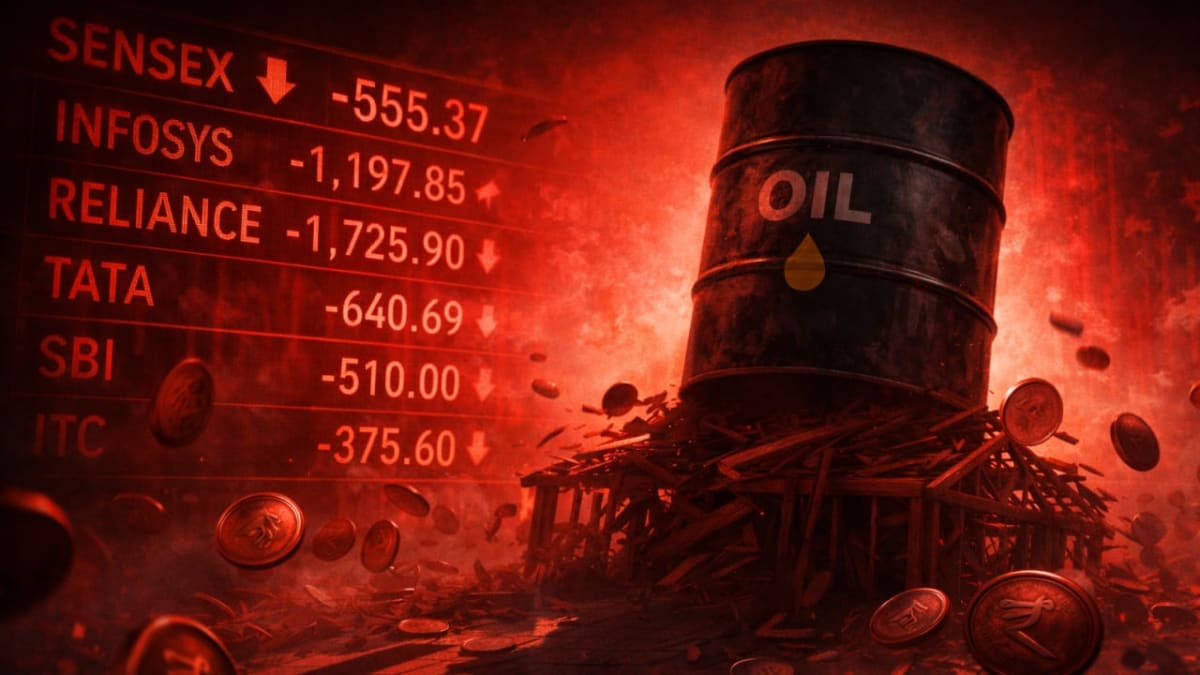
Picture a trader staring at two screens Monday morning. One shows Brent crude pushing past $90. The other shows Nifty futures flashing red in pre-market. The weekend brought no relief — just more headlines from West Asia, more uncertainty about what Tehran might do next, and a rupee that's been quietly bleeding for weeks. This isn't just geopolitical noise. Every dollar crude moves up costs India approximately $1.5 billion more per month in import bills. When war rumors move oil, they move wallets — yours included.
The Shift
The week ending March 7 was brutal by any measure. The Sensex shed over 1,100 points in a single session, closing below 79,000 for the first time in ten months. The Nifty50 dropped roughly 1.3%, dragged down by rising crude prices and investor anxiety about a potential escalation between the US and Iran. Brent crude, which had been hovering around $82–84 per barrel in February, lurched higher on conflict fears — a move that carries outsized consequences for India, which imports over 85% of its oil needs. The rupee, already under pressure from a strong dollar and persistent FII outflows, weakened further, compounding the macro stress. India's current account deficit — which widens when crude rises — suddenly became the talk of trading desks again. Telegraph India flagged the risk plainly: the West Asia crisis is creating simultaneous pressure on inflation, the current account deficit, and the rupee. Three vulnerabilities. One trigger. That's the dangerous geometry the market is now pricing in, and Monday's gap-down open, flagged by News18's technical analysis, may only be the opening move in a longer adjustment.
What Everyone Thinks
The consensus on Dalal Street right now is straightforward and deeply pessimistic. Most market participants believe that if US-Iran tensions escalate into open conflict, oil could surge past $100 per barrel — a level India hasn't had to absorb since 2022. At $100 crude, RBI's inflation management becomes dramatically harder, rate cuts get pushed further out, and corporate margins across sectors from aviation to paints to chemicals come under severe pressure. The FII selling narrative — already strong through February — gets a fresh justification. Why stay in an oil-importing emerging market when geopolitical risk is spiking? The mainstream view also holds that the rupee is the most vulnerable channel. A weaker rupee raises the cost of oil imports even further, creating a feedback loop: crude up, rupee down, inflation up, rates stay high, growth slows, equities fall. Mint's weekly trigger roundup essentially reflects this consensus — five interlocking risks, each capable of amplifying the others. Most retail investors are being advised to reduce exposure to rate-sensitive sectors and avoid averaging down in mid and small caps until the dust settles.
The Contrarian Take
Here's what the panic narrative is missing. India in 2026 is not India in 2018 — the last time oil and geopolitics combined to batter the rupee and markets simultaneously. Foreign exchange reserves stand at approximately $640 billion, giving the RBI firepower to defend the rupee that it simply didn't have eight years ago. India's fiscal deficit, while not pristine, is being managed within target bands. And critically, domestic institutional investors — mutual funds flush with SIP inflows running at a record Rs 26,000 crore per month as of early 2026 — are providing a demand cushion that didn't exist during previous oil shocks. The FII selling that's been dominating headlines? DIIs have been absorbing a significant portion of it. Markets rarely crash in straight lines when there's a structural buyer in the system. There's also the oil hedge argument. India has been quietly diversifying crude suppliers since 2022, with Russian oil now comprising roughly 35–40% of imports at discounted prices. A West Asia supply disruption hurts global benchmarks, but India's actual import cost may not spike as severely as Brent futures suggest. The market may be pricing in a worst case that doesn't fully materialise. That gap — between fear and fundamental reality — is where patient capital tends to find opportunity.
The Uncomfortable Math
Let's be precise about the numbers, because vagueness is expensive. Every $10 rise in Brent crude adds approximately 0.4 percentage points to India's CPI inflation, according to RBI's own modelling frameworks. If crude moves from $85 to $105 — a $20 move that's plausible in a genuine US-Iran escalation — inflation could tick up by nearly 0.8 percentage points, pushing headline CPI closer to 5.5–6%, well above RBI's 4% target midpoint. That would almost certainly kill any hopes of a rate cut in the April or June MPC meetings. For equity valuations, higher rates mean higher discount rates, which compress PE multiples. The Nifty is currently trading at roughly 19–20x forward earnings — not cheap, but not bubble territory either. A multiple compression to 17–18x, which rising rate expectations could trigger, implies a further 8–10% downside from current levels before fundamentals reassert themselves. On the currency side, the rupee has already crossed 87 to the dollar. A sustained crude rally could push it toward 89–90, adding to imported inflation and widening the current account deficit toward 2.5–3% of GDP — uncomfortable, but not catastrophic given the reserve buffer. The math says this is serious. It also says it's survivable. The difference between a correction and a crisis often comes down to duration — how long the shock lasts.
Where This Actually Goes
The question for Indian markets this week isn't whether there will be volatility — there will be. The real question is whether this is a repricing event or the beginning of a sustained bear phase. Historically, geopolitical oil shocks tend to be sharp but mean-reverting unless they trigger structural supply disruptions lasting more than three to six months. Iran-related tensions have spiked crude before — 2019, 2020 — and markets recovered within quarters. What would make this different is if the conflict disrupts Strait of Hormuz flows, through which roughly 20% of global oil supply passes. Until that threshold is crossed, the base case remains a painful but temporary correction, not a fundamental breakdown.
The Bottom Line
Sensex down 1,100 points, crude flirting with $90, rupee under pressure — your portfolio is feeling West Asia before the war even starts. The math is uncomfortable but not catastrophic: India has more buffers now than in any previous oil shock. Watch crude, watch the Strait of Hormuz, and watch whether DII flows hold — those three signals will tell you more than the headlines will.


