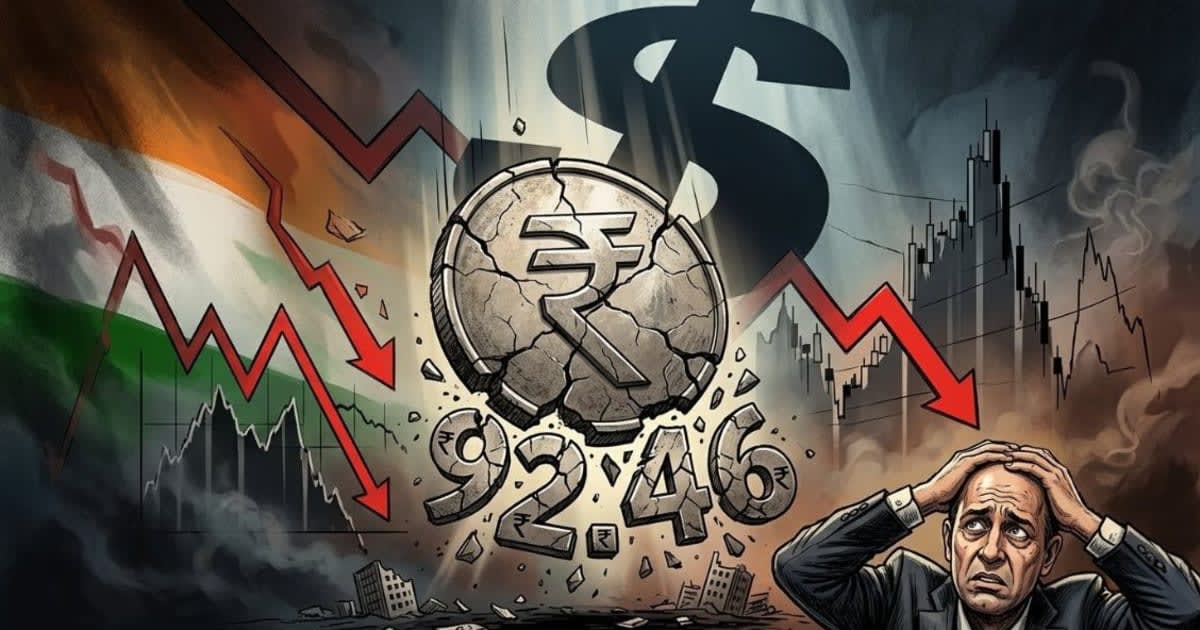
The rupee closed at 92.46 against the US dollar on Friday — a number that would have been unthinkable twelve months ago, when the same dollar bought just 84 rupees. That is a 10% collapse in purchasing power in under a year, and it is not slowing down.
This week alone, the currency dropped 0.7%. That sounds modest until you translate it: for an Indian business importing $1 million worth of crude or electronics equipment, this single week's move added roughly ₹6.46 lakh to the invoice — money that was not budgeted, cannot be recovered, and hits margins immediately. Multiply that across an economy that imports more than 85% of its oil, and the damage compounds fast.
For US and UK investors with exposure to Indian equities, emerging market funds, or simply anyone watching global currency stress as a leading indicator of broader contagion, the rupee's trajectory this week deserves serious attention. This is not just India's problem.
What's Happening
Three forces collided this week to push the rupee to its worst-ever close. None of them is new. All three are getting worse simultaneously.
First: oil. Brent crude held near $100 a barrel through the week, with West Texas Intermediate staying close to $95. India is the world's third-largest oil importer, sourcing more than 85% of its crude requirements from abroad. Every time oil climbs $10 per barrel and stays there, India's annual import bill swells by roughly $15 billion. That is $15 billion of relentless dollar demand flowing out of the rupee and into the greenback — pure, structural selling pressure on the currency that no central bank can fully offset.
Second: foreign investor exits. Foreign institutional investors pulled approximately $4 billion from Indian equities in the first two weeks of March alone, according to market data. On a year-to-date basis, net outflows from Indian stocks have hit $18.5 billion. Global money is chasing the safety of the US dollar and retreating from emerging markets broadly — India is not uniquely targeted, but its relatively high equity valuations after years of strong returns make it an obvious place to lighten positions when fear rises.
Third, and least discussed: the trade policy overhang. The US-India trade deal that markets were counting on to anchor sentiment has stalled. With no visible progress on that negotiation, one of the key positive catalysts that analysts had built into their year-end rupee forecasts has simply not materialised. Nomura and S&P Global Market Intelligence had both pencilled in 92 as their end-of-March target — a forecast that looked pessimistic two months ago and now looks accurate, if not conservative.
The Reserve Bank of India has not been sitting idle. Estimates suggest the central bank sold between $18 billion and $20 billion last week alone in direct foreign exchange intervention, depleting reserves at a pace that cannot be sustained indefinitely. The RBI also deployed buy-sell currency swaps to inject liquidity and prevent a full-blown crisis in domestic money markets. It is an aggressive defence — but the question every currency trader is asking is how long the RBI can keep absorbing this pressure before the dam breaks.
Why Your Money Cares
If you are based in the US or UK, there is a direct line from a weakening rupee to your portfolio — it just runs through less obvious channels than a domestic stock pick.
Emerging market funds, which sit inside many standard pension and investment portfolios on both sides of the Atlantic, carry Indian equities as a significant weight. The BSE Sensex fell more than 5.5% this week — its worst weekly performance in four years. BSE-listed companies collectively shed ₹20 lakh crore in market capitalisation in a single week. For investors holding global EM ETFs or actively managed emerging market funds, that kind of move typically shows up as a 1–2 percentage point drag on the fund's weekly return, depending on the India allocation.
There is a broader signal here too. When a major emerging market currency breaks to all-time lows against the dollar under conditions of $100 oil and capital flight, it raises the probability that other EM currencies follow. The Indonesian rupiah, the Thai baht, and the South African rand are all watching the rupee's trajectory closely. A coordinated EM currency selloff would tighten global financial conditions beyond what central banks in the US and UK have already engineered — and that matters for mortgage rates, corporate borrowing costs, and risk appetite globally.
For the UK specifically, the India-UK Free Trade Agreement — still under negotiation — becomes harder to finalise when one side's currency is in freefall and import inflation is accelerating. Business planning across sectors that had priced in post-FTA cost structures has to be recalibrated.
The Numbers That Matter
The headline rate of 92.46 tells only part of the story. The trajectory is what should command attention.
The rupee opened 2026 at 85.64 against the dollar. It crossed 90 — a major psychological level — before mid-January, taking less than 15 trading sessions to then push through 91. It has now closed above 92 for multiple consecutive sessions, having eclipsed successive record lows almost daily this week. That kind of momentum, once established in currency markets, tends to attract rather than repel further selling, as importers rush to hedge future dollar needs and exporters hold back from converting foreign receipts in hope of a better rate later.
MUFG's currency strategists ran the numbers this week. Their base case, with oil holding around $100 per barrel, puts the dollar-rupee rate at 95.50 by year-end — a further 3.3% depreciation from current levels. Their adverse scenario, where crude climbs to $120 amid an extended Middle East conflict, puts the rupee at 97.50 or beyond. At 97.50, a US company paying Indian software or outsourcing firms in rupees would be receiving a meaningful cost reduction in dollar terms — a currency dividend, of sorts. But for Indian households importing fuel, medicine, or electronics priced in dollars, that same rate means a material squeeze on real purchasing power.
India's consumer price inflation came in at 3.21% for February — up sharply from 2.74% in January and the fastest pace in 11 months. That number will almost certainly accelerate in March, as the LPG price hike of ₹60 per cylinder for households and ₹144 for commercial users flows through. Analysts at brokerage firms covering consumer staples flagged this week that Zomato's restaurant margins could take a 7% hit from rising LPG and fuel costs — a granular signal of how quickly the commodity shock is reaching the consumer economy.
Remittance flows from the Gulf — which account for roughly 3.5% of India's GDP — face a secondary risk if the West Asia conflict deepens and disrupts worker populations in the region. That is a tail risk, not a base case, but it would remove one of the rupee's structural support mechanisms if it materialised.
The Street Mood
The mood in currency markets this week was not panic — but it was close.
Traders describe the dynamic as a one-way market where buyers of dollars are aggressive and sellers of dollars are cautious. The RBI's intervention — aggressive as it has been — has succeeded in slowing the rate of decline without reversing it. That is a meaningful distinction: a central bank that is managing the pace of depreciation has implicitly acknowledged that some depreciation is happening regardless. Markets read that signal clearly.
Analysts are divided on whether the rupee finds a floor near current levels or extends toward 94–95. The optimistic camp points to India's current account deficit, which at 1–1.5% of GDP remains well within manageable bounds, and to the structural story of India's domestic consumption-driven economy, which is less externally exposed than manufacturing-heavy peers. The pessimistic camp — currently winning the argument in price action — notes that a country importing 85% of its oil at $100 per barrel, while simultaneously watching $4 billion walk out the door in a single fortnight, is not in a position to demand a premium on its currency.
The Sensex and Nifty 50's weekly performance says everything about domestic investor sentiment. The Nifty fell 5% — its steepest weekly drop since 2022. The Sensex settled around 74,563, having been above 80,000 as recently as December. That is a roughly 7% decline from the year's earlier peaks, denominated in rupees. For a US or UK investor holding an unhedged India equity position, the dollar-adjusted losses are considerably larger once you fold in the 10% year-to-date currency depreciation.
What to Watch
Three triggers will determine whether this week's record close is a floor or a staging post to something worse.
The most important is the Iran conflict timeline. Prediction markets currently assign a roughly 48% probability to no ceasefire before end of April. If the Strait of Hormuz remains disrupted past mid-April, oil stays elevated, dollar demand from India's import bill continues, and the rupee's path toward 94 becomes the path of least resistance rather than a tail scenario. Every week the conflict persists is another week of structural selling pressure that no RBI intervention can fully absorb.
The second trigger is RBI's next policy meeting and any updated guidance on intervention capacity. The central bank's foreign exchange reserves, while still substantial, have been drawn down materially — spending $18–20 billion in a single week is not a sustainable pace. If the RBI signals a shift toward allowing greater currency flexibility rather than defending specific levels, the market will treat that as implicit permission for further depreciation.
The third is the US-India trade deal status. Any substantive progress on that negotiation would restore a positive catalyst that has been absent from rupee forecasts all year — and could trigger a meaningful short squeeze as traders who positioned for continued weakness scramble to cover. The rupee closed at 92.46 on Friday. It started the year at 85.64. How that gap closes — and whether it closes at all — is a question that will be answered, as it almost always is in currency markets, not in negotiating rooms but at the next RBI press conference and the next oil price tick.
💰 What this means for your money: For US investors in EM funds, India's 10% currency drop this year costs ~1-2% of fund value.
"The rupee has lost 10% against the dollar since January. For an unhedged investor, that erases a year of equity gains overnight."
The Bottom Line
The rupee at 92.46 is not a blip — it is the logical destination of an oil shock landing on an economy that imports 85% of its crude and is simultaneously watching billions in foreign capital walk out the door. The RBI is fighting hard, but spending $20 billion a week to slow a decline is not the same as stopping one. Until oil comes off $100 or the trade deal gets unstalled, the path of least resistance for this currency remains downward.
Frequently Asked Questions
Why is the Indian rupee falling against the dollar right now?
The rupee is being hit by three simultaneous pressures: oil near $100 a barrel, which forces India to buy dollars to pay for energy imports; a strong US dollar attracting global capital away from emerging markets; and foreign investors pulling roughly $4 billion from Indian equities in March alone. The result is persistent, heavy demand for dollars against a currency with limited natural buyers.
How does a weaker rupee affect me as a US or UK investor?
If you hold emerging market funds, the India allocation — typically 10–15% of most EM ETFs — has delivered a double loss this week: the Sensex fell over 5.5% in local currency, and the rupee itself weakened a further 0.7%. On an unhedged basis, that can translate to a 1.5–2 percentage point drag on a standard EM fund's weekly return. Over the year, the rupee is now 10% weaker against the dollar, erasing significant returns for unhedged investors.
What would make the rupee recover, and when might that happen?
The fastest single catalyst would be a ceasefire in the Middle East bringing oil back below $80, which would immediately reduce India's dollar import demand. Progress on the US-India trade deal would be a second meaningful trigger. Watch the RBI's next policy statement — if the central bank signals confidence rather than stress, short-covering alone could produce a sharp technical recovery toward 90–91. The nearest scheduled RBI meeting is in early April.


