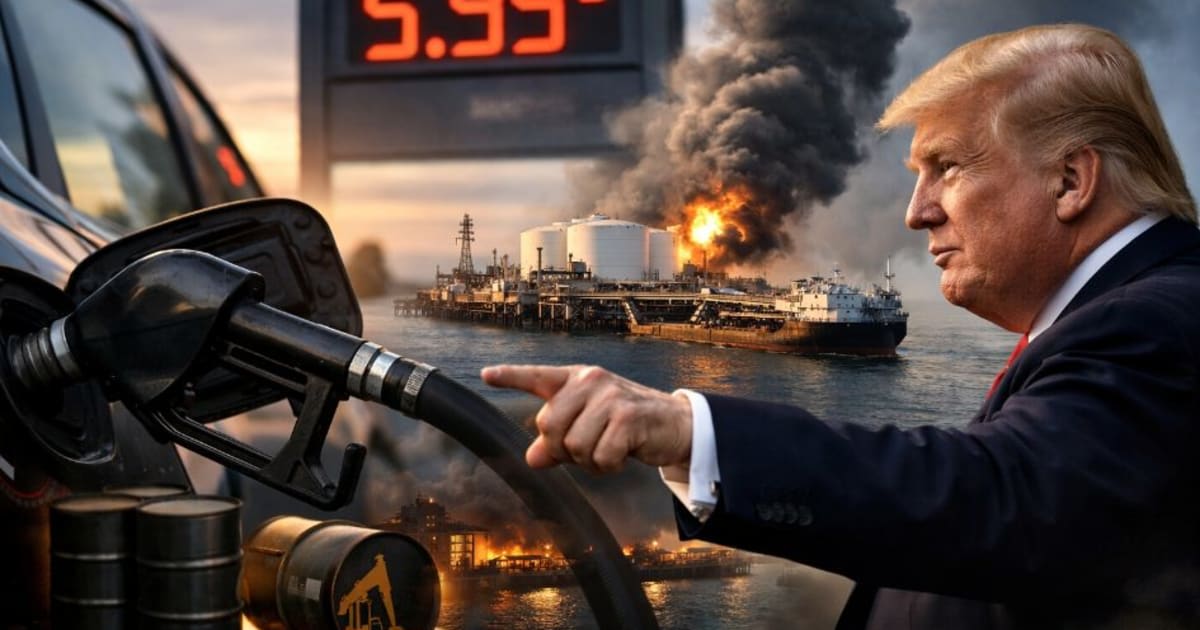
Oil just crossed $100 a barrel. That number hasn't appeared on trading screens since the post-pandemic commodity surge, and its return — triggered by a single presidential threat against Iran's most critical piece of energy infrastructure — should concentrate minds well beyond Wall Street. For the average American filling a mid-size SUV, a sustained $100 oil price translates to roughly $85 more per month at the pump compared to where prices were sitting in January. That's not a rounding error. That's a grocery run gone sideways.
The trigger is specific. President Trump warned that Kharg Island — the offshore terminal through which roughly 90% of Iran's crude oil passes before reaching global markets — could become a military target. The market didn't wait for confirmation. Brent crude moved more than 4% in a single session before settling around $101, the kind of single-day repricing that locks in higher fuel costs for weeks ahead regardless of what happens diplomatically.
Iran's retaliatory drone strike on a UAE oil terminal piled on. Two major Middle Eastern energy flashpoints activating within days of each other is not coincidence — it's escalation. And when oil escalates, everything downstream follows: airline stocks slide, shipping costs climb, inflation expectations tick upward, and the Federal Reserve suddenly faces a problem it thought it had buried. You may not trade crude futures. But $100 oil trades you.
The Core Problem
Kharg Island is not just an oil terminal. It is the arterial valve of Iran's entire petroleum economy — and the global market just had to confront the possibility that it might be switched off.
Situated roughly 25 kilometers off Iran's southwestern coast in the Persian Gulf, Kharg processes somewhere between 2.3 and 2.5 million barrels per day of Iranian crude. That figure represents the overwhelming majority of Iran's export capacity, which itself sits around 3.3 million barrels per day. Lose Kharg, and Iran effectively loses its ability to monetize its oil reserves. The island is not easily substitutable — Iran's secondary terminals lack the loading infrastructure, storage capacity, and deep-water access that supertankers require. A strike or sustained blockade doesn't just hurt Iran. It removes a meaningful chunk of global supply with no short-term replacement available anywhere.
The math is uncomfortable. Global oil markets currently carry around 3 to 4 million barrels per day of effective spare capacity, the majority sitting with Saudi Arabia. On paper, that buffer looks adequate. In practice, tapping Saudi spare capacity takes weeks to ramp, and it still wouldn't fully replace Kharg's throughput. A two-week supply gap at that scale would push oil toward $120, by most trading desk estimates. At $120 a barrel, American consumers are looking at $4.50 to $5.00 per gallon at the pump nationally — a level last seen during the worst of the post-Ukraine commodity spike in 2022. For a US household running two vehicles, that means an additional $150 to $200 per month in fuel costs alone, before a single other price in the economy has moved.
The problem isn't just supply. It's geography. Kharg sits near the mouth of the Persian Gulf, and any sustained military action in that zone immediately raises questions about the Strait of Hormuz — the 21-mile-wide chokepoint through which roughly 20% of the world's traded oil flows every single day. Around 17 million barrels pass through Hormuz daily. Iran has threatened before to close it. The market has always assumed that was a bluff. That assumption is being stress-tested in real time, and the pricing reflects it.
Why hasn't this resolved? Because the diplomatic architecture that once held US-Iran tensions in check — the 2015 JCPOA nuclear deal — is effectively rubble. There is no functional back channel, no crisis hotline operating at the level needed to de-escalate quickly. The US is reportedly weighing what officials describe as high-risk options, without committing to direct strikes on oil infrastructure — which is itself a signal. The administration knows the market consequences, but hasn't taken the option off the table. That calculated ambiguity is precisely what sent oil past $100. Markets can price bad news. They struggle to price uncertainty.
Historical Parallel
The last time geopolitical threats to Persian Gulf oil infrastructure pushed crude decisively above $100, the chain of events that followed took two years and a global recession to unwind. That was 2008, when Brent touched $147 a barrel. But the more instructive parallel isn't 2008. It's 1979.
The Iranian Revolution removed approximately 5.6 million barrels per day from global supply almost overnight. Oil prices didn't double — they more than doubled, moving from roughly $15 a barrel in early 1978 to over $35 by 1980. In today's inflation-adjusted terms, that move is equivalent to oil going from $65 to $150. The US economy entered recession. Inflation, already elevated, became entrenched. The Federal Reserve under Paul Volcker was eventually forced to raise interest rates to 20% to break the inflationary spiral — a medicine that caused unemployment to spike above 10% and wiped out billions in household wealth across America. For families at the time, the damage was immediate and physical: gasoline rationing returned for the first time since World War II, odd-even license plate rules dictated which days drivers could fill up, and heating oil shortages meant genuinely cold homes in Northern states through the winter of 1979.
The 2019 drone strike on Saudi Arabia's Abqaiq processing facility is a closer modern analogue. That attack, attributed to Iranian-backed Houthi forces, temporarily knocked out roughly 5% of global oil supply and sent Brent crude up 15% in a single session — the largest single-day price move in over a decade at that point. Oil peaked around $71 that day before retreating as Saudi Arabia confirmed production would be restored within weeks. The key difference then and now is stark: Abqaiq was restored quickly. Kharg Island, in a sustained conflict scenario, could not be restored on any short timeline, because the damage would be to infrastructure that took decades to build.
What's materially different this time? Three things. First, inflation is not dead — it's dormant. A sustained oil spike now hits an economy where price expectations are already sensitive, meaning the pass-through to consumer prices would be faster than in 2019. Second, the US Strategic Petroleum Reserve, used aggressively to cap oil prices during the 2022 Ukraine spike, currently holds roughly 400 million barrels — well below its historical average of 700 million, which limits Washington's ability to absorb shocks. Third, global spare production capacity is tighter than at any point since 2008. History doesn't repeat. But the cost of ignoring it compounds interest.
The Data Under the Hood
The headline number is $100 a barrel. The more important number is $10 — because that's roughly how much crude prices have risen in the past five trading sessions, and every $10 sustained rise in oil translates to approximately 24 to 25 cents per gallon added to US pump prices within two to three weeks. For UK drivers, each $10 rise in Brent adds roughly 2 to 3 pence per litre at the forecourt. Small on their own. Compounded across a full year of driving, a US household operating two vehicles loses another $600 to $700 in annual purchasing power — the equivalent of a monthly utility bill, gone, with nothing to show for it.
Look at what the options market was pricing before Trump's statement. Implied volatility on crude oil futures — a measure of how much uncertainty traders are paying to insure against large moves — was running at historically moderate levels around 28 to 30%. Within hours of the Kharg Island warning, that figure spiked above 40%, consistent with levels seen during the COVID-19 demand crash in 2020 and the first weeks of the Ukraine invasion in 2022. Traders weren't just buying oil. They were panic-buying protection against oil going dramatically higher.
Positioning data from the Commodity Futures Trading Commission tells a parallel story. Hedge fund net-long positions in WTI crude — bets that oil will rise — surged to their highest level since late 2023 in the week preceding this spike. The presidential warning didn't create the move. It detonated a powder keg that was already packed.
The broader supply picture adds context the daily headlines consistently skip. OPEC+ production cuts, in place since late 2022 in various forms, have kept roughly 5.8 million barrels per day off global markets. That supply could, in theory, return. But not all of it is immediately deployable. Saudi Arabia can credibly bring back around 2 to 2.5 million barrels per day within 90 days. The remainder — sitting with the UAE, Kuwait, and Iraq — faces infrastructure constraints, contract complications, and political considerations that make rapid deployment unreliable. The buffer is real but slower than the crisis calendar.
US shale is the other variable that deserves close attention. American production currently sits around 13.2 million barrels per day, near record highs. Shale producers can respond faster than conventional oil fields — a new well can go from approved to producing in as little as 60 to 90 days — but the economics only support acceleration if oil holds above roughly $75 to $80 per barrel consistently. At $100, every major shale producer's cash flow model looks dramatically better. Expect capital expenditure guidance to be revised upward at the next round of quarterly earnings. That is a signal worth tracking if you hold energy sector ETFs or individual producers.
The currency angle is the one most oil coverage leaves on the table. Oil is priced in dollars. When oil surges, the dollar typically strengthens as oil-importing nations must acquire more dollars to pay for their fuel. A stronger dollar makes UK and European exports less competitive, compresses emerging market margins, and puts acute pressure on currencies like the Indian rupee and Turkish lira, whose governments spend heavily on subsidized fuel imports. The dollar index was already up 0.6% on Monday. That quiet half-percentage-point move ripples through trade balances, inflation forecasts, and central bank rate expectations across three continents.
Two Sides of the Coin
The bull case for oil here isn't speculative. It's structural — and it doesn't require a single missile to be fired.
Threat alone is doing the work. Geopolitical risk premiums, once embedded in oil pricing, are notoriously sticky. The 2019 Abqaiq attack added roughly $5 to $7 per barrel to oil's base price for several months, even after Saudi production recovered fully. A credible and ongoing threat to Kharg Island — one backed by public statements from the sitting US president — sustains that premium indefinitely without any kinetic event. If the standoff drags on unresolved through April, oil analysts at major trading desks are marking their Q2 forecasts up toward the $105 to $110 range. At those levels, average US gas prices cross $4.50 per gallon nationally. Some high-cost states push north of $5.50. UK forecourt prices approach the record highs of 2022, when diesel hit 199 pence per litre and family budgets bent visibly under the weight.
The bear case is real, but it requires coordination that history suggests is difficult to execute quickly. If OPEC+ moved to fully unwind its voluntary production cuts — a decision requiring agreement among 13 member states with competing national interests — it could theoretically add back enough supply to offset the Kharg risk premium and push oil back below $90. Saudi Arabia, in particular, has expressed private discomfort with prices above $100. Riyadh understands that sustained high oil creates the conditions for demand destruction and accelerated transition away from fossil fuels — neither outcome serves the kingdom's long-term revenue model.
The bear case also rests on the assumption that Trump's threat remains exactly that: a threat. US administrations have maintained a consistent, bipartisan reluctance to directly strike oil infrastructure in the Persian Gulf, for the straightforward reason that doing so punishes American consumers first and most visibly. That calculus hasn't changed. The threat is more likely a negotiating lever than an operational plan, and sophisticated oil traders are pricing that probability in. If the market concludes this is pressure rather than prelude, the risk premium partially deflates and oil retreats toward $92 to $95.
The honest read is that neither side is clearly winning this argument. Oil markets are pricing roughly a 60/40 split between continued elevated tension and some form of de-escalation — which is why prices haven't gone to $120 but also haven't fallen back to $95. That equilibrium is fragile, and the next significant diplomatic or military development will break it decisively in one direction.
Scenarios & What-Ifs
Three scenarios are worth pricing from here, and they carry very different consequences for energy bills, portfolios, and the broader US and UK economies.
Scenario one: diplomatic retreat. Trump's threat achieves its intended effect — pressuring Iran back toward negotiation — and no military action materializes. Oil pulls back toward the $88 to $93 range over the following three to four weeks as the risk premium deflates. This is the market's current base case, though by a thin margin. The Federal Reserve gets a reprieve: inflation expectations stabilize, and the case for holding rates steady remains intact. US gas prices ease back toward $3.50 to $3.80 per gallon nationally. Energy sector stocks, which rallied sharply this week, give back some gains as the supply-disruption narrative cools.
Scenario two: sustained standoff, no kinetic action. The threat remains live, neither side blinks, and oil consolidates in the $98 to $108 range through the second quarter. This is the most underappreciated risk — it doesn't require a dramatic event to cause significant damage. Sustained $100-plus oil through Q2 would add an estimated 0.4 to 0.6 percentage points to US headline inflation by June. That changes the Fed's calculus meaningfully. Rate cuts that markets were pricing for the second half of 2026 get pushed back, bond yields stay elevated, and mortgage rates for American homebuyers remain sticky above 7%. Quiet, grinding, expensive.
Scenario three: kinetic escalation. A US strike on Iranian targets, or an Iranian attack on another Gulf energy hub, triggers a full supply disruption. Oil spikes toward $125 to $135 in the first 72 hours — a probability that options pricing currently puts somewhere in the 15 to 20% range. US gas would breach $5 nationally within weeks. UK pump prices would push toward record highs. Global equity markets would fall sharply on recession fears, and the dollar would surge, hurting anyone with exposure to emerging market assets.
Oil crossed $100 this morning on a threat. The question now is whether the diplomats or the generals determine what brings it back down — and whether either answer ends up being cheaper than what sent it up.
💰 What this means for your money: For the avg US household: ~$85/month more at the pump vs January 2026
"Oil didn't need a strike. It just needed the threat — and that's what makes $100 so hard to unwind."
The Bottom Line
Oil at $100 is a tax. It's not levied by Congress, it doesn't show up on your pay stub, but it comes straight out of your wallet through the pump, through airfares, through anything that moves in a truck. Trump's Kharg Island threat may well be negotiating leverage — sophisticated traders are pricing that possibility at roughly 60% odds. But leverage only works if the other side blinks, and right now nobody is blinking. Watch the diplomatic calendar, not just the price ticker.
Frequently Asked Questions
Why did oil prices go above $100 today?
Crude oil crossed $100 a barrel on March 16 after President Trump publicly threatened Kharg Island, the offshore terminal through which roughly 90% of Iran's crude oil exports pass. The threat immediately triggered geopolitical risk premium buying across oil futures markets, pushing Brent crude up more than 4% in a single session. An Iranian drone strike on a UAE oil terminal added further supply-disruption fears and accelerated the move.
How does $100 oil actually affect my gas prices and household bills?
Every $10 sustained rise in crude oil adds roughly 24 to 25 cents per gallon to US pump prices within two to three weeks. Compared to January 2026 levels, $100 oil could mean $70 to $90 more per month for a US household running two vehicles. UK drivers face roughly 2 to 3 pence per litre per $10 oil rise, adding £200 to £300 to annual fuel costs if prices hold at current levels.
What should I watch to know whether oil prices keep rising or fall back?
Three triggers matter most: any official OPEC+ statement on emergency production increases, any US diplomatic contact with Iranian officials suggesting back-channel talks are underway, and the weekly EIA crude inventory report — a significant surprise build in US crude stocks would pressure prices lower. The next market-moving window is the OPEC+ monitoring committee meeting expected around March 20 to 22.