The deal closed in two hours. That is the detail nobody is talking about loudly enough.

Nexstar Media Group received Federal Communications Commission and Department of Justice clearance for its $3.5bn acquisition of Tegna on Thursday, March 19, 2026 — and announced the transaction was done within 120 minutes of that approval. Eight state attorneys general had already filed a federal antitrust lawsuit the previous evening in Sacramento. DirecTV had filed its own suit that same morning. None of it mattered. The merger was legally complete before any court could read an emergency brief, let alone act on one.

That speed was not administrative efficiency. It was strategy.

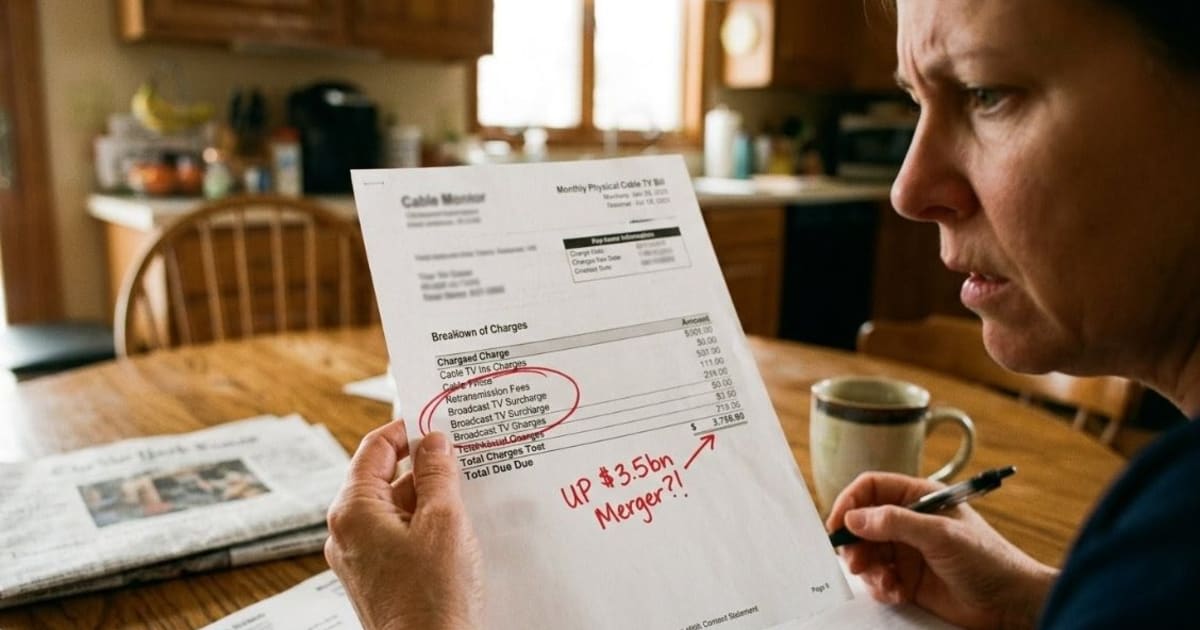
For the roughly 60 million American households still paying for cable or satellite TV, this merger carries a direct financial consequence. Retransmission fees — the payments your cable company makes to local broadcasters to carry their signals, charges that are then baked into your monthly statement — are already at historic highs. The combined Nexstar-Tegna entity now controls 265 full-power television stations across 44 states, reaching somewhere between 60% and 80% of US TV households depending on whose accounting you use. That is not a broadcaster anymore. That is leverage. And leverage, in the broadcast business, has only ever moved cable bills in one direction.

Whether you are watching local news in New York, tracking a satellite package in the UK, or managing a US media equity allocation from Mumbai, the economics of American broadcast consolidation now reach further than any antenna ever could.

The Core Problem

The central issue in this merger is not really about whether Nexstar is a responsible steward of local journalism. It is about a mechanism called retransmission consent — and once you understand how it actually works, the states' lawsuit becomes a much more urgent financial story.

Under the Cable Television Consumer Protection and Competition Act of 1992, local broadcast stations can demand payment from cable and satellite companies to carry their over-the-air signals. Those fees are then passed directly to subscribers as line items on the bill. In 2023, Nexstar collected $2.57 billion in retransmission fees alone — surpassing its entire advertising revenue. By 2024, that figure had climbed to $2.9 billion. The combined Nexstar-Tegna entity will now negotiate from an even more dominant position. Add Tegna's approximately $800 million in annual retransmission revenue and the new company is collecting roughly $3.7 billion per year in toll-booth fees before a single operational synergy is realized.

The mechanism has a structural problem built into it: there is no substitute. If your ABC affiliate in Charlotte is owned by Nexstar, Comcast cannot replace it with another market's ABC feed during a fee dispute. It is Nexstar's station or a blackout — and the cable company is legally required to carry it on its basic tier. That is monopoly-adjacent negotiating power, now operating across 132 of the country's 210 television markets.

The FCC understood this arithmetic. It approved the deal anyway. More than that — it waived a rule that had stood for decades, capping any single broadcaster from reaching more than 39% of US TV households. The combined entity will reach at least 60% by the FCC's own accounting, with pre-divestiture figures running closer to 80%. Chairman Brendan Carr, who had publicly posted his support for the deal weeks before the vote, approved it in a closed session. No public hearing. No full Commission vote. The FCC's sole Democratic commissioner, Anna Gomez, called it a 'broadcast behemoth approved behind closed doors with no transparency for the consumers and communities who will bear the consequences.'

For cable subscribers, the numbers are already uncomfortable. Average retransmission fees per subscriber reached $22.62 per month in 2024, up 14% in a single year according to S&P Global's Kagan research unit. Comcast's broadcast TV surcharge jumped from $32.75 to $37.50 per month at the start of 2025 alone — a $4.75 monthly increase on top of the base subscription. With Nexstar now commanding a substantially larger share of broadcast capacity, the next round of retransmission negotiations — most contracts renew on multi-year cycles, many expiring in 2026-2027 — will reflect a fundamentally changed market. Analysts broadly expect an additional $3-5 per month per household, or roughly $36-60 annually (around £28-47 or ₹3,000-5,000 per year at current exchange rates) for the average cable subscriber.

The states' antitrust filing invokes Section 7 of the Clayton Act, which makes illegal any merger that substantially lessens competition or tends toward monopoly. In 31 media markets across the country, Nexstar and Tegna stations currently compete head-to-head. After the merger, that competition disappears. In markets like Buffalo, New York — specifically named in the filing — it means fewer competing newsrooms and no local market pressure to hold retransmission rates in check.

There is a political dimension that cannot be untangled from the regulatory one. President Trump posted on social media in February 2026, urging Nexstar and Tegna to 'get that deal done,' framing the merger as a blow against networks he dislikes. FCC Chairman Carr responded on the same platform: 'Let's get it done.' The approval came weeks later, in a session closed to the public. That sequence of events is exactly what the eight state AGs are pointing to when they argue the FCC overstepped its authority.

Historical Parallel

The last time regulators allowed a broadcaster to approach this kind of scale, the deal collapsed — and the wreckage ultimately benefited Nexstar.

In 2017, Sinclair Broadcast Group announced a $3.9 billion bid to acquire Tribune Media. The combined entity would have controlled 233 stations reaching approximately 72% of US TV households — a footprint that drew fierce regulatory scrutiny. The FCC, then under Chairman Ajit Pai (himself a Republican deregulatory advocate), initially appeared supportive. Then the details of Sinclair's proposed station divestitures unraveled. Regulators discovered that Sinclair intended to sell stations to entities with close operational ties to Sinclair itself — a practice known as a 'sidecar arrangement' that effectively maintained control without formal ownership. The FCC referred the deal to an administrative law judge in 2018. Tribune sued Sinclair for breach of contract. The deal died.

Nexstar, as it happens, was waiting. It acquired Tribune Media in 2019 for $6.4 billion — buying the prize that Sinclair had failed to win. Now Nexstar is executing a larger, more politically aligned version of the same consolidation playbook, with a regulatory environment far more explicitly supportive from the top.

The contrast with 2018 is pointed. Ajit Pai, for all his deregulatory instincts, still ran a formal administrative process when serious questions arose. Brendan Carr announced his support for the Nexstar-Tegna deal on social media before the vote and approved it through the Media Bureau without a full Commission vote. That is a substantively different regulatory posture, and the Sacramento lawsuit is partly testing whether that posture exceeded the FCC's legal authority.

A second parallel — in a different sector but with instructive outcomes — is the AT&T acquisition of Time Warner for $85 billion in 2018. The DOJ sued under antitrust law. Judge Richard Leon ruled for AT&T, and the deal closed. But the litigation reshaped how regulators and courts think about vertical media consolidation for the years that followed. The Nexstar-Tegna fight, centered on horizontal competition in local broadcast markets, may play a similar role for broadcast ownership going forward.

For investors tracking this from London or Mumbai, the Sinclair parallel carries a specific financial lesson: these legal battles can stretch across years, and companies that have priced in synergies from a closed deal are vulnerable to rapid expectation unwinds. Sinclair's stock fell sharply when the Tribune deal collapsed in 2018. If the Sacramento court issues even a temporary restraining order — one that might later be lifted — the uncertainty alone could compress Nexstar's valuation multiple. Nexstar shares are up meaningfully since Trump's February endorsement, reflecting deal premium. A court-ordered pause would test how durable that premium actually is. Investors with S&P 500 index exposure carry indirect exposure to exactly this kind of media sector volatility.

The Data Under the Hood

The numbers most coverage is missing are not in the headline acquisition price. They are in the retransmission fee machine that Nexstar is now operating at unprecedented scale.

Start with the core revenue figure. In 2024, Nexstar generated $2.9 billion from retransmission fees — more than half its total revenue, and more than it earned from advertising across more than 200 stations. Tegna contributed approximately $800 million in retransmission income. The combined entity is therefore entering the market as a roughly $3.7 billion per year toll-booth operation, collecting fees from every cable, satellite, and virtual pay-TV service that carries local broadcast stations. That is not a media company in the traditional sense. That is a fee-extraction infrastructure at national scale.

The negotiating leverage this creates becomes concrete when you examine how blackouts actually work. In 2019, Nexstar blacked out 120 stations across 97 markets in a retransmission dispute with DirecTV. Subscribers in those markets lost access to major network programming — news, sports, prime-time events — for roughly two weeks until a new fee agreement was reached. That blackout threat involved 120 stations. The next time Nexstar's retransmission contracts come up for renewal, it will have 265 stations across 132 markets. The threat is proportionally larger. Cable companies understand this arithmetic before they sit down to negotiate.

The retransmission freeze that Nexstar committed to as a condition of FCC approval — holding rates steady for pay-TV providers through November 30, 2026 — is the timeline every cable subscriber should note. That date, now less than eight months away, is when the new pricing reality begins. Analysts at S&P Global's Kagan unit project industry-wide retransmission revenues to reach $15.93 billion by 2027, up from $14.8 billion currently. Nexstar, as the dominant player, captures a disproportionate share of that trajectory.

The FCC's ownership cap waiver is the detail with the longest-lasting market implications. For decades, the 39% national household reach limit served as an effective ceiling on broadcast consolidation. By granting Nexstar a waiver through the Media Bureau rather than a full Commission vote, the FCC has signaled that this ceiling is negotiable — and rival broadcasters are already drawing conclusions. Sinclair Broadcast Group (SBGI) rose approximately 4% in the week following the FCC approval announcement. Gray Television (GTN) saw similar movement. The market is pricing in a new wave of broadcast mergers, citing the Nexstar-Tegna approval as precedent. That wave, if it materializes, would further concentrate retransmission fee leverage across fewer owners — compounding the pressure on cable bills for years.

For global investors, the exposure is less direct but not trivial. UK pension funds and Indian equity mutual funds that hold S&P 500 or MSCI World index products carry passive exposure to US media sector sentiment. If sustained legal uncertainty compresses Nexstar's valuation multiple, the effect propagates into those portfolios. The FTSE 100 and Nifty 50 do not hold Nexstar directly, but the broader US media sector weighting in global indices means broadcast consolidation risk has a small but real read-through for diversified global holders.

There is one more data point that rarely surfaces in the coverage: Nexstar's political relationships and their financial value. Nexstar owns The Hill, one of Washington's most-read political publications, as well as NewsNation, a national cable news channel. In the run-up to FCC approval, Nexstar reportedly pulled a Jimmy Kimmel segment from its affiliates after FCC Chairman Carr threatened ABC over unrelated content — a sequence that critics characterized as a broadcaster greasing the regulatory skids. Whether that characterization is accurate or not, the political economy of this approval is inseparable from its financial consequences.

Two Sides of the Coin

The bull case for this merger begins with a reality the critics rarely acknowledge upfront: local television is in serious structural trouble.

Cord-cutting has been relentless and accelerating. The US pay-TV subscriber base has contracted from roughly 100 million households in 2015 to under 60 million today. As that base shrinks, the economics of producing local news — which requires reporters, cameras, broadcast infrastructure, and newsroom staff in every market — become harder to sustain on advertising revenue alone. Nexstar CEO Perry Sook has argued publicly that scale is the only path to keeping local journalism financially viable, and the National Association of Broadcasters echoed that position when it called the FCC's waiver decision 'a meaningful sign that the Commission understands the urgent need for ownership reform.' Wall Street, broadly, agrees. Analyst commentary following the deal closure was upbeat, with most framing the merger as an inevitable and arguably necessary consolidation in a structurally weakened industry. If the alternative to a large, financially resilient Nexstar is a fragmented landscape of smaller broadcasters that cannot afford to fund local newsgathering at all — and in some markets, that outcome is already arriving — the bull case has genuine economic weight.

The Nexstar-Tegna combination also promises operational efficiencies that could theoretically benefit content quality. Shared back-office functions, unified purchasing of sports and entertainment rights, and access to Nexstar's Washington D.C. news bureau for all Tegna stations are cited by the FCC itself as public interest benefits. For viewers in smaller markets who currently receive limited local news, there is a scenario where Nexstar's scale actually improves their coverage.

The bear case is grounded in harder, more specific data.

In 31 media markets, Nexstar and Tegna currently operate competing stations. That head-to-head competition disappears the moment integration begins. Research on previous broadcast consolidation rounds consistently shows that reduced local market competition leads to higher retransmission fees, fewer original local newscasts, and a drift toward centralized, nationally produced content broadcast under local call letters. Nexstar's own history provides evidence: the company drew sharp criticism for shutting down local news operations in Los Angeles, Chicago, and New York following previous acquisitions. The AGs cited those specific layoffs in their filing. The pattern is documented, not speculative.

The fee timeline is concrete enough to mark on a calendar. Nexstar's retransmission freeze expires November 30, 2026. After that date, the company negotiates as the owner of 265 stations rather than 201 — and with the knowledge that courts have not unwound the merger. The question is not whether fees rise. They will. The question is the magnitude. An additional 10-15% on retransmission fees across the combined portfolio translates to roughly $370-555 million in additional annual revenue — money that flows from cable companies, which pass it to subscribers in the form of broadcast surcharges.

The honest analytical read: both sides have substance. But the mechanism by which this merger costs consumers — higher retransmission fees embedded in monthly cable bills — is measurable, predictable, and will arrive on a specific date. The mechanism by which it helps consumers requires trusting that a company with a documented history of closing newsrooms post-acquisition will behave differently when it controls far more of the market. One of those outcomes shows up on your statement. The other is a commitment.

Scenarios & What-Ifs

Three scenarios, in descending order of near-term probability based on current legal posture.

Scenario one: The Sacramento court denies the emergency temporary restraining order. This is the most likely near-term outcome. Courts are structurally reluctant to unwind transactions that have received dual federal approval and have already legally closed. Nexstar's commitment to freeze retransmission rates through November 2026 gives judges a basis for finding that immediate consumer harm is limited. In this scenario, the antitrust trial proceeds on its merits over 12 to 18 months. Nexstar continues integration, captures operational synergies, and enters the November 2026 retransmission negotiating cycle as the dominant US broadcast entity. Cable subscribers feel the fee pressure in their bills by mid-2027.

Scenario two: The court grants a temporary restraining order and pauses integration. This would be unusual for an already-closed transaction — but the speed of closure (two hours after federal approval, one day after the lawsuit was filed) could work against Nexstar. A judge who finds that the states have a meaningful likelihood of success on their Clayton Act claims, and that irreversible integration harm would follow without action, may issue a pause. In this scenario, Nexstar's stock — which has priced in deal synergies and a new retransmission fee trajectory — faces significant downside pressure. The company's debt load, substantial after a $6.2 billion enterprise value transaction, would draw scrutiny from credit rating agencies. The retransmission freeze continues de facto, delaying consumer fee pressure by at least a year.

Scenario three: Negotiated settlement with expanded structural remedies.Given the political complexity — a Republican-endorsed deal opposed by eight Democratic AGs — there is a credible middle path. The states, facing a long and uncertain antitrust trial against a closed deal, may accept additional binding commitments: more station divestitures beyond the initial six, an extended retransmission fee freeze, mandatory local newsroom investment, or independent oversight of integration. This is arguably the most consumer-protective realistic outcome short of a full block. It doesn't reverse the merger. But it adds enforceable operational constraints that the FCC's closed-session approval conspicuously lacked.

What all three scenarios share is this: the race against the courts that Nexstar ran on March 19, 2026 has not ended. It has simply moved into a different, slower phase — one where the outcome will determine whether this deal becomes the template for the next decade of American media consolidation.

💰 What this means for your money: For the average cable subscriber, this could mean $3-5/month more (~£2.40-4 / ₹250-420) by mid-2027.

"Nexstar closed the deal two hours after federal approval — before any court could read the emergency brief."

The Bottom Line

The deal is done, legally speaking — for now. What the Sacramento court decides over the next several months will determine whether closing a merger in two hours becomes standard playbook for every future media consolidation, or a maneuver that gets unwound in public. Either way, the November 30, 2026 retransmission freeze expiry is the date your cable bill has already circled. The courts are racing it.

Frequently Asked Questions

Will the Nexstar Tegna merger actually raise my cable bill?

Very likely, though not immediately. Nexstar froze retransmission rates through November 30, 2026 as a condition of FCC approval. After that date, the company negotiates with 265 stations rather than its previous 201 — significantly more leverage. Analysts broadly expect an additional $3-5 per month per cable subscriber once the new retransmission cycle begins, building on average fees that already reached $22.62 per month per subscriber in 2024.

What does the Nexstar Tegna deal mean for my money if I don't have cable?

Retransmission fees affect virtual pay-TV services like YouTube TV, Hulu Live, and DirecTV Stream, not just traditional cable. If you subscribe to any live-TV streaming service that carries local broadcast channels, you are paying retransmission fees embedded in your monthly price. A 10-15% increase in Nexstar's post-merger fee demands could add $3-5 to streaming live-TV subscriptions as well.

What happens next in the Nexstar Tegna lawsuit?

The eight states and DirecTV have filed in the US District Court for the Eastern District of California. The immediate step is the emergency temporary restraining order hearing — if granted, it pauses integration while the antitrust case proceeds. Key dates to watch: the TRO ruling (expected within days to weeks), and November 30, 2026, when Nexstar's retransmission rate freeze expires and new fee negotiations begin.