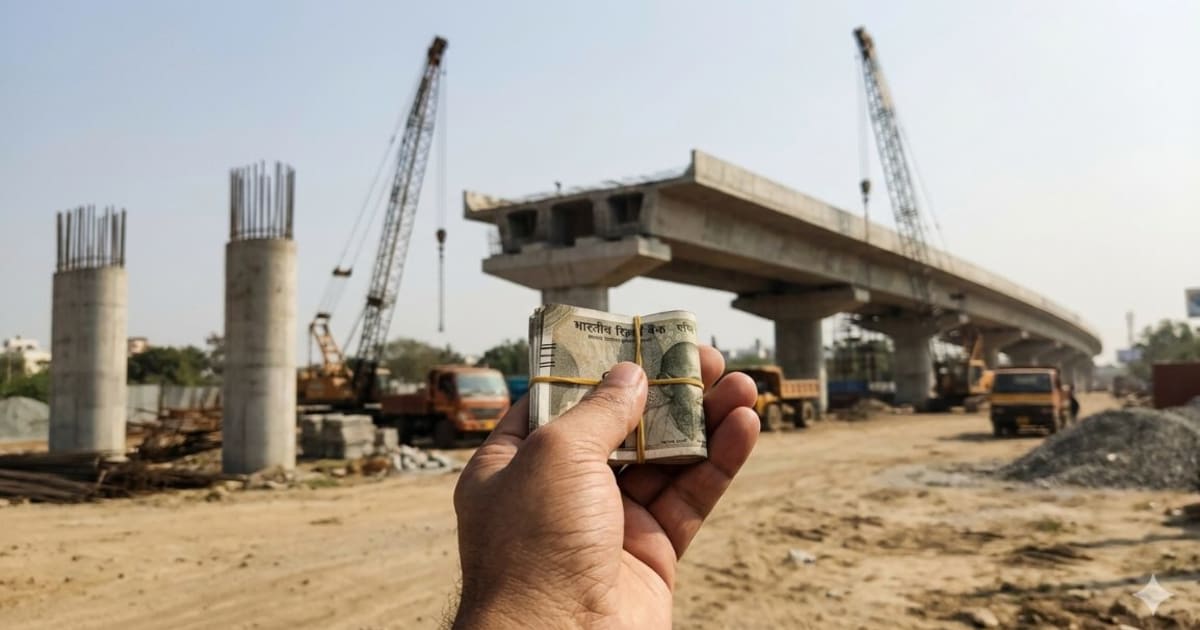
The Number That Never Makes Headlines
₹2.1 lakh crore. That is the scale of economic output India will not generate this fiscal year compared to what a 7.7% growth path would have delivered. It is a staggering aggregate — but it lives inside government spreadsheets, not bank accounts. The number that actually touches your life is smaller, more personal, and almost never published: roughly ₹8,300 per year in slower real income growth for a salaried household earning ₹10 lakh annually.
BMI — Business Monitor International — has pegged India's FY27 GDP growth at 6.6%, down from 7.7% in FY26. The Reserve Bank of India's own projection lands at exactly the same number. When two independent forecasters converge like this, it is not a coincidence. It is a consensus around a structural deceleration that most financial coverage reduces to a single sentence before moving on.
This article does not move on. Instead, it translates every percentage point of that slowdown into a rupee figure that lands in your household — in your appraisal cycle, your SIP corpus, and your fuel bill.
Why 1.1 Percentage Points Is Not a Rounding Error
A drop from 7.7% to 6.6% looks modest on a chart. Finance ministry briefings have called similar moves 'healthy normalisation.' But the mechanism behind a deceleration matters far more than its magnitude — and this one's mechanism is particularly stubborn.
BMI pins two culprits: weaker private investment and softer consumption. These are not external shocks that can be absorbed with a policy tweak. They are internal signals — businesses pulling back on capital expenditure, households tightening discretionary spend. When both contract simultaneously, a multiplier effect amplifies the slowdown beyond what the headline number suggests.
Here is what the data shows about the dual compression driving the FY27 story:
- Private investment growth expected to ease to ~7% in FY27 from ~9% in FY26
- Private consumption growth projected at ~6.5% versus ~7.8% in the prior year
- Government capex, the traditional growth backstop, faces fiscal consolidation constraints targeting a 4.5%-of-GDP deficit ceiling
- West Asia trade disruption adds a compounding risk: India's merchandise exports to the Gulf region were worth approximately ₹2.4 lakh crore in FY25, and any sustained conflict premium on shipping corridors raises both export risk and import costs simultaneously
The West Asia angle is particularly underappreciated in domestic coverage. India imports roughly 85% of its crude oil, with the Gulf accounting for a large share of both energy supply and remittance inflows. A protracted regional crisis does not just spike oil prices — it threatens the ₹1.5–2 lakh crore annual remittance corridor that underpins consumption in states like Kerala, Tamil Nadu, and Uttar Pradesh. That remittance income goes almost entirely into household spending, not savings. Disrupt it, and the consumption slowdown deepens well beyond what investment data alone would predict.
What the GDP Composition Data Actually Shows
India's GDP is an aggregate of four expenditure streams: private consumption, investment, government spending, and net exports. The FY27 deceleration is not hitting each stream equally. Knowing which one is weakening fastest tells you exactly where your personal exposure sits.
| GDP Component | FY26 Growth (Est.) | FY27 Forecast | Change |
|---|---|---|---|
| Private Consumption | ~7.8% | ~6.5% | −1.3 pp |
| Gross Fixed Capital Formation | ~9.0% | ~7.2% | −1.8 pp |
| Government Expenditure | ~6.5% | ~5.8% | −0.7 pp |
| Net Exports (contribution) | Negative drag | Wider drag | Deteriorating |
The sharpest deterioration is in Gross Fixed Capital Formation — the investment line. This matters because investment today is income tomorrow. When a factory or highway project does not get sanctioned this year, the downstream chain of assembly-line jobs, component supplier contracts, and real estate demand around industrial corridors does not materialise either. That lag runs 18–24 months.
For a salaried professional in the formal sector, the transmission is not immediate. Your salary does not get cut the week GDP prints at 6.6%. What changes is your negotiating leverage at the next appraisal, the pace of new headcount approvals in your department, and the likelihood of your company's variable pay hitting its upper band. The mechanism is slow, diffuse, and almost invisible — until you compare your increment letter to a colleague who switched jobs in a 7.7% growth year.
Your Household, in Rupees
Let's make this concrete. Assume you are a salaried professional with a total household income of ₹10 lakh per year — close to the median for formal-sector urban earners with five to ten years of experience.
Historically, real wage growth in India's formal sector tracks GDP growth with an elasticity of roughly 0.75 to 0.85. That means:
- At 7.7% GDP growth → real wage growth of ~5.8–6.5% → annual increment of approximately ₹58,000–₹65,000
- At 6.6% GDP growth → real wage growth of ~5.0–5.6% → annual increment of approximately ₹50,000–₹56,000
- Gap: ₹8,000–₹9,000 per year, or roughly ₹650–₹750 per month in foregone real income
This is not money removed from your account. It is money that simply will not arrive — slower promotions, thinner appraisal bands, fewer lateral offers carrying meaningful premium packages.
The consumption side compounds this. If your household spends ₹60,000 per month, and discretionary categories — dining out, entertainment, electronics, leisure travel — account for 25%, that is ₹15,000 per month in flexible spend. Slower income growth means this buffer shrinks first. Data shows that discretionary spending typically contracts at 1.5–2x the rate of income deceleration during moderate growth slowdowns.
Then there is the fuel wildcard. If West Asia disruption pushes crude from ₹75 to ₹90 per barrel, petrol prices rise by approximately ₹8–12 per litre at current taxation structures. For a household running one car and two two-wheelers covering 1,500 km combined per month, that translates to ₹900–₹1,300 per month in additional fuel expenditure — or ₹11,000–₹16,000 per year. Your raise shrank and your fuel bill grew, in the same fiscal year.
What a Slower GDP Cycle Means for Your SIP Corpus
Here is the part most macroeconomic coverage skips over entirely: GDP growth does not affect equity markets directly. It flows through corporate earnings, which shape valuations, which then compound inside your portfolio over decades.
India's nominal GDP in FY27 will run at approximately 11–11.5% (real 6.6% plus inflation at 4.5–5%). Nifty 50 earnings growth has historically tracked nominal GDP with a slight amplification. At 11% nominal GDP growth, consensus Nifty EPS growth lands around 13–15%. That compares to the 17–19% range achievable in a 12.5%-plus nominal GDP environment.
For your monthly SIP, this difference compounds meaningfully over time:
| SIP: ₹10,000/month | 10-Year Corpus | 15-Year Corpus |
|---|---|---|
| 15% CAGR (high-growth GDP cycle) | ₹27.9 lakh | ₹67.7 lakh |
| 13% CAGR (moderate GDP cycle) | ₹23.2 lakh | ₹52.5 lakh |
| Difference | ₹4.7 lakh | ₹15.2 lakh |
Over fifteen years, the gap between a high-growth and moderate-growth equity return environment — at just ₹10,000 per month — is ₹15.2 lakh. That is not catastrophic. But it is a car, or three years of a child's undergraduate fees, or the equity component of a down payment buffer on your next property.
The important counter-argument: India at 6.6% is still among the fastest-growing major economies globally. Markets do not need 20% GDP growth to deliver 13% EPS growth — operating leverage, margin expansion, and sector rotation can compensate for macro softness in specific pockets. If you are invested in domestic consumption-linked sectors or rate-sensitive financials, the RBI's easing cycle (already 50 basis points in 2025-26) may deliver more than the GDP headline implies.
📊 The real-world cost: Salaried household (₹10L/yr): ~₹8,300 less in annual real income growth vs FY26 trajectory
The Case That the Deceleration Is Overstated
Not every analyst reads the 6.6% figure as a warning sign. A credible set of observers argues the composition of the moderation is actually healthier than the rate suggests — and your portfolio may end up better positioned than the headline implies.
The first argument is base effects. FY26's 7.7% was partly a catch-up year: post-election government spending, infrastructure backlogs clearing, and an unusually strong kharif harvest that lifted rural incomes and farm-linked consumption. Comparing FY27 against that elevated base inflates the apparent deceleration. Strip the base distortion, and the underlying demand trajectory looks more stable.
The second argument is about investment quality, not investment quantity. If the slowdown in gross fixed capital formation reflects companies completing existing capacity rather than cancelling new projects, the pipeline remains intact. The RBI's quarterly industrial capacity utilisation survey is the critical tell here. Utilisation above 75% signals that investment is pausing between cycles, not reversing. Below 70%, and you should genuinely worry about job creation over the following four quarters.
The third argument is the monetary tailwind that has not fully fed through yet. The RBI cut the repo rate by 25 basis points in both February and April 2026. Transmission to retail lending rates typically runs two to three quarters. Your home loan EMI on a ₹50 lakh outstanding at 8.5% drops by approximately ₹750–₹900 per month if rates fall another 50 basis points — a move the market currently assigns roughly 60% probability to at the August 2026 policy meeting. That is a direct, measurable cash-flow boost that partially offsets the wage growth deceleration described earlier.
The intellectually honest reading sits between the bears and the optimists. Six-point-six percent is not a crisis. It is a cycle. The question is not whether to act on fear — it is which specific numbers to track so you know, precisely, when the cycle turns.
The One Number to Watch
Watch India's Gross Fixed Capital Formation growth rate in the Q1 FY27 GDP print, due November 2026. If it holds above 8%, the investment cycle is pausing between rounds — and the 6.6% forecast may prove conservative heading into H2. If it prints below 6.5%, the wage and job-creation effects will run harder and longer than current consensus models, and your appraisal cycle in early 2027 will feel it directly.
Key Questions Answered
Will a 6.6% GDP growth rate directly cut my salary?
Not directly — salaries are sticky and don't move quarter to quarter with GDP. What does move is the appraisal increment band and lateral hiring premium. For a ₹10 lakh earner, the data-implied cost is roughly ₹8,000–₹9,000 less in annual real income growth compared to a 7.7% GDP environment, felt over 12–18 months.
Should I pause or reduce my SIP given the growth slowdown?
This is not financial advice, but the historical pattern across India's 2011–13 and 2018–20 slowdown cycles shows that maintaining or increasing SIP amounts during moderate decelerations typically outperforms pausing. Slower growth often compresses valuations, which means your monthly SIP buys more units — a benefit that compounds when the cycle eventually recovers.
When will we have clearer visibility on whether FY27 beats or misses 6.6%?
The National Statistical Office will release the Q1 FY27 (April–June 2026) advance estimate around November 2026. An earlier signal will come at the RBI's August 2026 MPC meeting — any upward or downward revision to the RBI's 6.6% forecast will move both bond and equity markets and will be the fastest indicator to track.
The views expressed here are for informational purposes and do not constitute personalized financial guidance. Readers should consult a licensed advisor before making investment decisions.