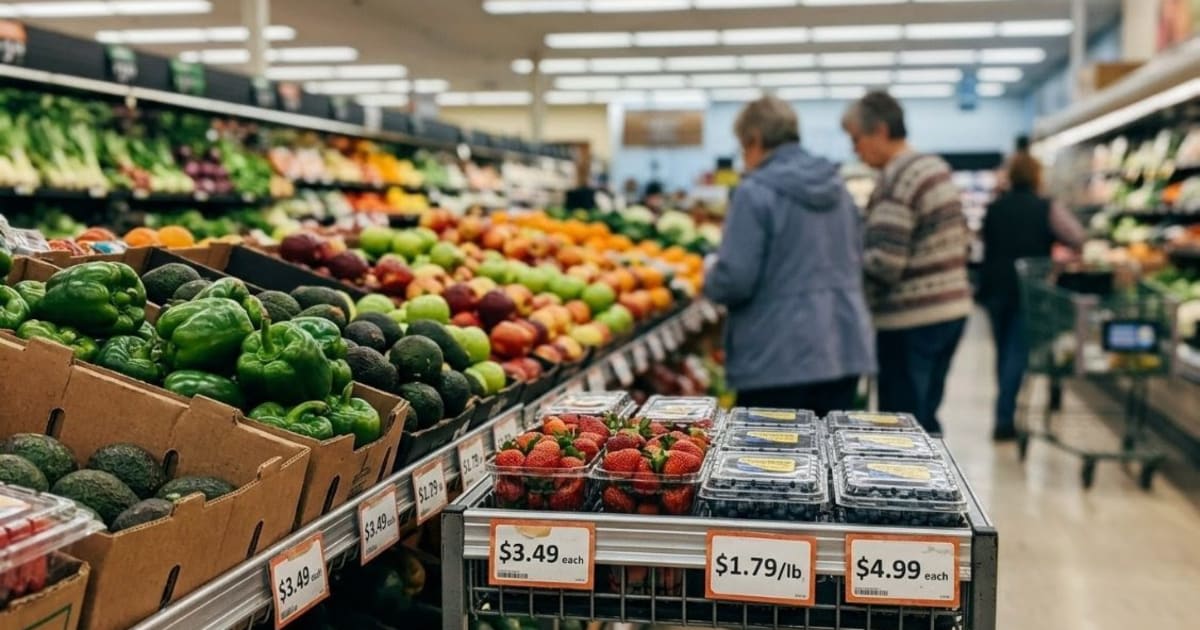
Everyone's watching oil. That's understandable — Brent crude crossed $110 a barrel last week, and a gallon of gas now costs about $1 more than it did a month ago. But while markets fixate on the energy story, a quieter crisis is building underneath it. One that will show up not at the gas pump first, but at the grocery checkout.
The Strait of Hormuz has been effectively closed since late February, following US-Israeli strikes on Iran. About one-third of the world's seaborne fertilizer normally moves through that narrow waterway. It is not moving right now. Nearly a million metric tons of urea — the nitrogen fertilizer that feeds American corn, which in turn feeds American beef, poultry, and processed food — is physically stranded in the Persian Gulf. At the same time, the 12-to-18-month lag on tariff cost pass-throughs is quietly reaching its expiration date. CPG brands and retailers cannot absorb indefinitely. They have been trying for a year. That cushion is nearly spent.
None of this is distant. The spring planting window in the United States — the single highest-demand period for fertilizer all year — is happening right now. Farmers are being told to pay $150 to $200 more per ton for urea already sitting in their distributor's warehouse. Some distributors won't even quote a price. That hesitation doesn't stay on the farm. It seeps into the food supply, then into the can of soup on your shelf, then into your grocery bill — probably by this fall.
The Core Problem
This isn't one problem. It's four layered cost shocks arriving simultaneously, and each one compounds the others.
The first layer is fertilizer. Urea prices at the New Orleans import hub — the main gateway for farm-bound nitrogen into the American interior — jumped 32 percent in a single week after the Hormuz closure began. In mid-December 2025, a ton of urea cost farmers the equivalent of 75 bushels of corn. By early March, that same ton cost 126 bushels. That's not a commodity fluctuation. That's a structural input cost shock landing at the worst possible time: spring planting season, when nitrogen demand peaks and timing is non-negotiable. Miss the application window by three weeks and yield projections change — not by a little, but by enough to shift harvest volume and downstream food prices.
The second layer is packaging. Steel and aluminum tariffs already in place from earlier trade actions drove up the cost of cans and metal bottle caps across the grocery industry before any of this started. Now, with oil above $110, petrochemical inputs for plastic packaging films are rising in parallel. The result is a cost increase that doesn't hit one product category. It hits canned goods, beverages, refrigerated cases, and shelf-stable center-store items all at once, meaning there's no aisle in the grocery store that escapes the compression.
The third layer is shipping. Disrupted trade lanes through the Middle East have pushed freight and insurance premiums higher across global routes. Off-season produce from Mexico — which supplies 69 percent of US vegetable imports and 51 percent of fresh fruit — relies on diesel-powered refrigerated transport. Higher fuel costs raise those logistics bills directly. Berries, avocados, peppers, and tomatoes are particularly exposed because they're perishable, high-volume, and sourced overwhelmingly from a single trade partner already subject to tariff pressure of up to 25 percent.
The fourth layer — and the one most people don't see yet — is the tariff lag. Market research firm Spins analyzed how grocery supply chains historically respond to commodity cost spikes and found a consistent 12-to-18-month gap between input cost events and shelf price changes. The Trump administration's Liberation Day tariff package took effect in April 2025. Twelve to eighteen months from that date puts the maximum shelf-price impact squarely between April and October 2026. You are inside that window right now.
Manufacturers and retailers absorbed much of the 2025 cost increases through margin compression and selective promotion cuts. That cushion is nearly gone. When the grocery sector's year-over-year price increase accelerated from 1.7 percent to 2.8 percent over the past year, that was the early signal. The Hormuz closure and surging fertilizer costs are the accelerant.
What does all of this look like in your grocery cart? The average American household spends roughly $900 a month on groceries. Coffee, tea, and chocolate — heavily reliant on imports from tariffed countries — could be up 15 percent by fall, adding $10 to $15 per month for regular buyers. Beef could rise $0.50 to $1 per pound, which on a family buying 20 pounds monthly adds another $10 to $20. Fresh berries and produce from Mexico, hit by higher diesel and tariff costs simultaneously, add more. Before long, you are looking at $40 to $60 in additional monthly grocery spend for a typical household — and that is not the worst-case scenario.
Historical Parallel
The last time fertilizer markets seized up this badly, the world was watching Russia invade Ukraine.
In February 2022, Russian forces crossed into Ukraine and global fertilizer markets lurched upward almost immediately. Russia accounts for roughly 20 percent of the global fertilizer trade, and the combination of sanctions and Black Sea shipping disruption sent urea and ammonia prices to multi-year highs. American food inflation hit a 40-year peak by summer of 2022, with year-over-year grocery price increases running above 10 percent for several consecutive months. For the average American household spending around $800 a month on groceries at the time, that translated to more than $80 in additional monthly food costs — roughly $1,000 per year absorbed almost entirely by working families, not by corporations.
The parallel to today is direct. Except the current disruption is arguably worse on every structural dimension that matters.
In 2022, when Russian fertilizer flows were disrupted, markets could reroute around the problem. Russian exports were complicated but not fully severed — some continued through non-sanctioning countries, and alternative suppliers in North Africa partially filled the gap. That geographic flexibility doesn't exist today in the same way. The Strait of Hormuz is the only seaborne exit for Gulf fertilizer. Saudi Arabia built a pipeline to route oil exports around Hormuz, but no equivalent exists for ammonia or sulfur. Traders are scrambling to build long positions in North Africa and Southeast Asia, but the supply volumes simply aren't there to offset what Gulf producers normally provide to the world.
Timing makes it worse. Russia invaded Ukraine in late February 2022 — technically at the edge of, but not squarely inside, the peak North American planting window. The Hormuz closure began February 28, 2026, directly at the start of the critical March-April fertilizer application season in the US. Vessels traveling from the Persian Gulf to the US Gulf Coast take roughly 30 days. Supply disrupted now doesn't just cost more — in many cases, it arrives too late to matter for this year's crop.
There is also a third dimension that didn't exist in 2022: tariffs. Four years ago, the food supply chain's stress was largely a single-variable problem — fertilizer and energy costs spiked, then moderated, and the system normalized over roughly 12 months. The 2026 shock arrives on top of a supply chain already dealing with tariff-inflated costs on packaging, steel, aluminum, and produce from Mexico and Canada. Each of those pressures was already partially embedded in grocery prices before the Strait closed. Adding a fertilizer supply shock and $110 oil to a tariffed, margin-compressed industry is a genuinely different problem than what 2022 presented.
History provides a useful warning here: the 2022 grocery price spike took nearly two years to fully unwind. Shelf prices ratchet up quickly and come down slowly, if they come down at all. Americans who watched beef hit record highs in 2022 and waited for prices to return to 2021 levels are still waiting.
The Data Under the Hood
The numbers most coverage is skipping tell the story more clearly than any narrative summary.
Urea prices at the New Orleans port hub went from $516 per metric ton on February 27 to $683 per metric ton by March 5. That is a 32 percent increase in eight days. Zoom out further and the picture gets starker: from mid-December 2025 to early March 2026, urea prices climbed 77 percent in total — not from a depressed cyclical base, but from levels that were already 18 percent above pre-pandemic norms, according to CSIS analysis. By March 11, global urea prices had settled at roughly $585 per metric ton, up 26 percent from the immediate pre-war level of $465.50. Those aren't speculative forward prices. Those are what American grain farmers are paying right now.
The sulfur story is less covered and more structurally alarming. Gulf producers account for approximately 44 percent of the world's sulfur supply. Sulfur isn't something most households think about, but sulfuric acid is what converts raw phosphate rock into a plant-absorbable form. No sulfur flow, no functional phosphate fertilizer. Gulf countries also account for about 20 percent of global phosphate trade. The cascade runs like this: sulfur scarcity raises phosphate fertilizer costs, which raises corn and soy input costs, which eventually flows into the grocery shelf prices you encounter three to six months later. The chain is real. Each link takes time. But the links are connected.
Here is what the fertilizer surge means in concrete food terms. Corn is the most fertilizer-intensive major crop in the US, representing roughly 95 percent of total grain and feed production by volume. Higher corn input costs flow directly into beef, pork, and poultry prices through feed cost escalation — a transmission mechanism that operates with roughly a two-to-three quarter lag. Industry analysts projected beef could rise between $0.50 and $1.00 per pound by fall 2026. A family of four buying 20 pounds of beef per month faces $10 to $20 in additional monthly spending from that line item alone.
Coffee and chocolate operate on entirely separate cost trajectories. The US imposed a 50 percent tariff on Brazil, the world's largest coffee producer, and Colombia — supplying 20 percent of the US market — faces a 10 percent duty. Coffee prices were already up 21 percent year-over-year as of August 2025. Chocolate depends on cocoa routed through import chains subject to both tariff and elevated shipping insurance premiums. Analysts project coffee, tea, and chocolate could be 15 percent higher by fall, adding roughly $10 to $15 per month for households that regularly buy these items.
Fresh produce from Mexico deserves its own accounting. Mexico supplies 69 percent of US vegetable imports and 51 percent of fresh fruit — including the majority of berries, avocados, and out-of-season produce that American consumers treat as year-round staples. Those products face cost pressure on multiple simultaneous fronts: higher diesel costs for refrigerated trucking, higher fertilizer costs on the farms themselves, and tariff exposure of up to 25 percent on goods outside USMCA exemption rules.
The aggregate picture: the Bureau of Labor Statistics recorded food-at-home inflation at 2.4 percent year-over-year in February 2026. That data was collected before the Hormuz closure fully registered in retail pricing. The CPI number arriving in the summer will reflect a different supply environment. Historical analysis places the full tariff pass-through window at April through October 2026, and the fertilizer and oil shocks are arriving on top of that pre-loaded pressure.
For the household spending $900 per month on groceries, a conservative 5 to 7 percent increase equates to $45 to $63 per month — $540 to $756 per year. A more adverse 10 to 12 percent scenario produces $90 to $108 in additional monthly spending, or roughly $1,000 to $1,300 per year. The 2022 shock eventually cost the average American household approximately $800 to $1,000 annually at its peak. This cycle is building toward a comparable number, without the single-variable simplicity that made 2022 eventually predictable.
Two Sides of the Coin
Not every analyst sees this as inevitable. There is a genuine bull case, and it deserves fair hearing.
The optimistic scenario starts with domestic fertilizer self-sufficiency. The United States produces roughly 75 percent of the fertilizer it consumes, using abundant domestic natural gas priced independently of Gulf supply chains. That is a real buffer. While imported urea prices at New Orleans have surged 32 percent, domestically sourced nitrogen fertilizer — largely insulated from Hormuz disruptions — can absorb some of the supply gap. The American Farm Bureau Federation has formally lobbied the White House to temporarily suspend countervailing duties on imported fertilizer, and if that happens, import price pressure moderates at the margin.
The planting flexibility argument has merit too. When corn input costs spike, some farmers rationally shift acreage toward soybeans, which fix their own nitrogen from the atmosphere and require far less synthetic fertilizer. That substitution doesn't fully solve the problem, but it limits downside on corn supply. There's also a $12 billion USDA farmer bailout program — enrollment opened February 23, 2026 — that provides direct support to operations squeezed by input cost escalation and lost export markets. That money goes somewhere, and some of it prevents the most severe production cutbacks.
On the retail side, the 2025 track record matters. Manufacturers and retailers absorbed significant tariff-related cost increases last year without fully passing them on to consumers. Private label grocery sales have grown steadily as consumers trade down, and that dynamic creates genuine competitive pressure against large price increases. No brand wants to be the first to post a 15 percent hike while the store brand sits three inches to the left on the same shelf at a lower price.
The bear case, though, is harder to dismiss.
Spring planting doesn't negotiate with geopolitics. The March-April nitrogen application window is fixed by biology, not logistics. Fertilizer stranded in the Gulf right now cannot be replaced fast enough by domestic production alone to fully cover the shortfall at current demand levels. Distributors across the Midwest are already rationing supply estimates and refusing to quote replacement prices for warehoused product — and they are adding $150 to $200 per ton in premiums even on inventory already sitting in the warehouse. That behavior reflects not current costs but expected replacement costs. It is how supply chain stress spreads before the shortage itself arrives.
The tariff structure creates a separate, sovereign-policy problem that no amount of Hormuz diplomacy resolves. Canadian potash — accounting for 80 to 85 percent of the potash used in US farming — remains subject to tariff costs not yet removed. Mexican produce faces up to 25 percent tariff exposure. Those pressures are embedded in the supply chain regardless of what happens in the Persian Gulf over the next 30 days.
There is also an asymmetry in how grocery price increases actually work. They rise fast and fall slowly. Even in 2022, when fertilizer and energy costs moderated significantly by year-end, grocery shelf prices stayed elevated well into 2023. The structural reasons are straightforward: wage adjustments at food processors, multi-year packaging contracts, logistics repricing cycles — none of these unwind as quickly as they were set. The American households still paying elevated grocery bills in early 2025 learned that asymmetry firsthand.
Scenarios & What-Ifs
Three outcomes are plausible from here. Which one materializes will largely be decided over the next 30 to 60 days.
The most favorable scenario assumes the Strait of Hormuz partially reopens, or a credible multinational naval coalition emerges, allowing fertilizer shipments to resume before the end of April. In this case, US farmers get enough nitrogen for a reasonable corn planting season, oil moderates back toward $90, and the tariff-lag grocery impact lands in the 4 to 6 percent range year-over-year by Q4 2026. For the average American household, that means roughly $35 to $55 in additional monthly grocery spend — painful but manageable, especially if wage growth holds near current levels. This scenario requires fast diplomatic movement, and as of today no country has publicly committed to a Hormuz Coalition.
The middle scenario — which current logistics data and market positioning suggest is most probable — assumes the Strait remains effectively closed through April, causing meaningful US corn acreage to be under-fertilized or shifted to soybeans. In this case, grain feed costs rise through summer, beef and poultry prices climb $0.75 to $1.50 per pound above current levels by Q4, and grocery inflation runs 7 to 10 percent year-over-year by late 2026. The monthly household impact reaches $60 to $90 — or $720 to $1,080 per year. On a median American income of around $60,000, that represents 1.2 to 1.8 percent of pre-tax earnings consumed by a single supply chain shock.
The adverse scenario — a closure extending six months or more, possibly accompanied by broader regional escalation — is the version nobody wants to price in. In this case, corn and soy yields both decline materially, beef and pork prices spike sharply, and food-at-home inflation runs toward double digits for the first time since late 2022. Historical precedent suggests a sustained 10 percent grocery inflation run costs the average American household approximately $100 per month in real additional spending — $1,200 per year, with no guarantee of a fast reversal.
Pineapples, plastic, chocolate, berries. Those items aren't arbitrary — they represent the full cost stack of the modern US food supply chain: imported tropical fruit, petrochemical packaging, tariffed cocoa inputs, and diesel-dependent fresh produce from Mexico. Americans are getting an unplanned education in how that system actually works. The problem is that tuition is collected at the checkout counter.
💰 What this means for your money: For the average American household, this means $540–$1,080 more per year in groceries by late 2026.
"The Strait of Hormuz isn't just an oil chokepoint. It's where America's corn crop gets its nitrogen."
The Bottom Line
Americans are about to get a graduate-level course in supply chain economics, and the exam is graded in dollars at the checkout line. The Hormuz closure on top of the tariff-lag window is the worst-timed double shock the US grocery system has faced since the 2022 Ukraine fertilizer crisis — and this time, there's no clean rerouting option. If the Strait stays closed through April, the spring corn crop takes the first hit, and your grocery bill takes the second one sometime around Q3. Watch the April CPI food-at-home number. That's when the denial ends and the bill arrives.
Frequently Asked Questions
Why are grocery prices going up in 2026?
A combination of three forces is converging at once: the Strait of Hormuz closure is blocking about one-third of global fertilizer exports, hitting spring planting costs; oil above $110 is raising packaging and transport costs; and tariffs from 2025 are now hitting the 12-to-18-month lag window when they typically reach retail shelves. Together, they could add $50 to $90 per month to an average American household's grocery bill by Q4 2026.
Which grocery items will get most expensive?
Coffee, tea, and chocolate face a potential 15 percent price increase by fall, driven by heavy tariffs on Brazil and Colombia. Beef could rise $0.50 to $1.00 per pound due to higher fertilizer and feed costs. Fresh berries, avocados, peppers, and out-of-season produce from Mexico face dual pressure from tariffs and higher diesel transport costs — making fresh produce one of the fastest-moving cost categories in the near term.
When will higher grocery prices actually show up?
Market analysts at Spins place the peak tariff pass-through window between April and October 2026. Fertilizer-driven crop cost increases typically take an additional two to three quarters to flow through from the farm to the shelf. The clearest signal to watch will be the CPI food-at-home reading for April and May 2026 — those numbers, released in May and June, will show whether the shock is already embedding in retail prices.