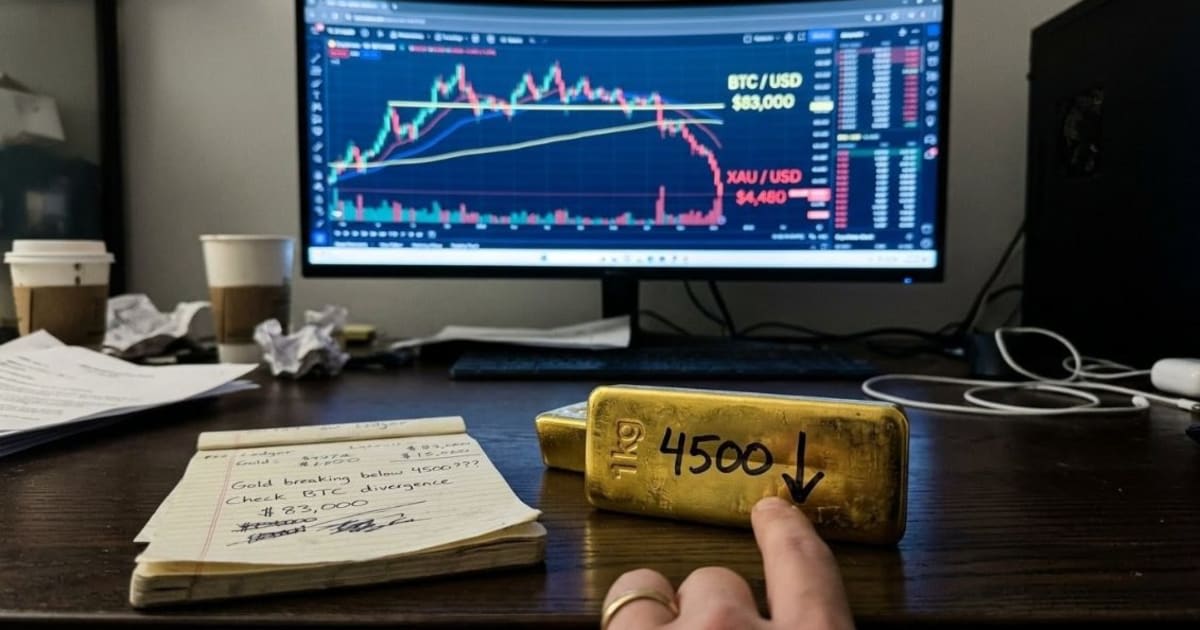
Gold just cracked below $4,500 — violating a support level that had held since November 2025 — while Bitcoin sat near $83,000 and barely moved. That divergence is not a glitch. According to 21Shares' macro chief, it is a clean split between two completely different buyer bases, and understanding which side your savings are on right now may be the most important financial question of the quarter.
What's Happening
Since Middle East hostilities escalated earlier this month, markets expected the classic fear trade: gold and Bitcoin rising together as investors fled risk. That playbook broke down. Gold dropped through the $4,500 level — its most-watched floor — shedding roughly 4% from its recent peak near $4,700. Bitcoin, meanwhile, tracked near $83,000, roughly flat across the same period. During a live geopolitical shock, that is genuinely unusual behavior for a volatile crypto asset.
The 21Shares macro desk points to a structural split in who owns each asset. Central banks — the biggest institutional gold buyers globally over the last three years, averaging record purchases near $75 billion per quarter through 2024 — have turned net sellers in Q1 2026. Under geopolitical pressure, sovereign wealth funds and central reserve managers need liquid, conflict-neutral assets fast. Gold's earlier surge toward $5,000 gave them a clean exit window. They took it.
Bitcoin is being absorbed by an entirely different crowd. Retail inflows — younger investors in the US, India, and Southeast Asia buying through apps and crypto funds — have stayed positive for six straight weeks according to on-chain flow data. The S&P 500 dropped 0.9% on escalation news. The FTSE 100 fell 1.1%. The Nifty 50 shed 1.2%. Bitcoin barely registered.
Why Your Money Cares
If you hold gold — through an ETF, a Sovereign Gold Bond, or physical bars — this hits your balance sheet directly. A 4% drawdown from $4,700 to below $4,500 means roughly $200 per ounce lost. On a $10,000 gold position, that is $400 gone in under a month. UK investors are looking at approximately £315 in lost value on the same holding. For Indian investors in Sovereign Gold Bonds, the math is about ₹33,000 lost per ₹8,25,000 invested — before any currency move adds to the damage.
Bitcoin tells the opposite story, and that matters even if you do not own any. An $83,000 BTC price holding flat during what should have been a flight-to-safety collapse signals genuine retail conviction. If you have been sitting on the fence about crypto exposure in a diversified portfolio, the market is running a live experiment right now — and the early results favor BTC over gold as a geopolitical hedge in 2026.
The deeper problem is for balanced portfolios. Standard 60/40 models that include gold as a hedge are suddenly running a hedge that is not hedging. Whether you hold a pension in the UK, mutual funds in India, or commodity ETFs in the US, the gold allocation in your portfolio may be working against you at exactly the moment it was supposed to protect you.
The Numbers That Matter
Gold is down roughly 4.2% from its recent high near $4,700, sitting below the $4,500 level for the first time since November 2025. That is a $200-per-ounce drop in weeks. On a standard $5,000 gold ETF holding, you are looking at a $210 loss in less than a month. In Indian rupee terms, that translates to approximately ₹17,500 on a ₹4,15,000 position.
Bitcoin is holding near $83,000. Flat. During a war scare that sent equities down nearly 1% across three major indices simultaneously. Historically, BTC has dropped 15 to 20% during geopolitical flare-ups — not held flat. This is a meaningful statistical outlier.
Central bank gold demand has visibly slowed from its record quarterly pace. Institutional positioning data shows speculative long positions in gold futures have fallen an estimated 8% since hostilities began — the crowd betting on $5,000 gold is quietly unwinding.
On-chain Bitcoin retail inflows have been positive for six consecutive weeks. That is the floor under the current price. It is not institutional money holding BTC up right now. It is everyday investors, many of them in their 20s and 30s, from Mumbai to Manchester to Miami.
The Street Mood
The Crypto Fear and Greed Index is sitting at 47 — Neutral. Not panic. That is the surprise. Every major geopolitical shock in the last five years pushed this index below 30, into deep fear territory. This time, retail is not running. That is a structural signal worth paying attention to.
Gold sentiment is moving in the opposite direction. Futures open interest has dropped an estimated 8% since the conflict escalated, and options skew in gold derivatives has shifted bearish for the first time since Q3 2025. The crowd that was positioned for $5,000 gold is quietly exiting.
The put/call ratio on Bitcoin-linked ETFs is trending lower, meaning options traders are not rushing to buy downside protection on BTC. Whether you are watching from London, Mumbai, or Chicago, the signal is consistent. This divergence is not being treated as temporary noise by the money that actually moves markets.
What to Watch
Three dates matter from here. On April 2, the Federal Reserve releases its latest FOMC minutes — any language signaling rate cuts could push both gold and BTC higher together, potentially closing the divergence gap. For UK mortgage holders and Indian home loan borrowers, that same signal could also soften lending rates in the months ahead.
A Middle East ceasefire update is expected in the April 5 to 7 diplomatic window. A credible de-escalation could reverse gold's slide overnight and push it back above $4,500 — which would test whether retail Bitcoin holders take that moment to rotate profits or hold.
Finally, Q1 2026 central bank gold reserve data publishes in late April. If it confirms the net-selling trend, the BTC-gold divergence stops being a blip and becomes structural. That is the number that rewrites portfolios.
💰 What this means for your money: For the average household, this means gold ETF holders face ~$400 loss per $10,000 invested this month.
"Central banks are quietly selling gold to fund geopolitical costs. Retail is buying Bitcoin instead. That split just became your portfolio problem."
The Bottom Line
Gold falling while Bitcoin holds is not just a market curiosity — it is a live signal that the traditional safe-haven playbook is being rewritten. Central banks are de-risking out of gold; retail is absorbing BTC. The two-asset crisis hedge strategy that worked for a decade may already be obsolete — and most balanced portfolios have not caught up to that reality yet.
Frequently Asked Questions
Why is gold falling while Bitcoin is staying stable right now?
Gold has dropped below $4,500 — roughly 4% from its recent peak — as central banks reduce holdings to cover geopolitical liquidity needs. Bitcoin, near $83,000, is being supported by consistent retail inflows from younger investors globally, which has offset any institutional selling pressure.
Does gold falling below $4,500 actually affect my pension or savings?
Yes, directly. A 4% drawdown on a $10,000 gold position means approximately $400 in losses. UK pension holders with commodity exposure face around £315 in equivalent losses. Indian Sovereign Gold Bond investors are looking at roughly ₹33,000 lost per ₹8,25,000 invested — and the support level that would signal a recovery has not yet held.
What should I watch to know if gold will recover or this gets worse?
Two key triggers: the Federal Reserve FOMC minutes on April 2 and any Middle East ceasefire update expected in the April 5-7 window. A de-escalation alone could push gold back above $4,500 quickly. Central bank Q1 reserve data in late April will confirm whether this selloff is temporary or the start of a structural shift away from gold.