Bitcoin ended March at roughly $67,600 — almost exactly where it started. Scroll past that number and the typical headline writes itself: 'Crypto weathers Iran conflict.' Close the tab. Move on.

Don't.

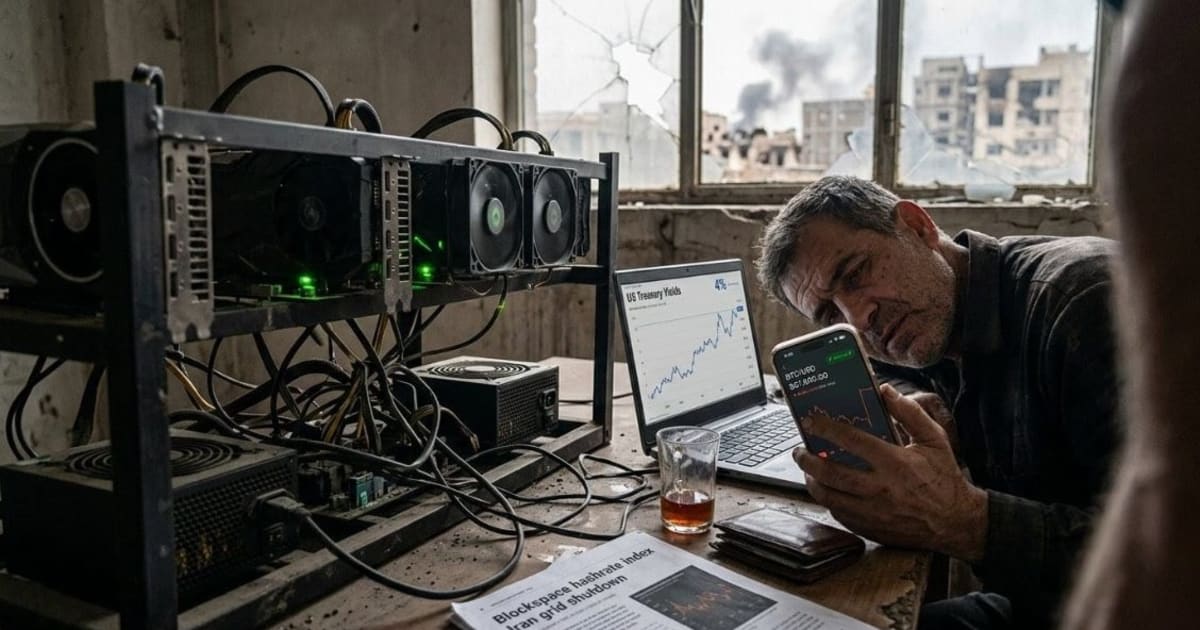
Beneath that placid price tag, the Bitcoin network lost more than 100 exahashes per second of computing power — the equivalent of roughly 12% of the entire network going dark in less than three weeks. Miners who had quietly operated inside Iran for years, benefiting from subsidized energy and sanctions-driven financial isolation, saw their grid infrastructure hit by coordinated US-Israeli strikes. The hashrate plunged to 937 EH/s from 1,086 EH/s in late February. And while Bitcoin's price appears steady, for anyone holding a position — whether you're in New York, London, or Mumbai — the picture underneath is considerably more unsettling than the headline lets on.

The Shift

The month's story began on February 28, when US and Israeli forces launched a comprehensive strike campaign against Iranian military and energy infrastructure. Oil depots in Tehran. Refineries in Alborz province. IRGC headquarters complexes. Within days, Iran's power grid was operating under emergency load-shedding protocols — and something few Western analysts had fully priced in became immediately visible in the data.

Iran had been mining Bitcoin at scale for years.

Estimates vary, but analysts put Iran's share of global hashrate at somewhere between 3% and 7% at its peak — a figure that had been quietly growing since the country legalized mining in 2019 as a tool for sanctions evasion. When the grid went dark, so did the rigs. The 7-day average hashrate peaked near 1,083 EH/s on March 1, then fell to roughly 954 EH/s by March 16 — a drawdown of nearly 12%, according to data tracked by analysts cited in Blockspace and CoinDesk.

Bitcoin's network difficulty adjusted downward by 7.7%, falling to 133.79T from 145.04T. That's one of the steepest negative adjustments in five years. As Blockspace co-host Colin Harper put it, 'Bitcoin's hash rate typically is always marching upward… but we're seeing repeated downward adjustments, which just does not happen.'

For context: the last time the network saw this kind of sustained, repeated downward pressure was the 2021 China mining ban — a shock that wiped out roughly 50% of global hashrate overnight. This isn't that. But it rhymes.

Meanwhile, five-year US Treasury yields climbed 4% through March, according to CoinTelegraph's month-in-charts analysis. That number matters more than almost anything else in this story. When risk-free government bonds pay you more — in the US, that's around 4.4% on the 10-year — speculative assets like Bitcoin have to work harder to justify their risk premium. For a UK pension holder watching gilts edge up, or an Indian SIP investor tracking the Nifty 50's correlation to global yields, the macro message is the same: the price of waiting has gone up.

What Everyone Thinks

The consensus read on March is essentially: Bitcoin proved its resilience. The Iran conflict disrupted energy markets, hashrate wobbled, but BTC stayed above $65,000. The network didn't collapse. Blocks kept clearing. Institutional ETF flows, which had seen brutal outflows in February, partially stabilized.

Robinhood's 16% monthly decline gets explained away as a cyclical story — crypto trading volumes fell, retail sentiment soured, and the stock is a leveraged bet on crypto activity. If crypto recovers, so does HOOD. The $1.5 billion buyback management announced on March 24 signals, by this read, that leadership sees the dip as a buying opportunity, not a structural problem.

And on Bitcoin's hashrate? Most coverage frames Iran's contribution as negligible — below 1% by some estimates, maybe 3% to 7% by others. Either way, analysts at Luxor Technology's Hashrate Index found that roughly 90% of global Bitcoin hashrate operates in countries where electricity prices have little correlation with crude oil. So the energy shock, this view holds, was a narrative event more than a network event.

That's a fair read of the surface data. Prices held. The network kept running. For an S&P 500 investor already seasoned to watching markets absorb geopolitical shocks, this looked like just another bad month that ended sideways.

The problem is that 'sideways' isn't neutral here — and the math behind it is considerably less comfortable than the chart suggests.

The Contrarian Take

Here's what most coverage missed: Bitcoin didn't hold flat because of strength. It held flat because two opposing forces — sell pressure from macro tightening and buy pressure from short liquidations — roughly cancelled each other out. That's not stability. That's a tug of war.

On March 27, Bitcoin fell below $67,000, triggering more than $50 million in long liquidations in a single hour. Over the full week, more than $1.3 billion in leveraged positions were wiped out, even as BTC traded within a relatively tight $66,000-$72,000 band. The price looked calm. The underlying book was carnage.

The yield story is the one that actually changes the calculus for global investors. The 10-year Treasury yield hit 4.41% — its highest since August 1, and up 48 basis points since the Iran conflict began on February 28, per data tracked by MEXC analysts. The two-year yield jumped 57 basis points to 3.94%. For a US household with a $400,000 variable-rate mortgage, each 50-basis-point rise in benchmark rates translates to roughly $1,600 more per year in debt service costs — money that isn't flowing into ETFs, risk assets, or Robinhood accounts.

For UK mortgage holders on tracker rates, the equivalent hit is approximately £1,100 per year per £200,000 of debt. In India, rising global yields have pushed the rupee weaker, increasing import costs and crowding out discretionary investment into SIPs and crypto platforms alike.

Robinhood's 16% monthly slide — on top of a 42% decline year-to-date and a 50% collapse over the past 12 months — isn't purely a crypto sentiment story. It's a signal that the retail investor class that drives crypto volume is under financial pressure, from multiple directions at once. Goldman Sachs cut its price target from $102 to $91. Loop Capital still has it at $130. The $117 consensus target implies 78% upside from current levels. Someone is very wrong.

The truth is that hashprice — the revenue a miner earns per unit of computing power — already hit an all-time low of $27.89 per PH/s/day back in February, per Luxor's Hashrate Index. That was before the Iran escalation. The network was already stressed. The conflict just made it visible.

The Uncomfortable Math

Let's do the arithmetic the headlines won't.

Bitcoin started March at roughly $67,000 and ends March at roughly $67,600 — a gain of less than 1%. But the all-time high was $126,080. That means anyone who bought near the top is sitting on a 46% paper loss. Only 57% of Bitcoin supply is currently in profit, a level historically associated with early bear markets, per on-chain data from CoinGecko. For the average retail investor who bought in Q4 2025 — attracted by the $126K high and institutional ETF momentum — the unrealized loss is real, even if the chart looks flat.

On Robinhood specifically: the stock peaked at $153.86 over the past twelve months and now trades near $66. That's a 57% drawdown from peak for shareholders. The company earned $1.88 billion in 2025 — genuinely strong, and analysts are right that the long-term story hasn't broken. But the near-term math is punishing. A 46% decline year-to-date in a market where the S&P 500 is down just 7% means HOOD has underperformed the broader index by roughly 39 percentage points in three months.

For an Indian investor in dollar-denominated crypto assets, the rupee's depreciation adds another layer. A portfolio worth ₹50 lakh in Bitcoin at the start of the year — roughly $60,000 — has not just absorbed BTC's price moves but also the currency headwind. The effective loss in rupee terms has been steeper than the dollar-denominated number suggests.

The prediction markets angle is genuinely interesting, though. CoinTelegraph's month-in-charts data shows prediction market transactions rose more than 2,800% year-over-year. That's not a footnote. It's a data point about where retail financial engagement is migrating — away from passive crypto holding and toward active, event-driven betting. Robinhood acquired MIAXdx to get into this space. Whether that pivot pays off determines whether HOOD's current price is a floor or a false bottom.

Where This Actually Goes

Bitcoin started this month flat. Whether it ends Q2 the same way depends on a question that has nothing to do with hashrate: what does the Federal Reserve do in April?

CME FedWatch data from late March showed the probability of a rate hike — not a cut — at the April meeting rising to 12%, up from 0% just one week earlier. That's a small number, but the direction is what matters. If oil holds above $100 and inflation data surprises to the upside, the rate-cut narrative that was supposed to lift crypto in 2026 could flip entirely.

For the average household — whether you hold Bitcoin through Coinbase, HOOD, or a Nifty 50-linked crypto fund in India — the calculus is the same: every upward yield move makes the risk premium on crypto harder to justify. The 4% rise in five-year Treasury yields this month isn't a rounding error. It's roughly $800 per year in forgone returns on every $20,000 you might otherwise have kept in bonds versus Bitcoin.

Bitcoin started March flat. The question heading into April isn't whether prices held — it's whether the conditions that allowed them to hold are still intact. The data suggests they aren't.

💰 What this means for your money: For the average household, this means ~$800/year less reason to choose Bitcoin over rising-yield bonds.

"The flatness is a red flag, not a green one. Every underlying metric deteriorated in March."

The Bottom Line

Bitcoin's flat March is doing a lot of work hiding a genuinely ugly month beneath the surface. The hashrate collapse, the yield surge, and HOOD's continuing implosion all point in the same direction: the macro conditions that were supposed to fuel a 2026 crypto rally are deteriorating, not improving. The halving cycle thesis may still play out — but it needs a Fed that cooperates, and right now that looks like a stretch.

Frequently Asked Questions

Why did Bitcoin's hashrate fall in March 2026?

Bitcoin's network hashrate dropped roughly 6-12% through March, falling from about 1,086 EH/s to 937 EH/s. The primary driver was the US-Israeli strikes on Iran's energy infrastructure starting February 28, which disrupted the power grid used by Iranian Bitcoin miners. Iran had been mining Bitcoin at scale since 2019 as a sanctions-evasion tool, accounting for an estimated 3-7% of global hashrate at its peak.

Why is Robinhood (HOOD) stock down so much in 2026?

HOOD is down roughly 42% year-to-date and 16% in March alone. Rising Treasury yields have reduced retail investors' appetite for speculative assets, directly cutting crypto trading volumes that drive Robinhood's revenue. The stock peaked near $153 and now trades around $66 — a 57% drawdown. Goldman Sachs recently cut its price target to $91, though the analyst consensus still implies significant upside at $117.

What should crypto investors watch in April 2026?

The Federal Reserve's April meeting is the key catalyst. Rate hike probabilities rose from 0% to 12% in a single week as oil stayed above $100 and inflation remained above 2%. A surprise hike, or hawkish language about future policy, would likely send Bitcoin and crypto-linked equities lower. Conversely, any Iran ceasefire deal could ease oil prices and restore some risk appetite.